Bitter Rice places commercial impulses amidst the innovations of neorealism, and it’s all the better for it. Set during Italy’s rice harvest in 1948, shot on location in the province of Vercelli, it begins as though it were a documentary. A man speaks directly into the camera, offering background information about this annual event. Going on for at least 400 years, it’s reserved for women: since they’re generally shorter, they can more easily bend down and pluck away at rice plants. As poverty hit Italy immediately after World War II, women have traveled from all over the country for this opportunity to work. Bitter Rice creates the illusion of a direct window onto reality and then breaks it. The camera pulls back, revealing that the film’s expert is actually a journalist speaking on Radio Turin.
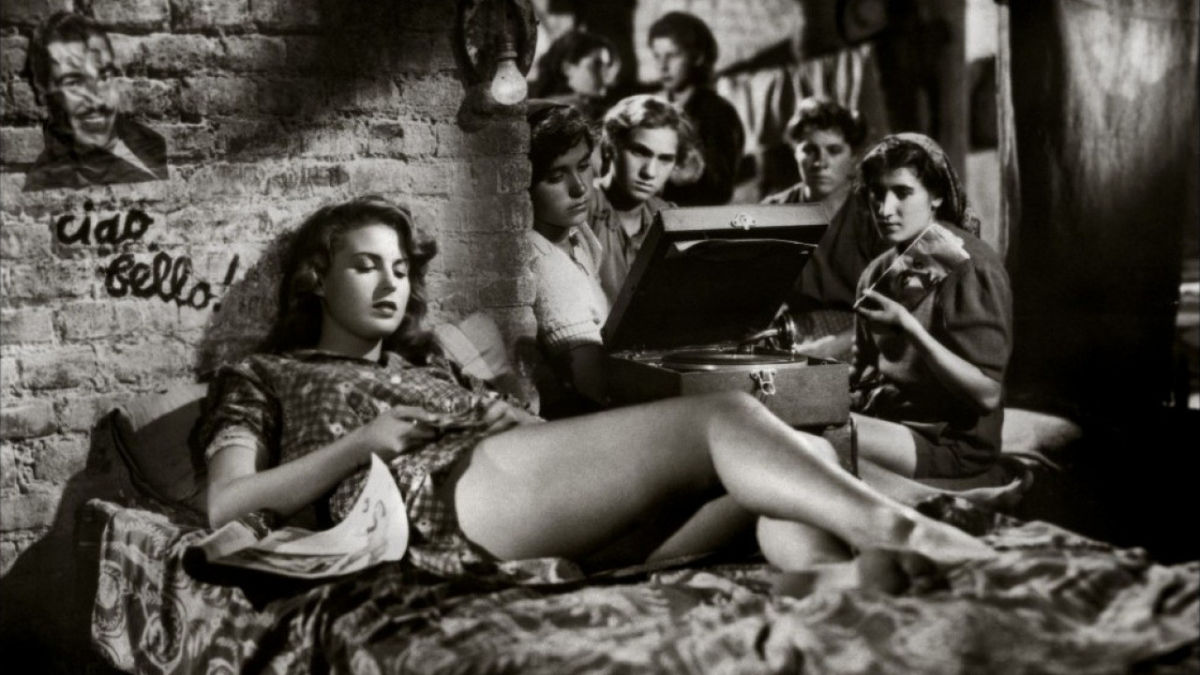
The melodramatic impulses of neorealism are easier to see now than when the early films of Vittorio De Sica, Roberto Rossellini, and Luchino Visconti were first shown internationally. While the movement leaned towards shooting in natural settings (especially the streets of cities damaged by war) and casting non-professional actors, even a film like Rossellini’s Rome, Open City sports a star turn from the beautiful and charismatic Anna Magnani. In Bitter Rice, these tendencies, which culminate in the casting of Silvia Mangano, are taken even further; De Santis claimed that he was looking for an Italian Rita Hayworth. (Bitter Rice’s producer Dino De Laurentis married her.)
The director forged his ideas as a film critic and screenwriter, contributing to Visconti’s Ossessione. His version of neorealism flirted with the thriller, from his very first film, Tragic Harvest. After Bitter Rice became a popular success, its impurity made it a target for criticism, despite de Santis’ dedication to leftism.
Following their theft of a necklace, taken from a hotel, Walter (Vittorio Gassman) and Francesca (Doris Dowling) attempt to hide in the crowd waiting for a train to the rice fields. Escaping onboard, Francesca heads to Vercelli. She soon befriends Silvana (Mangano), a blonde woman who loves dancing. Without permission from a union to work, Francesca becomes an “illegal,” but she’s eventually allowed to contribute to the harvest legally. When Walter arrives, he plans to stage a robbery, making off with most of the rice. Pulled in by his looks, Silvana agrees to participate in it.


In Academy ratio, Bitter Rice’s framing is remarkable. De Santis uses every centimeter available to him. The film contrasts long tracking shots of crowds with more intimate interior scenes. In the liner notes for Criterion’s 2016 Blu-Ray, Pasquale Iannone spends a paragraph detailing the elaborate choreography of several scenes’ camera movements. One never forgets that its characters are part of a larger community, and even indoors, truly private space is very scarce. As with Jean Renoir’s ‘30s films, the world appears to spill out beyond the small space of the film screen.
For all Bitter Rice’s resemblance to film noir, Silvana is never treated as a femme fatale. Rather than dragging men down, she becomes corrupted by them. She’s contrasted with Francesca, who becomes the moral and political voice of the film. (When Marco says “jail isn’t the only solution, prison never helped anyone,” he’s certainly expressing De Santis’s own sentiments.) All of the main actors are attractive, but Silvana’s beauty is the motor behind the story. The film’s conscience is troubled by how sexy it finds her. Its marketing played up this angle: many posters sported a drawing accentuating her breasts.
Despite sexualizing Silvana, Bitter Rice dodges sexism. Women play the most important roles, while men turn out to be unworthy of their time. Francesca can see the traps facing Silvana clearly, acting with a wary intelligence, trying her best to protect Silvana. The film depicts a nearly all-female universe of workers supporting each other, singing to each other, their words illustrating the tensions among them: “Poor thing, the illegal/ who works so hard, then you do not.” Despite the physical hardships of their work, they’re extremely lively, even jovial.
Few of De Santis’ other films are remembered today in the U.S. Rome 11:00, inspired by the true story of a building collapsing under the weight of job applicants, is the only one with much of a reputation. Made in Yugoslavia, 1959’s The Road A Year Long earned a nomination for Best Foreign Language Film Oscar, but it’s unavailable to stream. If his films were available here, they can now only be seen on out-of-print DVDs. Does De Santis’s filmography contain more films as strong as Bitter Rice? One hopes that this restoration may allow us to find out.
The new 4K restoration of “Bitter Rice” opens Friday at New York’s Film Forum.