James Ivory, Screenwriter: A Primer

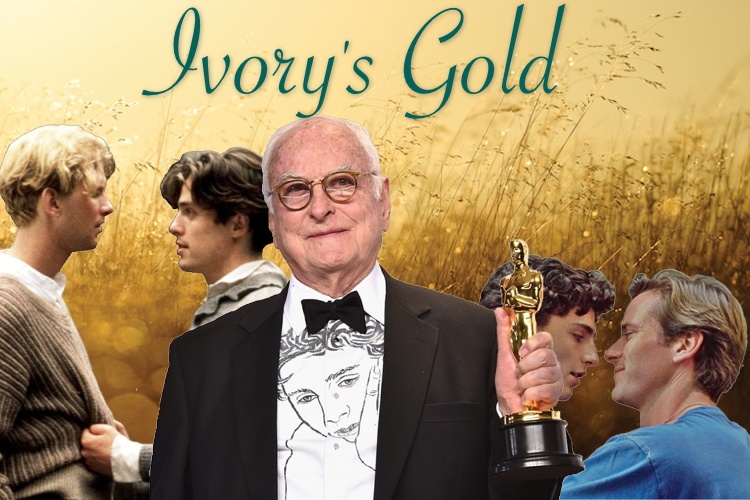
With his Best Adapted Screenplay win for Call Me by Your Name, James Ivory received some long-overdue recognition from the Academy. (He also became, at 89, the oldest winner in any category in Oscar history.) His prior nominations – all in the Best Director category – were for A Room with a View (1985), Howards End (1992), and The Remains of the Day (1993), three of the films that defined Merchant Ivory Productions in the public’s imagination. Together with producer Ismail Merchant and frequent screenwriter Ruth Prawer Jhabvala, Ivory became synonymous with sumptuous literary adaptations, but he began honing his writing chops decades earlier, co-authoring three of the four features Merchant Ivory produced when they were based in India in the 1960s.

Following the success of their initial outing, 1963’s The Householder, written for the screen by Jhabvala based on her own novel, Ivory and Jhabvala collaborated on the story and screenplay for their follow-up, 1965’s Shakespeare Wallah. Where The Householder centered almost entirely on Indian characters, depicting the turbulent first year of marriage between an inexperienced college lecturer and his young wife, Shakespeare Wallah follows a traveling theater company whose English actor-manager finds to his dismay there isn’t as much demand for the classics in post-colonial India as there used to be.

Ivory and Jhabvala based their scenario’s Buckingham Players on the real-life troupe headed up by Geoffrey Kendal and Laura Lidell, who play fictionalized versions of themselves, and featuring their teenage daughter Felicity, making her screen debut as its impressible ingénue, Lizzie. The film doubles as a coming-of-age tale for her since she falls for idle rich Indian Sanju (Shashi Kapoor, the husband in The Householder), who already has a lover in stuck-up Bollywood actress Manjula (future Merchant Ivory standby Madhur Jaffrey), who demonstrates the power of film over Shakespeare by upstaging a performance of Othello. And she’s not the only one troubled by Lizzie and Sanju’s relationship, as one of Ivory’s deep-focus shots reveals one of the Indian actors in Kendal’s troupe is plainly holding a torch for her. Rather than force the issue the way Manjula does, though, he chooses to keep his feelings to himself.

Ivory and Jhabvala collaborated again on 1969’s The Guru, which looks at the collision of Eastern and Western values, this time through the medium of music. Michael York plays a pop sensation called Tom Pickle (yes, Tom Pickle) who travels to Bombay to take sitar lessons from a master, only to find there’s more to Indian music than learning how to play the instruments. In this, he’s shown up by spiritual seeker Jenny (Rita Tushingham, a fixture of British films throughout the ’60s), who takes Tom’s sitar teacher Ustad (Utpal Dutt, one of Buckingham’s patrons in Shakespeare-Wallah) as her personal guru in spite of the fact that she can’t play a note.

Along with the East/West contrast, The Guru includes its own variation on the scene where a serious artist is upstaged by a flashy entertainer. Here it’s Ustad who is upset by the screaming fans his inattentive disciple attracts. Meanwhile, Jenny’s resolve is tested when she learns her guru isn’t quite the holy man she expected. Finding out he has two wives (something permitted by his religion, but taboo in the culture she comes from) just doesn’t gibe with the image she had of him.

The contrast between manufactured image and stark reality is even more pronounced in 1970’s Bombay Talkie, again co-written by Jhabvala and Ivory. Jennifer Kendal (Felicity’s older sister) stars as Lucia Lane, a serial divorcée and famous author who travels to Bombay to get the inside scoop on its film industry. (It’s said her previous book was about Hollywood, so the speculation is her next will be about its Indian counterpart.) While observing the filming of a spectacular dance number atop a giant typewriter (neatly echoing her profession), Lucia becomes smitten with leading man Vikram (Shashi Kapoor, her real-life husband), conveniently ignoring the fact that he’s a married man. Meanwhile, she is pursued by cynical screenwriter Hari (Zia Mohyeddin), who’s resentful of all the attention Vikram gets while he toils in obscurity.

Fame is a double-edged sword, however, as Vikram discovers when he’s forced to sign on with a disreputable producer (played by The Guru’s Utpal Dutt) when his fortunes take a tumble. No matter how popular you are today, there’s always somebody waiting in the wings, ready to replace you at a moment’s notice – or a fickle producer’s whim. Witness the scene where Vikram attends a recording session for one of the musical numbers he’s going to be pantomiming in playback and spies his virtual double in the booth across the way. That sort of thing can’t inspire too much in the way of job security.

After Bombay Talkie, nearly two decades passed before Ivory received another screenplay credit, but he still found ways to keep his hand in. In addition to writing the narration for various Merchant Ivory documentaries (something he had experience with going back to his first short, 1957’s Venice: Theme and Variations), he also came up with the idea for 1972’s Savages, the team’s first American adventure, hashing out a treatment with George Swift Trow and Michael O’Donoghue (later of National Lampoon and Saturday Night Live), but leaving the actual scripting duties to them.

A similar situation arose a decade later when Ivory, Jhabvala, and Merchant all pitched in on 1983’s The Courtesans of Bombay, a docudrama that marked the feature directing debut of Merchant (who had made a half-hour short under the Merchant Ivory banner in 1974). Harking back to their Bombay films, Courtesans is a portrait of the Pavan Pool compound, which is home to female singers and dancers who support their families by plying a completely different trade after hours. Made for the UK’s Channel 4, the film alternates between three narrators: the property’s genial rent collector (and actual owner), a former resident played by actress Zohra Sehgal (who had previously appeared in The Guru and later had a role in Merchant’s The Mystic Masseur), and a frequent visitor played by Saeed Jaffrey, whose connection with the team went back to narrating Ivory’s 1959 documentary The Sword and the Flute and the Merchant-produced 1961 short The Creation of Woman. (The latter was the first film for which Merchant was nominated for an Academy Award. The second was 1985’s A Room with a View, which earned nominations for all three of Merchant Ivory’s pillars and Jhabvala her first of two Oscars.)

Jhabvala didn’t feel equipped to tackle the milieu of closeted homosexuality in Britain’s upper classes in Maurice, the team’s next E.M. Forster adaptation, so that chore fell to Ivory and Kit Hesketh-Harvey. A distant echo of Call Me by Your Name’s overt gay romance, the relationships in Maurice are more furtive since homosexual acts at the time were criminalized to such a degree that Ivory and Hesketh-Harvey invented a character whose life is ruined when he propositions the wrong laborer, to serve as an object lesson for James Wilby’s Maurice and his college chum Clive (played to lip-biting perfection by Hugh Grant). While the latter retreats into a conventional and presumably passionless marriage to preserve his standing in society, Maurice tries going to an American hypnotist (played by Ben Kingsley) who tells him “England has always been disinclined to accept human nature” and suggests he move somewhere homosexuality isn’t a crime. Prefiguring the later film’s setting, it’s telling that one of the alternatives he suggests is Italy, but Maurice finds happiness closer to home with a rough-and-tumble groundskeeper played by Rupert Graves.

Ivory’s next writing credit – shared with Jhabvala – was on 1998’s A Soldier’s Daughter Never Cries, based on the Kaylie Jones novel, a thinly veiled depiction of her relationship with her father here renamed Bill Willis and played by Kris Kristofferson. The film is divided into three sections, each named for a different male figure in the life of Charlotte Anne Willis (played by Leelee Sobieski as a teenager), the daughter of the title who’s told on multiple occasions she can never cry, but waits until the final part (subtitled “Daddy”) to call him on it. The other two cover the period when Willis is living as an expatriate in Paris, with “Billy” covering the introduction of Charlotte Anne’s adopted younger brother into the family and “Francis” encompassing her friendship with an opera-mad American. The cast also includes Barbara Hershey, Jane Birken, Jesse Bradford, and Isaach De Bankolé, reflecting the caliber of actors Merchant Ivory was able to attract in the years following the twin successes of Howards End (1992) and The Remains of the Day (1993).

Even more star-studded, however, was 2003’s Le Divorce, which roped in Kate Hudson, Naomi Watts, Leslie Caron, Glenn Close, Sam Waterston, Stockard Channing, Thomas Lennon, Bebe Neuwirth, Matthew Modine, and Stephen Fry. A frothy romantic comedy based on a novel by Diane Johnson (Kubrick’s co-writer on The Shining), Le Divorce found Ivory and Jhabvala working in a lighter mode than usual, but still keeping things relatively grounded. While Watts’s Roxeanne realistically deals with the fallout of her broken marriage to a cad who wants a quickie divorce in spite of the fact that she’s carrying their second child, Hudson’s Isabel blithely takes up with an older man who showers her with expensive gifts while stringing along an artist her own age who offers something more fulfilling. The main engine of the plot, however, is the contentious wrangling over a painting that has been in Roxeanne and Isabel’s family for generations and which could fetch a high price at auction if it turns out to be a La Tour, which it does.

With their international stars and million-dollar budgets, A Soldier’s Daughter and Le Divorce seem far removed from Merchant Ivory’s humble beginnings scraping together financing in Delhi and Bombay, but they traffic in the same themes of cultures in collision and the role of the artist in society. Similarly, the convention-defying same-sex attraction of Maurice finds its counterparts in the doomed love affairs between English women and Indian men in Shakespeare Wallah and Bombay Talkie. And all of these films look ahead to Call Me by Your Name. Whether it’s Armie Hammer’s Oliver fretting over whether he’s “ruined” his host’s teenage son and worrying they may pay for what they’ve done, or Timothée Chalamet’s Elio experiencing disillusionment comparable to Lizzie in Shakespeare-Wallah or Jenny in The Guru, or Michael Stuhlbarg’s Samuel pining for the love he might have had under different circumstances (much like Clive does at the end of Maurice), Call Me’s characters reveal their fragility and humanity in ways Ivory has been doing consistently for six decades and counting.


Join our mailing list! Follow on Twitter! Like us on Facebook!

Craig J. Clark watches a lot of movies. He started watching them in New Jersey, where he was born and raised, and has continued to watch them in Bloomington, Indiana, where he moved in 2007. In addition to his writing for Crooked Marquee, Craig also contributes the monthly Full Moon Features column to Werewolf News. He is not a werewolf himself (or so he says).

Leave a Reply

Your email address will not be published. Required fields are marked *

This site uses Akismet to reduce spam. Learn how your comment data is processed.

Back to top
Exit mobile version