Spoilers for Us.
For most in the film business, marketing is simply a tool, a way to let potential customers know about a product being sold. There are a few filmmakers, however, who have control over their marketing materials and, rather than just use them as advertising, make them an extension of the experience of the movie.
One such filmmaker is Jordan Peele, whose runaway success with Get Out (2017) earned him the clout necessary to control how his next film was sold. That movie, Us, has been advertised primarily on the strength of Peele’s name, putting him with the likes of William Castle and Alfred Hitchcock, horror movie moguls who were known just as well on camera as they were off. Peele is also the host of the new “Twilight Zone,” reminiscent of Hitchcock making new films while hosting his own genre anthology show, “Alfred Hitchcock Presents.” With all this recognition and creative power, Peele did a very clever thing in advertising Us, in that he not only hinted at the film’s major themes and ideas, but he also hid the movie’s major rug-pulling twist in plain sight.
Us’s guessing game with the audience started 10 months before the film was released, and Peele used each new ad to build anticipation as well as speculation, challenging fans to decode what the film might be about. Horror movies have a long history of ambiguous advertising (what’s scarier than the unknown, after all), and to be sure, the ads for Get Out weren’t exactly straightforward. Yet as those marketing materials continued, the basic premise of Get Out became clearer, setting up anticipation of what was going to happen to the protagonist rather than raising questions about what was going on, full stop.


In retrospect, it’s obvious that the image represents the concept of doubles, of the humans and their Tethered counterparts from the movie. Without that context, however, the image is very ambiguous, and even resembles a Rorschach blot from psychiatry exercises, implying that the meaning of the image is up to the viewer — which is one of the major themes in Us itself.


Additionally, there’s an intriguing callback to the first teaser poster, as the shape of the top of the scissors recalls the shape of the two heads in that image. This connects with statements Peele has made about the use of scissors in the film, explaining that “there’s a duality to scissors — a whole made up of two parts but also they lie in this territory between the mundane and the absolutely terrifying.” Thus, the duality of scissors connects with the duality of the humans and Tethered within the film, a theme furthered by the new treatment of the title on the poster. Whereas the title on the teaser poster was in a fairly average font, here the “Us” has strands coming off of it, almost like it’s becoming untethered — which is, of course, exactly what happens in the film.
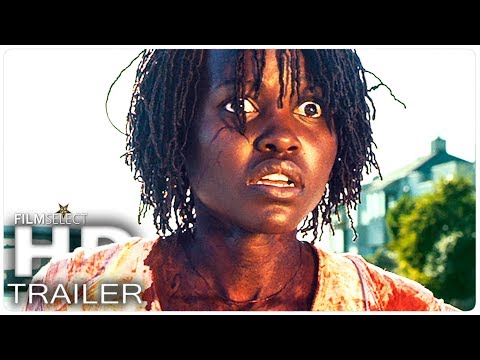
Our first real taste of Us came with the trailer. Peele’s control over the material is still evident here, as only one major trailer and a handful of TV spots were released — different from the usual strategy of bombarding audiences with at least three main trailers and dozens of smaller spots. The trailer finally makes clear the basic premise of the film: A family on vacation at a house near the beach is attacked by another family that strongly resembles them. It looks like a home invasion movie — one character even wears a white mask with a face drawn onto it, as in the home invasion classic The Strangers (2008) — and there’s a sense that the movie is centered around a single location.
Yet this is a mislead, as the film is surprisingly expansive in location, and especially large in scope. Similarly, there’s a tagline (“We are our own worst enemy”) that at first glance seems generically suited to the idea of a doppelgänger movie, but in hindsight signals the national context Peele’s movie is getting at: This isn’t a film just about individuals being self-destructive, but entire cultures and nations. The ambiguous nature of the movie is reinforced by the reappearance of the Rorschach patterns (modified to look like blood droplets) from the initial teaser poster, further signifying the idea that the movie can mean many things to many people.
Perhaps the most impressive element of the movie’s marketing is how it obfuscates the film’s major reveal, using both a “hide in plain sight” technique as well as assumptions about other horror films and influences against the audience. The very first scene of the trailer shows the Wilson family driving in their car listening to Luniz’s “I Got 5 On It.” After a joke about the song’s meaning (which the father and daughter interpret differently!), Lupita Nyong’o’s Adelaide turns to her son in the back seat, telling him to “get in rhythm” and snapping her fingers to the song. There’s something wrong, though: It’s subtle, but noticeable, that she’s snapping just off-beat. It’s a huge clue — right in the first scene of the trailer — that Adelaide is not entirely human.


The movie itself begins with a shot of young Adelaide watching television, the set surrounded by VHS tapes of films that influenced Us and that hint at what’s to come, but in ways that mislead the audience. The presence of A Nightmare On Elm Street (1984), for instance, may seem to indicate that the movie will turn out to be someone’s dream, when actually it’s acknowledging the debt the Tethered’s look has to Wes Craven’s film. That entire opening sequence, in fact, is presented less like the setup to a twist and more like a character’s prologue, which is why the reveal hits with such impact at the end. The switch doesn’t occur during the main narrative, and what’s more, it was indicated as far back as the trailer.
The twist in Us is the final chess move in what had been a long game between Peele and his audience. Its effectiveness is not just in its entertainment value, but in how it reframes the entire movie, drawing a clearer analogy for the concepts Peele is addressing, yet complicating them enough to not be locked into one meaning. In that way, the movie stands alongside other metaphorically ambiguous horror classics like the Invasion of the Body Snatchers films and Stanley Kubrick’s The Shining (1980), movies with relatively straightforward narratives that also leave a lot of room for personal interpretation. Peele was savvy enough to realize that he could extend this quality all the way to the advertising, announcing the grand aims of his movie with an inkblot poster and going as far as telegraphing the final twist in the trailer. The trailer wasn’t just a piece of marketing put together by an advertising firm for hire, either, but ended up contributing an important piece of the film’s narrative, too — the response to it caused composer Michael Abels to incorporate the remix of “I Got 5 On It” into the movie itself, a remix that had been suggested to the marketing team by Peele, showing just how close he was to the direction of the advertising. The two worked in concert so well, that you might even say the film and the ads were … Tethered.