In You Were Never Really Here, Lynne Ramsay continues to uphold her reputation for being an artist of uncompromising originality and skill. Despite only making four features in nearly two decades, the Scottish filmmaker’s work is studded with awards and accolades. Ramsay’s films are atmospheric, gritty, disturbing and strangely redemptive. They all seem linked by characters whose narratives are heavily laced with guilt, alienation, and trauma.
Ratcatcher (1999) is set in a Glasgow slum during the 1973 garbage workers strike. A 12-year-old boy named James Gillespie, inadvertently responsible for the drowning of a playmate, is haunted by guilt and sadness and spends his days exploring construction sites. James’ fantasy of a new home for his family, as well as his realization that he doesn’t feel welcome anywhere, colors his interactions with others: He seems constantly yearning for something just out of reach. He briefly connects with a local girl whose sexual precocity — the source of her being teased by the other boys — is relaxed so the two outsiders can forge a chaste, playful bond. Ramsay teases moments of beauty and serenity from the grim setting, and James’ final scenes are so tensive and lyrical you may need something restorative after watching.
Morvern Callar (2002), adapted from Scottish author Alan Warner’s 1995 novel, begins with the title character (a stunning breakout performance by Samantha Morton) lying on the floor as Christmas lights twinkle in the background, embracing her dead boyfriend’s body. His suicide note instructs her to pay for his funeral and send his just-finished first novel to a publisher. She passes the novel off as her own work and takes the funeral money for an impromptu holiday in Ibiza with a girlfriend, after first pragmatically disposing of her partner’s body. Morvern’s guilt is fleeting and arbitrary; she mainly lives for going to raves, getting high, and listening to music in her Walkman. The film’s dreamy, colorful vibe and rather cold-blooded narrative are a troublesome but alluring combination. With this follow-up to her explosive debut, Ramsay’s unusually intimate approach to sound and imagery seemed to crack cinema’s sensory possibilities wide open; critics started referring to Ramsay as one of the UK’s strongest auteurs.
After several projects that fell through (including a hotly anticipated adaptation of Alice Sebold’s novel The Lovely Bones that occupied Ramsay for five years), We Need to Talk About Kevin came in 2011, co-written with her husband Rory Stewart Kinnear (based on Lionel Shriver’s novel), and set in the United States with big-budget stars (Tilda Swinton and John C. Reilly). With subject matter that feels familiar, Ramsay made an electrifyingly original film. Swinton plays Eva, a solitary woman haunted by a traumatic event involving her son. The film’s first shot, of a white curtain blowing in the breeze, is not only a melancholy harbinger of a horrific scene that is more fully realized later, but a reference to the opening shot of Ratcatcher, in which James wraps himself in a white curtain at the window, spinning slowly and lazily until his mother slaps him on the head. Morvern Callar’s boyfriend was also named James Gillespie (a sly cinematic “what if”); Ramsay keeps returning to riff on these themes, fragmenting and reinventing them each time. But in her third feature, the guilt and trauma are constant and all-consuming. The second shot finds Eva, a successful travel writer before the tragedy, taking part in an Italian harvest festival where, apparently, half-naked people gather in the streets, writhing and marching, covered in smashed tomatoes. It’s sensual, but the similarity to bodily gore is striking. Eva awakens from this half-dream, half-memory to find her front door and porch have been vandalized with huge splotches of red paint.
The use of color in Ramsay’s work had previously been more subtle. In Ratcatcher, James’ world is drab and only portrays a flash of green life when he escapes to the meadows on the outskirts of the stinking city. In Morvern Callar, the colors are chaotic and arbitrary: Christmas lights, beach houses, dance clubs, and the frequent sight of street and traffic lights that has become a visual trademark of Ramsay’s: bright but blurry spots of color that somehow feel both accidental and intentionally symbolic. In We Need to Talk About Kevin, colors are literal signposts: of violence, fear, and control in red, yellow, and blue. Eva’s memories of her life “before” often leap up unbidden, portrayed with fleeting glimpses, shadows, partly seen moments of human affection, celebration or stress, etchings of her lonely, haunted state. The use of sound is similarly exacting and semiotic: the sound of a lawn sprinkler (a ubiquitous noise in the suburbs, a place Eva fought against moving into) repeats periodically until its origin is revealed in a flashback scene that fully conveys the scope of Eva’s loss.
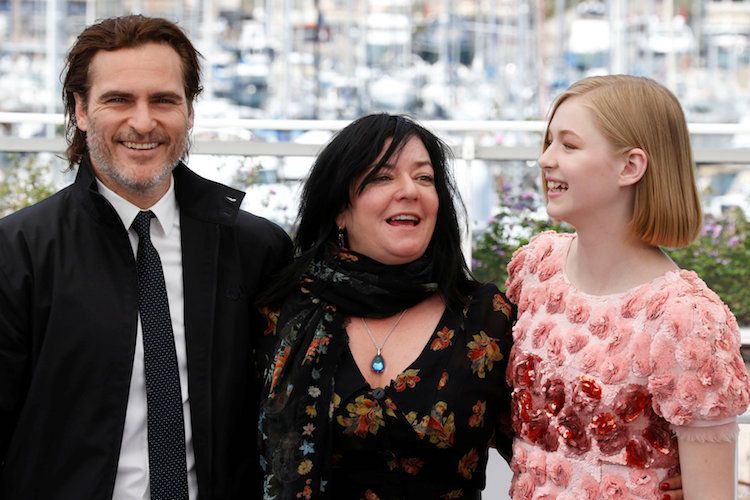
The protagonist in You Were Never Really Here, Joe (Joaquin Phoenix), a hired gun for a secretive yet high-profile investigation firm, has also suffered traumatic loss, but the details are shaky, shown in snippets that cause him to react with panic and physical discomfort. It’s hinted that Joe is a combat veteran, but not at all clear what war he fought in. There’s a brisk but horrific flashback shot of a shipping container full of young girls, trapped and suffocated, and their faces still trouble Joe, who sees them at inopportune moments. Despite his post-traumatic stress, Joe’s work as a ruthless mercenary is focused and efficient.
There’s a moment near the beginning of You Were Never Really Here when Joe visits his boss John (John Doman) to find out about his next assignment. He’s listening to John describe the job, tracking down a young girl who’s been kidnapped by sex traffickers. He grabs a handful of jelly beans from a dish and lies down on a leather couch, eating them one by one. Speaking softly under his breath while John continues going over the details, Joe dreamily asks himself, “Why are there never any green ones? I like the green ones.” He then finds a green jelly bean and crushes it slowly between his fingers before he eating it. It’s hard (for me, anyway) not to think about Kevin (Ezra Miller) in Ramsay’s previous film, pouring Fruity Pebbles on the countertop and lightly crushing the colorful pieces with his fingers before eating them. Also hard not to think of James, who yearned for the green meadows outside Glasgow, or Morvern, who wanted to lose herself in the verdant Spanish wilderness, or the fact that both of them had a fondness for sweets.
Joe’s latest assignment goes wrong when he is ambushed and must reinvent the protocols he’s become used to. His personal demons loom larger and it’s unclear if he’ll be able to overcome the new atrocities and obstacles thrown in his path. Not for the faint of heart, Ramsay’s story of young girls stolen by powerful men nods to other recent powerful works with similar themes, like the 2011 Australian film Sleeping Beauty or the 2013 Israeli thriller Big Bad Wolves, minus their fairy tale symbolism. Joaquin Phoenix’s portrayal of Joe, a man beset with visions of doom yet with a curiously animalistic survival instinct, is a white-hot tour de force.
Lynne Ramsay’s films tell stories of tragedy and violence tearing open people’s lives. But instead of positioning her viewpoint at a distance where one might safely observe and absorb the details, Ramsay pulls us in, perilously, deliriously close. Her dexterous weaving of cinema’s moving parts — action, mood, sound, image, rhythm, language, color, music, symbolism — yields works that are like moving medieval tapestries, tinged with human mysteries that feel ancient, and yet achingly familiar, tapping into the collective consciousness of pain, yearning, evil and redemption. It’s surprising that Ramsay and Phoenix have gone so many years before merging their dark arts in this brutal, beautiful film.