Let us contemplate, just for a moment (or, more accurately, the few minutes it will take you to read this), the conundrum of the contemporary movie musical. There was a time when the musical was one of the sure-things of mainstream studio fillmmaking, from the first big smash of the talkie era, The Jazz Singer, to the biggest box-office hit since Gone With the Wind, 1965’s The Sound of Music. The studios thought its massive success was a dictate from the masses to make more musicals, bigger and pricier ones, when in fact it was the genre’s last gasp; those late-‘60s roadshow disasters are always pinpointed as the bloated dinosaurs that were put into the ground by the New Hollywood movement.
It wasn’t really as deliberate as all that — it was mostly a question of bad timing. Because at that very moment, the decades-old Hays Code was, at long last, being disemboweled, allowing the filmmakers of the late 1960s and early 1970s to finally make movies that truly reflected the way real people talked and acted. And so, in a flood of movies that reflected a newfound, unfiltered realism, what could look more phony, more like a relic from the era of make-believe, than films where people burst into song?
That essential question has dogged the genre ever since, and while there have been occasional successes (Wicked, Chicago, La La Land), they’ve been far outnumbered by the failures. The dominance of the musical is now far enough in the rearview that most audiences simply won’t swallow it as a device within a realistic narrative film; it’s unsurprising that most of the most culturally and commercially successful musicals of recent decades have been cartoons.
So how does one turn a stage musical favorite like Stephen Sondheim’s Merrily We Roll Along into a movie? Well, luckily, we have two opportunities to find out. In 2019, Richard Linklater commenced production on a movie musical adaptation, with an ambitious game plan. As with his 12-year production of Boyhood, he will shoot Merrily, which takes place over 20 years, over the same period of time — shooting segments at intervals, with the actors (and the director) aging alongside their characters.
To further complicate the process, the story is told in reverse order, meaning they began by shooting the chronological beginning of the story that’s also the end of the film. (On top of all of that, the project has already hit a snag: after shooting the first segment, Linklater had to go back and reshoot after recasting the leading role.)
The Linklater film promises to be a fascinating experiment, and not just from the standpoint of its protracted production. It may well amount to the purest example yet of the tension between reality and musical theater — the most direct attempt yet to graft cinematic reality onto a fanciful art form. The old-age makeup and similar (sometimes slipshod) theatrical elements of a show that covers this kind of timeframe are accepted as part of the bargain for musical theater; we nod and go along with slapped-on age lines and sprayed-on greyed temples, just as we nod and go along with out-of-nowhere belting and instrumentation. But will seeing Beanie Feldstein literally age backwards make her flights of musical fancy seem even more peculiar?

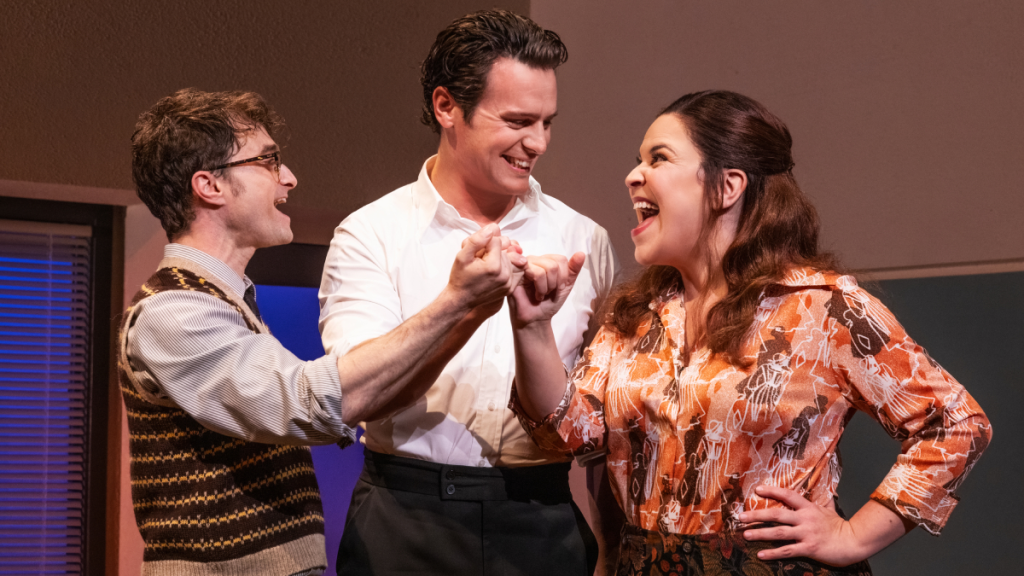
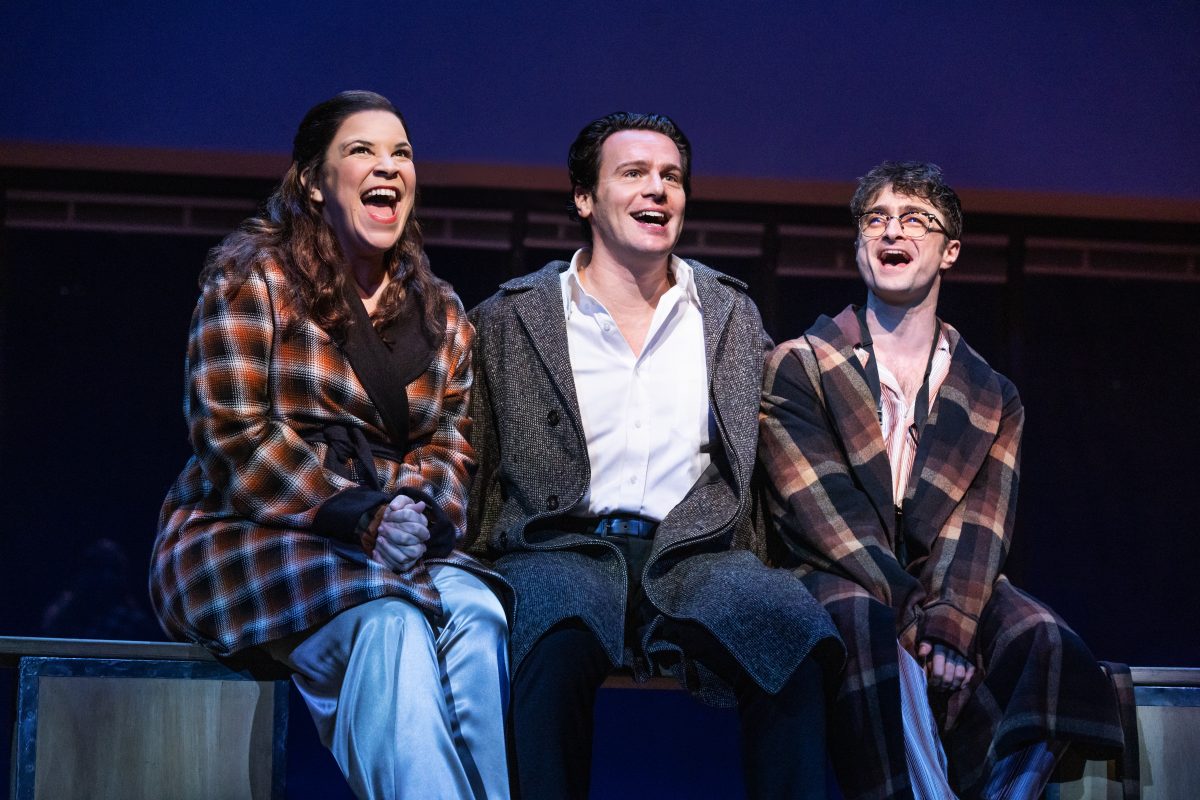
Sadly, we won’t know the answer to that question until 2040, but Sondheim-heads have a 2025 film version of Merrily to tide them over. This version is very much the play on film — a performance (well, multiple performances, but edited into one) from its Broadway run in 2024, with that show’s cast in place and laughs and applause from a live audience. So as opposed to Linklater’s version, which fully turns Merrily into a movie, this is a live capture, a la the recent Hamilton and Waitress: The Musical.
It’s a fascinatingly fractured film, two things at once, not fully one or the other. Its actors — particularly leading actors Daniel Radcliffe, Jonathan Groff, and Lindsay Mendez — must strike an especially tough balance. They’re doing two very different kinds of acting simultaneously: on stage, an actor must communicate their emotions to the back of the house, while a screen actor can work in a much smaller manner, since the camera is so close, and so perceptive. Director Maria Friedman mostly goes for the gusto, shooting tight close-ups, often with a handheld camera that feels less like an observer than a participant.
Some of the acting errs on the side of theatricality, particularly among the supporting players, but the main trio is plenty camera savvy — Groff in particular straddles that line between styles with ease. They all understand the challenge of the structure, starting at their story’s end and working backwards, with fallout followed by fissures, and vague allusions explained the farther back it goes. It remains an ingenious conceit, allowing us to observe the vault lines, and then the cracks they began as.
The cast rises to the challenge, stripping away the cynicism to convey their earlier youth and innocence, aided immeasurably by the angst, regret, bitterness, and disappointment of Sondheim and George Furth’s songs. The music is breathtakingly complex — formally and emotionally — and self-aware to boot. Groff and Radcliffe’s characters are musical theater composers, so the notion that you can put big, important ideas and complicated emotions into musicals is built right into the text; when idealistic Franklin (Groff) tells his partner Charley (Radcliff) that “we can change the world,” it feels like a mission statement.
On his late, lamented podcast WTF, Marc Maron would frequently confess to crying at musical theater productions — not even out of the emotion of the material, but just for the mere act of character (and actors) singing, because it’s so very vulnerable. Merrily We Roll Along is a genuinely vulnerable piece of work, and yet one cannot help but wonder how much of its force is built into the proximity of the experience; Maron would cry because they were right there, letting it all hang out. This performance film captures something of that, but the distance is still there, so it ends up something of a hybrid, half film, half concert, not quite fully formed. It kinda makes you want to see a movie of it.
“Merrily We Roll Along” is in theaters Friday.