“There is something about this middle-aged bald guy that is thrilling!” A Curb Your Enthusiasm joke that’s as much about middle-aged bald guy Larry David as the show resting on his slumped shoulders, it also calls into question the unlikely appeal of the action sub-genre represented almost exclusively by one man and one franchise — Liam Neeson and Taken.
By 2008, the actor’s career was headed comfortably in the direction of Batman Begins co-stars Morgan Freeman and Michael Caine – providing dignity and seasoned wisdom with a narration-ready voice, while occasionally playing God or God-equivalents. Then came Taken and, at 56 years old, Liam Neeson, action hero.
The Commuter, his seventh movie in a decade about a semi-retired family man with a very particular set of skills that involve guns and hitting, finds Neeson still punching anyone dim enough to threaten his family at the sprightly age of 65. But when it comes to the Middle-Aged Man Of Action genre, baldness optional, that’s just par for the course. Keanu Reeves decided the best way to play the world’s greatest assassin at 50 was to become him, then become him harder for the sequel. The combined age of The Expendables 3 cast was 850 years. Sean Penn, a James Bond, and half of Mr. Show have all heeded the siren song to play Murderous Men of a Certain Age while being about the same age as Tom Cruise. It took a Taken to bring the genre into mainstream appreciation, but it’s nothing new — Charles Bronson didn’t make Death Wish sequels until he was 73 just for the exercise — and not without some earlier highlights.

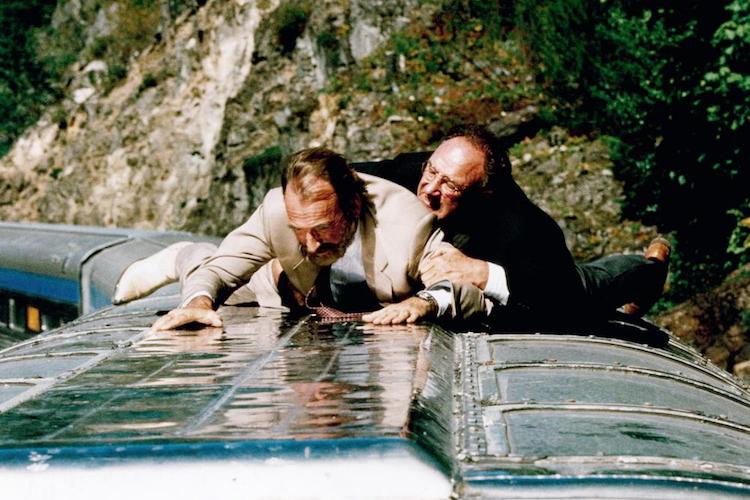
Narrow Margin (1990) doesn’t have the show-stopping spectacle of something like The Commuter, which ends in a grand computer-generated derailment, but when you see a 60-year-old Gene Hackman anxiously climb out onto the side of a train hurtling around a mountain in a single, unfaked shot, you forget about your popcorn.
In more ways than its action, Narrow Margin feels like a time capsule. The cast is a murderer’s row of sorely missed character actors last seen in a 1996 courtroom drama. There’s Hackman himself, Anne Archer, James Sikking, J.A. Preston, Harris Yulin, and, making a casting royal flush, both Walshes from the Mount Rushmore of That Guys — the late, great J.T. and M. Emmet. Before tape ever meets VCR, Narrow Margin earns a point for entertainment by Roger Ebert’s sacred Stanton-Walsh Rule, which states “no movie featuring either Harry Dean Stanton or M. Emmet Walsh in a supporting role can be altogether bad.”
Those are respectable credits considering the movie’s B-grade roots, or perhaps because of them. Peter Hyams, the only director-cinematographer-occasional-writer crazy enough to make a sequel to 2001: A Space Odyssey and a Van Damme movie involving time police, wanted to resurrect a forgotten film noir. The Narrow Margin, a 1952 RKO effort stocked with reliable contract players and produced for peanuts to round out drive-in double bills, offered a tight enough plot and low enough profile to justify a remake. Half of Hyams’ assessment was correct; every review couldn’t help but compare Narrow Margin to the uncharacteristically well-made original and find it wanting.

The crime is set up in a single scene. Anne Archer meets J.T. Walsh for what, in retrospect, is a pretty rough blind date. Not only does he break down in tears, but he also gets shot in the head by the crime boss who doesn’t appreciate his groveling. Archer hides until the killers leave, then runs to Canada.
We don’t see her flight. That’d take too much precious time and momentum. Instead, Gene Hackman tells us about it with a Christmas morning grin. As Deputy District Attorney, said crime boss is his white whale. M. Emmet Walsh, a cop two years from retirement and unaware of the “SHOOT ME” sign on his back, relays the shrewd trail of detection that gave away Archer’s hiding spot with hound dog pride. All that’s left is to go get her. But the actual district attorney won’t hear it — too much paperwork and money and other suspiciously convenient obstacles.
This is the part in most crime thrillers when the hero must wiggle through a loophole or decide to settle the score outside the slow lane of the law. Hackman tells his superior they’re flying to Canada anyway.
And they do. No hemming or hawing, no scene in a murky bar deciding who to trust. Just motion. Everything moves in Narrow Margin. Only Hackman gets a regulation backstory, but only in passing and only the CliffsNotes. By the time his Neeson-approved past is revealed (he’s an ex-Marine with a bureaucratic chip on his shoulder), we already know everything we need to know from the way he thinks, acts. And when provoked about it, with the observation that his chip is the only thing keeping him from dropping the “deputy” in his title, Hackman only smiles with righteous satisfaction and admits, “Shame, isn’t it?” The villains are defined only by noir standards — unusual height, generous frame, a killer pair of cowboy boots. Hackman and Archer, the impressively game cornerstones of it all, only open up to one another as the duress erodes them and everything — the plot, the movie, the train — hurtles on with sickening speed.
Hyams’ trademark style — smoky, deliberate and anamorphic — follows streamlined suit. More than once, he wrings a jolt that most horror movies would kill for by simply leaving the camera on an unobtrusive wide shot and waiting for violence to intrude. When it comes time for the inevitable — everyone rolling around on top of the train as it peeks in and out of tunnels — Hyams lets the speed and the mountains work for him. The camera doesn’t need to rattle when we can see it’s actually Hackman and Archer shambling along the sadistically sloped roof at 50 miles per hour. Cutting between the actors and stunt doubles is as seamless as it is irrelevant; when two people roll off the top of a speeding train as it crosses a bridge some hundred feet in the air, one grabs a rail along the top and the second grabs the other’s waist, it’ll thrill you no matter who they are.
At the 1990 box office, Narrow Margin came in just below Nuns on the Run, an Eric Idle comedy about criminals on the run posing as nuns. Its critical response was no warmer. But today, now that there exists an audience hungry for middle-aged men kicking their way through conspiracies aboard speeding trains, Narrow Margin plays better than it probably ever did. Much like the no-budget noir it remade, it’s a rollicking B-side made better than most hit singles, where hitmen speak in lines as loaded as their .45s, the good guy’s only risking his neck because it’s the Right Thing To Do, and killers lurk in the shadows of every car and compartment. It’s a stylish lesson in thriller fundamentals that cuts the brake lines and dumps all baggage, for better and (rarely) for worse.
Not all courses in Advanced Neesonry are created equal, but Narrow Margin answers that greatest of cinematic riddles: There is something thrilling about this middle-aged bald guy. And it involves punching.
Jeremy Herbert lives in Cleveland, looks forward to punching people in his old age.