Although it caters to a large community of retirees, the Palm Springs International Film Festival still features its share of daring selections, on a program full of awards favorites (thanks to the festival’s timing, right in the middle of awards season) and official submissions for the Best Foreign Language Film Oscar (this year’s festival played 43 of the 87 submissions). The movies that stuck with me the most at PSIFF this year all played around with the cinematic form, whether just for one scene or for their entire running times, taking risks that might alienate some viewers but that pay off in exciting and unexpected ways.
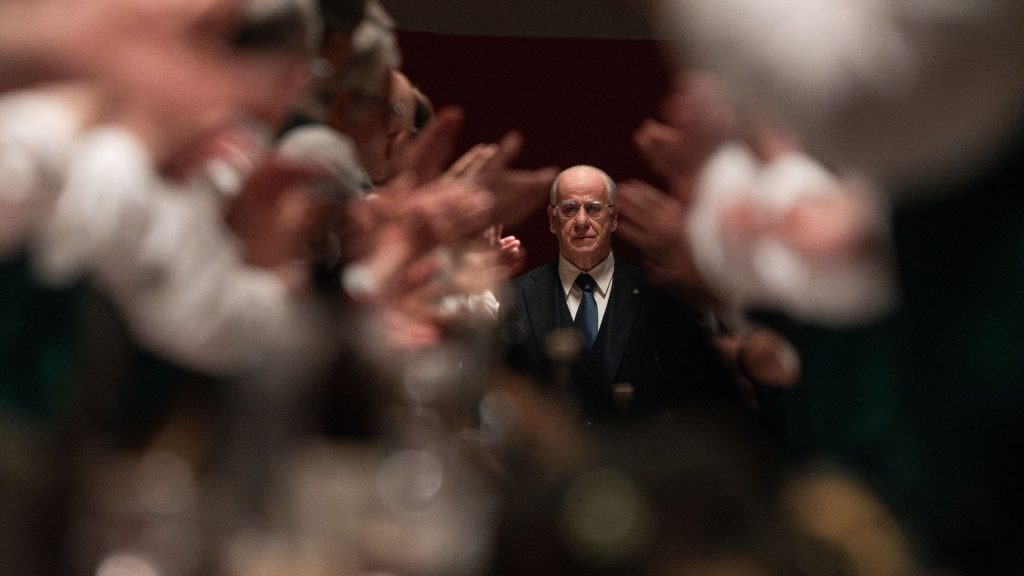
It might not be entirely accurate to call László Nemes’ Sunset (in theaters spring 2019) an experiment, since it employs a slight variation on the filmmaking technique that the Hungarian director used for his breakthrough first feature, the Oscar-winning 2015 Holocaust drama Son of Saul. But it still feels often startlingly fresh, as Nemes holds his camera tight on lead actress Juli Jakab for the majority of the film’s 144 minutes. As in Son of Saul, this device has the effect of placing the viewer right alongside the main character, sharing in her anxiety, her fear, her excitement and, often, her confusion, as the movie provides almost no context for the story aside from an opening title card.
That title card sets the movie in 1913 Budapest, where Jakab’s orphaned millinery heiress Irisz Leiter has returned to reclaim her birthright at her late parents’ hat store. That may sound like a much lower-stakes story than one set in the middle of the Holocaust, but Irisz’ quest to take hold of her family’s legacy coincides with a turbulent time on the eve of World War I, and eventually encompasses riots, kidnapping, and conspiracies. This is certainly the most intense movie ever made about hats, and Nemes manages to make the shady practices at the store carry just as much weight as the civil unrest happening around the city. He opens up the frame a little more often than he did in Son of Saul, but Jakab’s fantastic performance as the equally naive and determined Irisz carries the movie, even when it’s completely unclear what’s happening to her. She’s constantly moving forward, even if just by instinct, and she always carries the audience along with her.
The French giallo-style slasher movie Knife + Heart (U.S. release date TBA) is also often inscrutable, although its plot turns out to be surprisingly straightforward in the end, considering the genre from which it takes its inspiration. Like Peter Strickland (Berberian Sound Studio) and the team of Hélène Cattet and Bruno Forzani (Amer, Let the Corpses Tan), director Yann Gonzalez has taken inspiration from the visually striking, sometimes sleazy Italian horror movies of the 1960s and ’70s, and used it in service of something a bit more highbrow and abstract.
But while Gonzalez may be interested in commenting on the dangers of gay life in 1979 Paris, he does so via an entertainingly over-the-top story about a killer targeting the performers at a gay porn company led by Vanessa Paradis’ Anne. The killer uses a knife concealed within a dildo to take out several of his victims, and Gonzalez has a playful sense of humor about how being stalked by a crazed murderer is just one more transgression for his art-provocateur characters. He uses the garish colors of giallo movies to heighten both the sense of danger and the near-constant sexual arousal the characters experience.
Performance art also plays an important role in Patricia Rozema’s Mouthpiece (U.S. release date TBA), which is adapted from a two-woman stage show and often has the feel of a theatrical experiment. The original writers and stars of the stage version, Amy Nostbakken and Norah Sadava, co-wrote the movie with Rozema and also both star as Cassandra, a 20-something writer struggling with her mother’s death and her own career and personal insecurities. Nostbakken and Sadava don’t play Cassandra at different ages or in different settings; they’re both onscreen together as the character for the entire movie, sometimes moving and speaking in sync, but more often at odds with each other, representing Cassandra’s conflicted thoughts and feelings in the days leading up to her mother’s funeral.
Neither version of the character embodies one particular personality trait; instead, they’re constantly in dialogue with each other, perspectives shifting as Cassandra’s emotions remain in turmoil. There are a few stagey devices (including a couple of brief musical numbers) that don’t quite work, but overall Rozema manages to make a very theatrical conceit into effective filmmaking, putting a fresh spin on the familiar angsty-creative-type-in-the-city indie drama.
Icelandic director Benedikt Erlingsson’s Woman at War (in select theaters March 1) relies on one relatively well-worn cinematic device — casting its lead actress as twin sisters — and another quirkier twist, integrating its musical score into the action via musicians and singers who literally follow the main character around (although she never acknowledges their presence). Halldóra Geirharðsdóttir plays choir director and radical environmental activist Halla, who stages elaborate actions to sabotage power lines around Iceland, in protest of large-scale multinational corporate industrialization coming to the pristine countryside. As she carries out her solo covert actions, she’s often accompanied by an instrumental trio and/or a group of Ukrainian folk singers, who form a thematic connection to Halla’s efforts to adopt a Ukrainian war orphan. The oddball musical presence, combined with Geirharðsdóttir’s warm, humorous performances (she also plays Halla’s somewhat flighty yoga-teacher sister) help to lighten the heavy subject matter, without undercutting Halla’s serious sense of purpose.
Austrian director Katharina Mückstein’s L’Animale (U.S. release date TBA) also uses unconventional musical accompaniment, albeit only at one pivotal moment in the story. Otherwise it’s a fairly low-key coming-of-age tale about teenager Mati (Sophie Stockinger) exploring her sexuality, while her parents deal with their own identity crises. A tomboy whose friends are all crude dudes on dirt bikes, Mati is perfectly comfortable joking around with the guys (perhaps a little too comfortable, given how she supports them when they harass other girls), until her best male friend declares his romantic intentions toward her. She may not entirely understand her feelings yet, but she knows that she doesn’t want to be more than friends with him. That rejection, along with Mati’s increasing (yet primarily chaste) attraction to a shy female grocery-store clerk, causes a rift in her group of friends that slowly spirals out of control.
Meanwhile, Mati’s mother discovers that her husband is engaging in clandestine sex with men, and she begins an affair with a married male friend. The adult subplots are a bit underdeveloped, but Mückstein explores Mati’s sexual awakening with tenderness and specificity, showing the effects of toxic masculinity on her ability to be true to herself and honest with the friends she’s supposedly so close to. The plot threads culminate in a surreal but moving sing-along to the title song (by Italian singer Franco Battiato), as the various characters, all stuck in moments of despair, lip-sync to Battiato’s vocals, much like the characters in Paul Thomas Anderson’s Magnolia singing along to Aimee Mann. It’s both jarring and cathartic, a single stylized moment in an otherwise naturalistic film.
Josh Bell is a freelance writer and movie/TV critic based in Las Vegas. He's the former film editor of 'Las Vegas Weekly' and has written about movies and pop culture for Syfy Wire, Polygon, CBR, Film Racket, Uproxx and more. With comedian Jason Harris, he co-hosts the podcast Awesome Movie Year.