In between Jamie Lee Curtis’ stints in the Halloween movies — after her character’s death in 2002’s Halloween: Resurrection and before her return in this week’s Halloween from David Gordon Green — Rob Zombie launched a remake series that at first promised a new direction for the franchise but is now treated more like a footnote. Green is returning to previous continuity, following up directly on John Carpenter’s 1978 original, cutting out every other version in the process, and it makes sense for him to put his own stamp on the material with a fresh start.
But reducing Zombie’s films to an unfortunate detour does a great disservice to a pair of distinctive, ambitious horror movies, especially 2009’s Halloween II. Taking on a remake of an iconic film like Halloween is a thankless task, and it’s not surprising that many horror fans had just as little patience for Zombie’s 2007 Halloween as they did for remakes of The Texas Chainsaw Massacre, A Nightmare on Elm Street and other horror classics around the same time.
Zombie himself struggles with making something new out of Halloween, and his first film suffers from the tension between Zombie’s original ideas and the obligation of retelling a familiar story. Even so, Zombie adds something new to the story of implacable killer Michael Myers, planting important seeds that pay off brilliantly in his second film. Zombie’s extended director’s cut also restores some of the balance between the film’s two halves, the first of which follows Michael (Daeg Faerch) as a young boy and charts his develop as a burgeoning psychopath.
While Carpenter devoted just a few opening minutes to Michael’s childhood murder of his older sister Judith and never gave any screen time to Michael’s parents, Zombie delves much more deeply into Michael’s early family life, portraying the boy as a bullied misfit who also takes sadistic pleasure in killing small animals. His murder spree is more brutal and more extensive, as he butchers not only Judith but also her boyfriend and Michael and Judith’s cruel stepfather, Ronnie (William Forsythe). This Michael isn’t just an inexplicable force; he’s an abused young boy who snaps and embraces the evil that’s lurking within him.

Nearly halfway through its running time, the film cuts to 15 years later and takes up the familiar story of teenage babysitter Laurie Strode (Scout Taylor-Compton) and her friends Annie (Danielle Harris, who as a child starred in Halloween 4: The Return of Michael Myers and Halloween 5: The Revenge of Michael Myers) and Lynda (Kristina Klebe) as they’re stalked by an escaped adult Michael (Tyler Mane), returned to his hometown of Haddonfield, Ill. While the original series didn’t introduce the idea of Laurie as Michael’s long-lost sister until 1981’s Halloween II, Zombie builds it in from the very beginning, showing (but not naming) her as a baby in the Myers household, and later revealing that Haddonfield Sheriff Brackett (Brad Dourif) arranged for her secret adoption to keep her in the dark about her family history.
So what was previously a story of random, unmotivated violence becomes a twisted saga about the legacy of family trauma. After hitting many of the story beats from the original movie, Zombie diverges for the finale, having Michael kidnap Laurie and take her to the dilapidated Myers house, where they have their climactic showdown. Instead of Loomis showing up to save Laurie (which he does, but ineffectively), the movie ends on a manic Laurie kneeling over Michael, emptying a gun into him. The final image before the credits is a freeze frame of Laurie’s blood-covered face contorted into a primal scream.
Halloween II is Laurie’s primal scream extended to feature length. Here, Zombie cuts loose to deliver the most powerful and artistically accomplished film of his career, a haunting examination of post-traumatic stress that’s full of psychedelic images. At times it’s more like a surreal art film that happens to star Michael Myers than a straightforward slasher movie. Not that it doesn’t feature plenty of blood and gore, but it does so in a way that often undercuts the typical audience excitement that comes from those elements.
The opening sequence mimics the structure of the first Halloween II, which began in the immediate aftermath of the first movie and focused on Laurie at the local Haddonfield hospital, where she continued to be stalked by Michael. Zombie heightens the intensity of that situation, making Michael even more violent and deranged, and having Laurie run from him while covered in bandages and casts. At one point Laurie falls into a pit of corpses, which is probably the first sign that the entire sequence will turn out to be a dream.
But what at first seems like a cop-out actually sets the tone for the whole movie, in which what is real and what is a dream or vision (and whether those dreams and visions are Laurie’s or Michael’s) is frequently in doubt. Two years after Michael’s attack, Laurie is living in a constant state of anger and confusion, unable to process or move past the incident that left her scarred physically and emotionally. Fellow survivor Annie is scarred, too, but seems more able to go forward with her life, and she and her father, Sheriff Brackett, have taken Laurie in to live with them.
While Taylor-Compton’s Laurie in the first movie was a typical teenager (if a little more brash and rebellious than Curtis’ version of teen Laurie), the Laurie in Halloween II is troubled and full of rage, lashing out at her therapist (Margot Kidder), at Annie, at Sheriff Brackett, at her new co-workers in a hipster book and music store. Taylor-Compton makes Laurie’s sadness and distress palpable, and the movie is as much about Laurie’s volatility as it is about Michael’s. Clad in a hoodie and sporting a huge beard, the Michael of Halloween II looks nothing like the Michael in any of the other movies, although he still wears his signature mask some of the time.
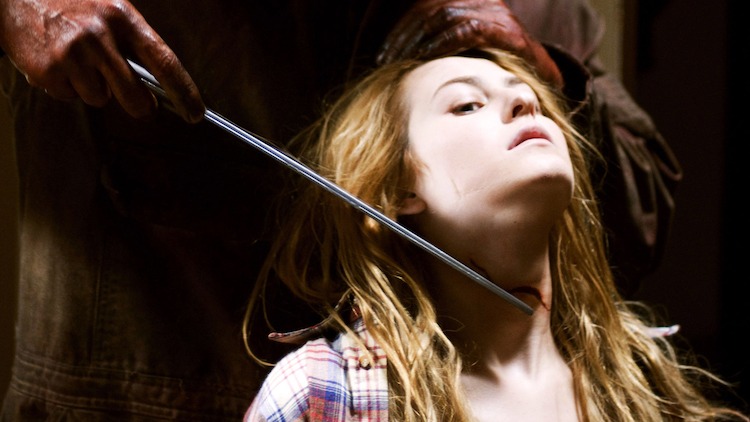
Of course she’s right, but Michael isn’t necessarily after her to kill her. It’s more like his visions are driving him to break her down in the same way that he was broken down, to destroy her life so completely that she has no choice but to go down the same path as the rest of her doomed family. There’s a real sadness to some of the killing in this movie, in contrast to the meaningless kills of most slasher films. After surviving the first movie, Annie dies here while cradled in Laurie’s arms, in a scene so poignant and heartbreaking (and beautifully acted by Harris and Taylor-Compton) that it counteracts any potential thrills from Michael’s attack.
Whether or not Zombie had plans for a third movie, his Halloween II brings the tragic story of the Myers family to a fitting, bleak end. While Carpenter depicted Michael as an unstoppable force of nature, and some of the later Halloween sequels made him into a cartoonish supernatural entity, Zombie’s vision of Michael has him as a product of a toxic culture, the carrier of a poisoned heritage, one that he passes on to his sister, even if she’s not aware of it. That may not have pushed the nostalgia buttons that fans and producers were expecting out of a remake, but it made an artistic statement that was more profound and more lasting.