For most viewers, cult director John Waters’ movies are synonymous with transvestism, “bad taste” humor, and toxic American kitsch. But the Baltimore auteur has explored various political, sociological, and psychological themes in his movies over the course of his half-century career (his first feature, Mondo Trasho, was released in 1969). Perhaps the most intriguing motif in Waters’ filmography is his singular, unmistakable take on female sexuality.
American comedies tend to focus on the carnal desires of men, but Waters’ movies are consistently populated by sexually assertive female characters. Along the way, a distinctive archetype has recurred in nearly every Waters film: the boy-crazy, hormone-driven young woman, often with horrified parents who attempt unsuccessfully to keep their daughter under wraps. Many of these characters even have a similar look, sporting bleached blond hair and fire engine red lipstick.
This motif developed directly from events in the director’s own early life. Born into a well-to-do Baltimore family in 1946, Waters always chafed at the stuffy formality of his social standing and yearned instead for scandal, sleaze, and debauchery. As he explains in his commentary tracks for Polyester (1981) and Cry-Baby (1992), his unflattering jokes about country clubs, debutante balls, and charm schools represent everything he wanted to escape as a child. His partner in mischief was Mary Vivian “Bonnie” Pearce, a peer whose family life was equally stodgy. As John and Bonnie reached adolescence in the 1960s, they began to run with a crowd of bohemians, cross-dressers, shoplifters, and pot smokers, including Pat Moran, David Lochary, and the plus-sized cross-dresser Divine. This was the beginning of John’s repertory company, the Dreamlanders, with whom he’d make all his early films in the ’60s and ’70s.
Pearce’s parents disapproved of her friendship with Waters and tried to keep the two apart. But the two were well-versed in trickery and would come up with various schemes to sneak her out of the house, including making phony dates with “straight”-looking boys. As told by Waters in interviews and commentaries, this story bears a striking resemblance to the Rapunzel myth, with Pearce as the damsel locked in a tower. Fairy tales are a touchstone for Waters throughout his career. He often cites Walt Disney as an influence and even includes a lengthy Cinderella fantasy sequence in his debut feature Mondo Trasho (1969). Fairy tales frequently have their young female protagonists in conflict with either jealous older females (evil witches, queens, and stepmothers) or predatory males (the Big Bad Wolf). Waters’ onscreen heroines routinely face both of these threats.

In Mondo Trasho, for instance, an unnamed blonde bombshell (Pearce) travels by bus to Baltimore’s Wyman Park, where she is stalked by a lecherous, wolf-like stranger who lures her into the woods so that he can lick her feet and suck on her toes, thus provoking the aforementioned Cinderella daydream. In her woozy, post-coital state, the blonde staggers out of the woods and is promptly run over by Divine, who in turn has been distracted by an attractive male hitchhiker (Mark Isherwood) she imagines is nude. It is important to note that, although Divine is biologically male, his characters in Waters’ films are meant to be sexually confident women, not drag queens.


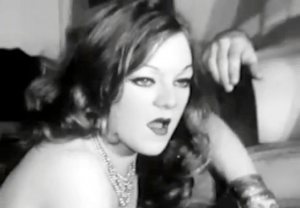

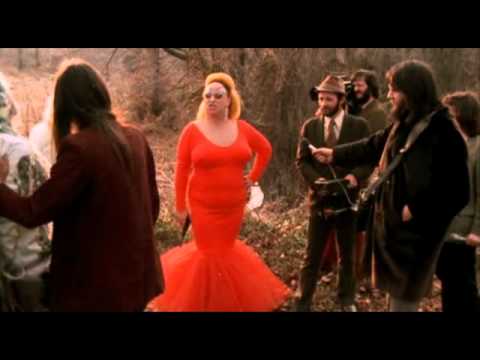
Waters’ next film, his breakthrough Divine vehicle Pink Flamingos (1972), presents yet another twist on female sexual desire in the character of Cotton (Pearce). While not exactly a daughter – she is vaguely described as Divine’s “traveling companion” – Cotton does fit the Waters mold of unabashed young women with strong libidos. What makes this one interesting is that Cotton’s personal kink is voyeurism. Current psychological literature suggests that paraphilia is more common in men than women. Cotton would dispute that, since she enjoys nothing more than watching Divine’s hillbilly son Crackers (Danny Mills) perform acts of bestiality with his various short-term girlfriends. In the 1998 intro to his book Trash Trio, Waters lists Cotton’s outstanding traits: “female horniness, vacant beauty and murderous loyalty.” A planned sequel, Trash Trio, would have had Cotton do her spying from a specially built “voyeur booth.”
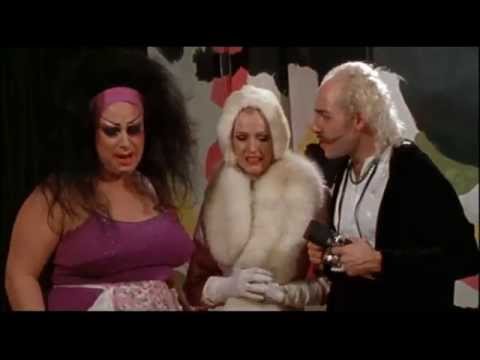
The follow-up film, Female Trouble (1974), returns to the daughter-versus-parents theme of Diane Linkletter. The plot centers around juvenile delinquent Dawn Davenport (Divine). While Dawn attends an all-girls public school, she still manages to shock and offend her parents and teachers on a daily basis. After a huge blowout on Christmas morning – Dawn doesn’t get the “cha cha heels” she requested – the rampaging teenager runs away from home and is immediately picked up by a classic Big Bad Wolf type: loutish Earl Peterson (also Divine, in male clothing). The fairy tale parallels continue here. A deleted scene has Dawn being banished to her room (again!), and in the fight scene, the girl refers to her mother as an “ugly witch.”
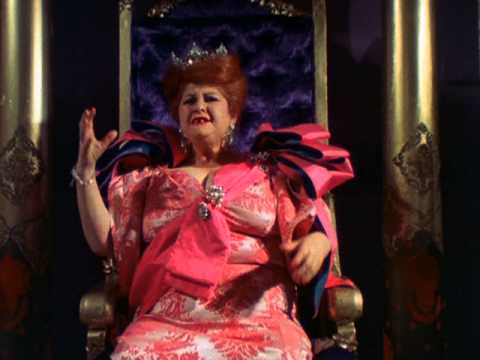
Waters’ last film made directly for the midnight/cult movie circuit was 1977’s Desperate Living, the first of his feature-length projects not to feature Divine. Instead, the film is the director’s own twisted bedtime story. High society murderess Peggy Gravel (Stole) takes refuge, along with her hefty maid Grizelda (Jean Hill), in the mythical kingdom of Mortville, a grotesque shanty town populated by fugitives and bums and presided over by the cruel Queen Carlotta (Edith Massey), who lives in a tacky plywood castle with her leather-clad soldiers/sex slaves.
Desperate Living is rife with references to fairy tales and nursery rhymes – Peggy and Grizelda even meet a pieman in their journey – and contains Waters’ most obvious Rapunzel yet in the form of Princess Coo Coo (Pearce), Carlotta’s rebellious daughter. The queen objects to her daughter’s amorous relationship with a commoner, a “nudist janitor” named Herbert (George Figgs), and tries to keep her locked in her royal bedroom. Unlike Diane Linkletter, Coo Coo finds a better way of escaping from her tower. She shinnies down a rope of sheets to see Herbert. Overcome with lust, the princess tells her paramour: “Oh, Herbert! I masturbated 14 times last night just thinking of you, and when I finally did fall asleep, my dreams were not exactly dry!” (The queen retaliates by having Herbert assassinated and Coo Coo injected with rabies. Touché.)
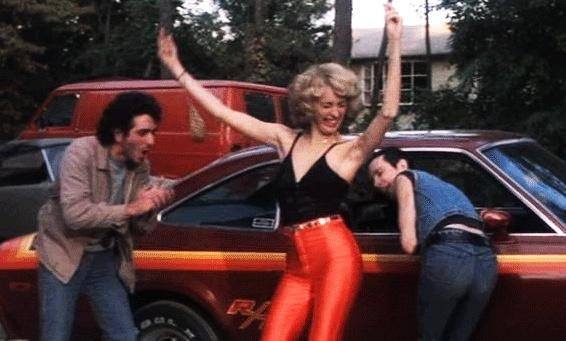

Lulu routinely makes dates with respectable boys just so she can sneak away with leather-clad lowlife Bo-Bo Belsinger (Stiv Bators). As Waters has revealed on the Polyester commentary track, this is a strategy Mary Vivian Pearce actually employed in real life to see him! Francine tries to keep Lulu away from temptation by banishing her to her room. Yet this Rapunzel comes prepared; she has a rope ladder by her bedroom window.

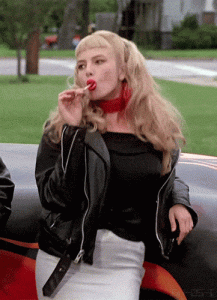

An interesting parallel to Allison is Wanda Woodward (Traci Lords), a female member of Cry-Baby’s crew. Her ultra-square parents (David Nelson and Patricia Hearst) actually try to ship her off to Sweden after she has a run-in with the local law. She responds by leaving home, a la Dawn Davenport, and is predictably set upon by another Big Bad Wolf, sleazy pornographer Toe-Joe (Alan Wendl). She unwisely accepts a ride in his hot pink 1952 Kaiser Manhattan but fortunately does not fall permanently into his clutches. (Dawn is impregnated by her Big Bad Wolf, with disastrous consequences.) Cry-Baby is again full of fairy tale and nursery rhyme references; there’s even a pivotal sequence set at a theme park called the Enchanted Forest.
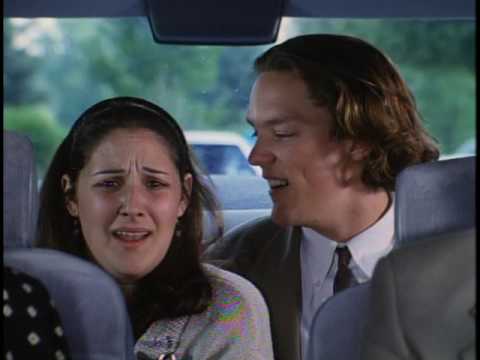

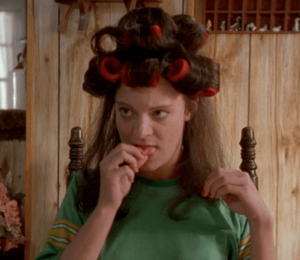

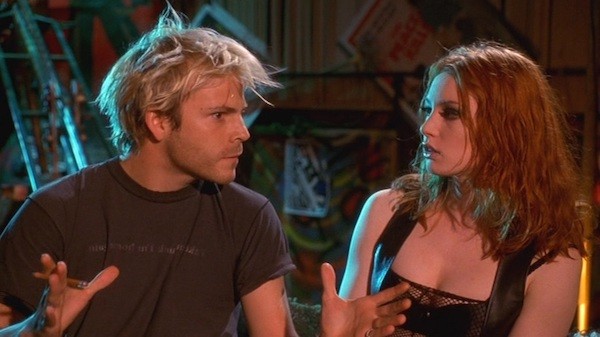



But then, Sylvia receives a blow to the head, instantly becomes a nymphomaniac, and joins up with a group of sex addicts led by the mysterious Ray-Ray (Johnny Knoxville). This, too, has a fairy tale element to it, as the head injury is analogous to the kiss that awakens Snow White, while Ray-Ray’s “apostles” are similar to the Seven Dwarfs, in that each person is defined by a particular trait. (Alan Wendl, for instance, portrays an adult baby.) A small-scale war breaks out between the sex addicts and the sex-hating “neuters,” led by the prudish Marge (Stole). Ultimately, Sylvia and Caprice learn to embrace their sexual addictions and become closer than ever before. A Dirty Shame is an often ugly, ungainly film with slapstick violence and childish humor, but it serves as a fine valedictory address by John Waters. This one movie, goofy as it is, synthesizes themes that the director had been exploring since at least the late 1960s. It shows that the Waters canon is, above all else, a sexual call to arms, especially for women.