This year’s Fantastic Fest was packed with surprises, sexual deviancy, revenge, and sorrow, and that was just on Twitter. The movies were likewise full of intrigue — it was a good lineup, everything else aside (“How was the film festival, Mrs. Lincoln?”) — but the 13th edition of the Alamo Drafthouse’s celebration of genre cinema was overshadowed by behind-the-scenes turmoil that got to the very heart of what Fantastic Fest is all about. It turned a week of decapitations, Scottish zombies, and medieval forest witches into a week of those things plus reflection and self-examination. Who knew the most unsettling encounter we’d have at Fantastic Fest would be with our own feelings?
Unfamiliar with the controversy? Let me break it down for you one (1) time.
An Orange Menace
It began Oct. 7, 2016, when a recording emerged confirming that a syphilitic slumlord named Donald Trump had a fondness for grabbing unsuspecting women by their genitals. (Public reaction was swift: he was elected president.) Among the people in the film community and decent society in general who tweeted disgust at Trump’s proclamation was Devin Faraci, known then as editor of the Drafthouse-owned website Birth.Movies.Death, an outspoken proponent of social justice, and something of a butthole.

Now, this article will include some opinions, but that’s an objective fact. I never had any beef with Devin personally, and I enjoyed chatting when we’d run into each other at film festivals, but I couldn’t stand to follow him on Twitter because of his constant bickering with and harassment of others, even when the objects of his scorn (GamerGaters, Men’s Rights Activists, and other trolls) started out deserving it. Anyway, Faraci’s tweet (“The most telling thing about the Trump tape? He wasn’t talking with his best friends. He was boasting to a TV host”) prompted one from a woman he’d known in 2004, before his Drafthouse employment: “quick question: do you remember grabbing me by the p**** and bragging to our friends about it, telling them to smell your fingers?” Faraci’s reply, and the last thing he tweeted: “I do not remember this. I can only believe you and beg forgiveness for having been so vile.”

Faraci quickly resigned from Birth.Movies.Death and fell out of the public view. There was no official statement from Drafthouse founder and CEO Tim League, but Faraci’s accuser tweeted that she’d spoken to League, “who was extremely supportive,” and that “it sounds like [Faraci] is genuinely interested in getting help.” League, like Faraci, was known to support progressive causes, but unlike Faraci, League had a reputation for being a good guy. (My reaction to the Faraci revelations mirrored that of many others in our industry: I knew he could be a jerk, but I didn’t know he was that kind of jerk. I’m trying to be more aware of the warning signs now.)
Fast-forward to a few weeks ago. When the program guide for this year’s Fantastic Fest went online, several of the 300-word capsules of hyperbolic praise that accompany each film were credited to one Devin Faraci. A mild uproar commenced. League posted a Facebook message saying that “once it became clear that his efforts [to address his addictions and better himself] were sincere, I offered Devin copywriting work at Alamo Drafthouse and have recently expanded that to include writing blurbs for our Fantastic Fest program guide.” Faraci had quit drinking, been to rehab, and was working on being a better person. Second chances and all that, you know?

But then it came out that the gap between Faraci’s resignation and his return had been no more than a handful of weeks. Backlash was swift, both from women and their allies and from people who despised Faraci anyway and had been glad to have a specific misdeed to hang him for. (Many people seemed to believe in their hearts that Faraci had resigned not for sexual assault but out of remorse for being Devin Faraci.) League quickly discovered that re-associating this person with the Drafthouse, even in a minor capacity (Faraci had no authority or leadership), was an unpopular idea, especially so soon after his dismissal, and especially on the down-low. It looked like League was giving a longtime friend and employee a pass on sexual assault. A day after his first Facebook statement, League posted another one cutting all ties with Faraci, for realsies this time.
But then it came out that another woman had emailed League last October with details of Faraci’s harassment of her — verbal, not physical — and that League had downplayed it. (“Thanks for sharing your story and I’m sorry to hear about this experience. I’ve been talking to Devin lately and he is going through some very serious soul-searching right now. I hope that he does emerge from this as a better person. I’d appreciate it if you kept this dialogue between us.”)
The same day that this came out, Todd Brown, a crucial Fantastic Fest programmer and a producer whose name often appears in the credits of Fantastic Fest movies, cut ties with the festival. His statement left the impression that he had other long-simmering issues with League and/or the festival and that the clandestine return of Faraci had been the last straw. “Anyone who has ever suggested that Fantastic Fest and the Drafthouse is just the geek friendly equivalent of the classic Old Boys Club, you have just been proven correct,” he wrote. (Todd Brown also founded Twitch, now called ScreenAnarchy, which I wrote for in 2012-13.)

League wrote a third Facebook apology in as many days (“I’ve realized that decisions I have made over these past months have been problematic. I am concerned about what these choices may say about me and the values of this company…. I’m humbled and deeply sorry”), though he still didn’t clarify when, exactly, Faraci had come back, nor did he address the other woman whose email he brushed off.
A Different Orange Menace
That’s where things stood on Sept. 21, when 1,800 genre fans descended on the Drafthouse’s flagship location in south Austin for Fantastic Fest. The mood was optimistic but subdued, with lots of “Will this be weird? What’s going to happen?” conversations. Many of us who had seen League’s fairness and decency firsthand wanted to give him the benefit of the doubt, but we felt increasingly disappointed in him as more facts came to light.

And then there’s Harry Knowles — founder of Ain’t It Cool News; the original Internet fanboy; enemy to women and the English language. Knowles’ breathless, hypersexual, poorly spelled, giant-fonted movie reviews and gossip had made him the godfather of online geekery at a time (1996) when the Internet was new. AICN launched several good writers’ careers (including Drew “Moriarty” McWeeny, C. Robert “Massawyrm” Cargill, and Eric “Quint” Vespe), but Knowles’ unprofessionalism and general shadiness also set the movement back. Even into the 2000s, studios were wary of Internet critics, thinking we were all spoiler-revealing muckrakers like Knowles. It’s like he built the S.S. Online Film Critic and then instead of becoming her captain became a floppy barnacle clinging to her underside and embarrassing the passengers.
Knowles, an Austin resident, had risen to prominence alongside the Alamo Drafthouse. In 1999, he launched Butt-Numb-A-Thon, a 24-hour movie marathon held in conjunction with his birthday each December at the Drafthouse. He co-founded Fantastic Fest in 2005, though if he ever had a prominent leadership role, it was gone by the time I started attending, in 2010. Ain’t It Cool News was a Fantastic Fest media sponsor, which is basically an exchange of free publicity. By all accounts it’s been several years since Knowles and League were anything more than business partners … but as we’ll see, that was enough to hurt them both.
A few hours before the festival started, IndieWire ran a story in which Knowles claimed to have pulled his “sponsorship” and would not be attending. Those of us who’d heard allegations of Knowles’ creepy conduct toward women over the years wondered if this was perhaps preemptive. Knowles seemed to confirm as much to IndieWire: “He added that his decision was partly motivated by accusations about his own activity. ‘There was a rumor about me and an ex-girlfriend that felt ugly,’ he said. ‘They’re a complete fabrication and lie.'” Fantastic Fest began while we waited for those other gross, gravy-stained shoes to drop.
Opening Night
The fest usually kicks off with a raucous welcome from Tim League, often in costume. League isn’t as involved in programming as he used to be, but he remains the face of the festival, the Chuck Barris-like master of ceremonies who cheerfully, beerfully, presides over the mayhem. But this year, Tim League was not there.
It was soon clear that this was the right choice. The situation has escalated beyond the point where he could start with a mea culpa and then have a regular festival. If he’d been there, there’d have been photos of him having fun, drinking beer — doing Fantastic Fest things — and the narrative would have been, “Look at this guy, acting like nothing happened.”

The duty of welcoming us to Fantastic Fest instead fell to executive director Kristen Bell (not that one), who’s been with the festival since the beginning and was a Drafthouse employee before that. Several people told me she’s the real driving force behind the day-to-day operations of Fantastic Fest, beloved by her teammates, and that she simply doesn’t enjoy the spotlight. She seemed uncomfortable but sincere as she addressed the crowd:
Recent events have put us all in a state of reflection on who we are, the values we hold, and most certainly how we’re perceived in the public eye. And we, the festival, we focus on change, and how we can be better, and how we can learn from the journeys we’ve been on, and how we can hold ourselves to our most highest standard. And I have had so many incredible conversations this week to that end, and I look forward to continuing to have those conversations throughout the week. So please don’t hesitate to approach me with ideas. We always welcome feedback, we always welcome criticisms. We want to be better, always.
“We are also a giant family, and we bind ourselves at the hips. And throughout the 13 years I’ve been a part of this festival, I have met so many amazing people from all over the world that have only expanded that family, and I really look forward to meeting more people every day this week and continuing to grow that family as big as we can get it. So if you see me, I am never too busy for you. Come say hi, let’s have a drink, let’s have a talk, and I look forward to it. So let’s watch some great movies, let’s have some great conversations, and let’s have a hell of a good time. Thank you all for being here.
Tim, Dicks, and Harry
Opening night went smoothly, with screenings of a dozen films and a pajama party complete with pillow fight, just like Cannes. If you weren’t there, it looked, except for League’s absence, like business as usual. But it wasn’t. Between watching movies and catching up with friends, our idle moments were filled with sober-minded (if not actually sober) conversations about the Troubles. What would happen next? What should happen next? Did League’s actions reflect Fantastic Fest culture? If so, what did we need to do to change it? How did women, in particular, feel about the festival now that its figurehead had proven to be a weaker ally than they’d thought?
A group of female and non-binary press and industry attendees had gathered the day before to discuss that very thing, in an unofficial, off-the-record forum that Suki-Rose Simakis described as “immensely empowering, positive, and, most importantly, productive.”
“It drove home for me that taking this conversation out of the online space and into face-to-face environments is an incredibly powerful communication tool,” Simakis wrote at IndieWire. “It confirmed for me that the only way these conversations were going to happen was if we showed up and had them. Setting this meet up directly before the festival began meant that no woman had to walk in alone; all of us knew who we could turn to if we felt uncomfortable. It was awesome.”

It was on the third day, Sept. 23, that the first direct allegation against Harry Knowles came out, again reported by IndieWire. (Poor Kate Erbland spent the week covering the “sexual harassment by movie bloggers” beat.) The accuser, Jasmine Baker, said Knowles “groped [her], opportunistically, on more than one occasion” in 1999-2000. She was friendly at the time with League and his wife, Karrie (who co-founded the Drafthouse with her husband and was actively involved until 2011, when their twin girls were born), and told them about it shortly after it happened. They “thought it was horrifying, but also didn’t know what to do.”
“Their suggestion was, ‘Just avoid him,’” said Baker, who later worked for the Drafthouse. “Today they might make a different choice about how to handle someone they did business with. But at that time, they were trying to bring inclusiveness to everyone and also didn’t want to confront a business partner.”
Two nights later, former Drafthouse employee Jill Lewis posted a Facebook message describing how the Leagues had failed to ban a regular patron who consistently harassed her and other women, a guy so notorious that many Drafthouse devotees knew who it was just by her description of him. (He’s still around. I saw him in the Drafthouse hallway a few minutes after reading Lewis’ post. The Leagues were sympathetic because he was devoted to the Drafthouse and because much of his erratic behavior was attributable to a brain injury.) Lewis also said a male co-worker had thrown a chair in a fit of anger and had been moved to another Drafthouse location rather than fired. She said she didn’t even bother telling the Leagues about Knowles’ actions during Fantastic Fest several years ago — “[he] grabbed my arm, asked me to come closer, and then told me he was on mushrooms, and that he and his wife had been talking about wanting to see me naked” — because she figured it “would be swept under the rug.”
There was another story in IndieWire the next day, this time featuring accounts from three women who said Knowles had harassed or assaulted them. Three Ain’t It Cool News writers quit in protest, and Knowles was booted from the Austin Film Critics Association. Still categorically denying everything, Knowles tweeted that he would “step away” from AICN, and that his sister would take his place. (It has been observed that the person writing as Knowles’ sister has a style remarkably similar to his. I have no comment on that, but I would love to hear yours.)
Those of us who were disappointed in Tim League were now approaching a destination some of our fellows had already arrived at: anger. Re-hiring Faraci so soon and so secretly was a bad choice, but it had come from a good impulse: he wanted to help his friend. Now there was a pattern emerging where League was letting his employees and patrons feel unsafe because he wanted to avoid confrontations with a business partner or a customer. League knew that Knowles was a creep and kept doing business with him.
League sent an email to Fantastic Fest attendees the same night as Jill Lewis’ Facebook post. Like his other apologies, it seemed good at first but sidestepped all of the specifics except for one: “We have severed all ties with Harry Knowles and he is no longer affiliated with the company in any capacity.”
Outrage from a Distance
Aside from League’s statements, nobody from Fantastic Fest was commenting on any of the controversy. Some in the outside world grew impatient, wanting to know what, exactly, the festival was doing to make things better. Todd Brown, the programmer who quit, wrote: “While insisting that they are having ‘important conversations’ and taking things seriously, Fantastic Fest continues to refuse to say publicly what those conversations actually are and what tangible actions are actually being taken.”
Mind you, this was during the festival. The people who would be making decisions about the future of Fantastic Fest were busy running Fantastic Fest. Anyone who’s ever been involved in a festival (including Todd Brown, I should think) knows it is an all-consuming, 24-hour-a-day job just to keep things functioning. To ask the programmers and staff to come up with solutions NOW was like asking a flight crew to check the engine while the plane’s in the air.
The problem was the timing, of course. If the Faraci and Knowles information had come to light six months ago, the conversations would have been had by now. But everything popped up immediately before the festival started, making the festival feel “too soon” for itself. Some of the events that normally wouldn’t have raised any eyebrows (at least not more than they’re meant to) suddenly felt inappropriate. It’s like when there’s a terrorist attack, and then the upcoming movies about terrorist attacks get rescheduled. It’s not that we shouldn’t have movies about terrorist attacks; we just don’t want to see them today.
At the same time, there were people not in attendance who persisted in second-guessing everything from a distance, often misunderstanding the facts. A prime example is the incident of the AGFA secret screening.
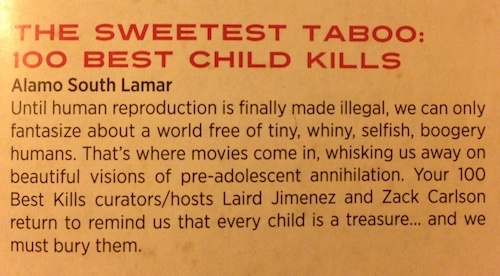
AGFA is the American Genre Film Archive, dedicated to preserving the kinds of movies that would have played at Fantastic Fest if it had existed back in the day. On the Sunday of the festival, AGFA and Something Weird presented a screening of a long-lost exploitation film, the title of which had been kept secret. Here’s how the Fantastic Fest program described it (emphasis added):
After years of detective work, AGFA located and purchased the only existing film elements for one of the most sought-after ‘lost’ holy grails in the history of exploitation cinema. We’d love to tell you the name of the movie. And also the name of the person who wrote, directed and stars in it. But that wouldn’t be fun. Trust us when we say that this movie was meant to be seen in a theater filled with gutter-dwelling perverts who demand nothing less than 1001% F-U-N.
It turned out to be a 1970 Ed Wood film called Take It Out in Trade, a “nudie cutie” in which Wood appears in full drag and which the AV Club’s Katie Rife said “takes a nonchalant attitude towards sexuality of all orientations.” It’s an exploitation flick typical of its era, full of nudity, simulated sex, and pervy behavior. It includes a scene where a woman gets slapped around. AGFA’s Joe Ziemba introduced the film and gave its background before it unspooled.
In the Q&A afterward, a male audience member asked what was being done to make Fantastic Fest a safer place for women. Ziemba, who doesn’t represent Fantastic Fest, said he would discuss it with the man privately. The man persisted, asking why they were willing to show a film like this if they wouldn’t talk about it (a fair question). AGFA’s Lisa Petrucci, an exploitation expert, stepped in and talked about this particular movie’s value (and issued a longer statement later) though she, too, was in no position to speak for Fantastic Fest generally.
And then the whole thing got purple-monkey-dishwashered. Soon after the screening, Brown posted a Facebook message based on what was, at best, secondhand information:

This was picked up by someone on Twitter who summarized it thus:

— you know, like they’d lured people in with promise of a Disney cartoon, locked the doors, and then shown A Serbian Film.
The program had described it as an “exploitation” film for “gutter-dwelling perverts.” Once people were there, Ziemba told them in detail what sort of movie it was. The four people I spoke to who were at the screening said the violence was limited to the slapping scene, and that the sex, while abundant, was simulated, consensual, and didn’t show penetration. Plenty of female audience members had positive things to say about it. By the descriptions from viewers, I would estimate 95% of Fantastic Fest movies are more violent, and 10% are more pornographic.
The mistake the festival made was in not having someone on hand who could speak for Fantastic Fest. Hindsight is 20/20 and all, but the people in charge ought to have known that these issues might come up in the Q&A for this particular movie.
But was it a mistake to show the movie altogether? Only out of context. It’s the sort of thing Fantastic Fest does. Now, it’s worth asking ourselves now and then why we do the things we do and whether we should keep doing them. Sometimes external factors make a person lose their taste for this or that type of entertainment — a death in the family puts you off morbid comedies for a while; a mass shooting makes you sick of movies that glorify guns. But to suggest that Fantastic Fest should stop being Fantastic Fest because one co-founder kept doing business with the co-founder who groped women is an overreach. If you don’t have the stomach for a sleazy exploitation movie, don’t go to the screening of the sleazy exploitation movie. And if Fantastic Fest isn’t your thing, by all means, don’t go to Fantastic Fest. But don’t not go and and then try to tell those who do go what type of entertainment they ought to enjoy while they’re there.
The Female Perspective
You talk to a lot of strangers at film festivals. Because of the law of averages, some of the strangers I talked to were women. If the subject came up, I would ask how they felt about everything that was going on. (To be clear, I wasn’t barging up to women and interrogating them. We were chatting and the subject arose. Get off my back.)
Almost every woman I talked to had an incident to report from years past — a handsy filmmaker, a pushy blogger, a drunk actor. None blamed Fantastic Fest per se; these were the problems you have any time large groups of people gather and are encouraged to party. The fact that men outnumber women at these events is undoubtedly a contributing factor — but again, that’s a problem at most geek-oriented activities, not just Fantastic Fest.
Of course, I was only talking to women who were there. So I asked one longtime attendee if she knew of women who’d had bad experiences at Fantastic Fest and hadn’t come back because of them. She emphatically answered “Yes” before I could finish asking the question. But when I asked if those women blamed Fantastic Fest or the Drafthouse, she was just as adamant in saying no. It’s a societal thing. For the most part, she said, the things that Fantastic Fest can do to improve are the things everyone can do to improve.
And what are those things? Well, not shielding sexual predators from consequences would be one of them. This probably does not need to be spelled out.
They could maybe show fewer rape movies, too. There aren’t as many as there were the first few years I went (Fantastic Festers complained), but it still pops up regularly, usually as a cheap plot point and rarely handled with the gravity it deserves. I’m embarrassed to admit that until this week, it never occurred to me to wonder how this trend affected female fans, even though it’s obvious they would react differently from me.
Then again, it’s all about context, isn’t it? One of this year’s most praised Fantastic Fest movies — especially among women — was the female-directed Revenge, in which a woman hunts down her rapist and his cohorts. This is nothing new (we’ve seen rape victims punish their attackers before), but the context gave it extra power. It may not be a great rape-revenge movie, but it’s the rape-revenge movie Fantastic Fest needed.
The Future
Tim League is the founder and face of Fantastic Fest, but he’s not the soul. The soul is the programmers who choose the movies, the filmmakers who bring the movies, and the fans who watch the movies. League’s exuberant presence was missed, but the festival went just fine without him.
League still needs to give a full accounting for the specific public accusations, I think, in order to give a full apology. He seems sincere in wanting to learn from this and correct his thinking. (The same goes for Devin Faraci, for that matter, not to put League’s offenses in the same league as his). If he makes a detailed apology, puts more women on the Fantastic Fest programming team, and lies low for a couple years while the festival runs without him, I think he can regain public trust. In the meantime, I’m looking forward to Fantastic Fest 2.0 next year. The festival is 13, so it’s no wonder its voice is changing.
Eric D. Snider lives in Portland, is fantastic.