It’s too bad that the new Bruce Springsteen biopic, Springsteen: Deliver Me from Nowhere, is coming out to tepid (at best) reviews, given that the album it revolves around—the Boss’s 1982 masterpiece, Nebraska—is already deeply connected to American cinema, perhaps more so than any other album in the annals of rock n’ roll.
As charted in the new film—director Scott Cooper’s adaptation of Warren Zane’s 2023 book of the same name—Springsteen (played by Jeremy Allen White) finds himself at a personal and artistic crossroads, leading to a musical reinvention at the height of his fame. In place of the bombastic sounds of Springsteen and his E-Street Band’s albums up to that point, Nebraska was stripped to the bone, both musically (it was infamously recorded on 4-track tape in his bedroom, although a mythical electric version of the album is getting its own long-awaited release this fall) and thematically. A born storyteller, Springsteen’s lyrics always stood out from the glut of Dylan wannabes (helped greatly by the fact that, per his own words, he could shred on guitar) for their originality, but the portraits of hardscrabble strivers and dreamers, set mostly in and around his home state of New Jersey, operated on the emotional logic of pop music more than the narrative thrust of literature and film.
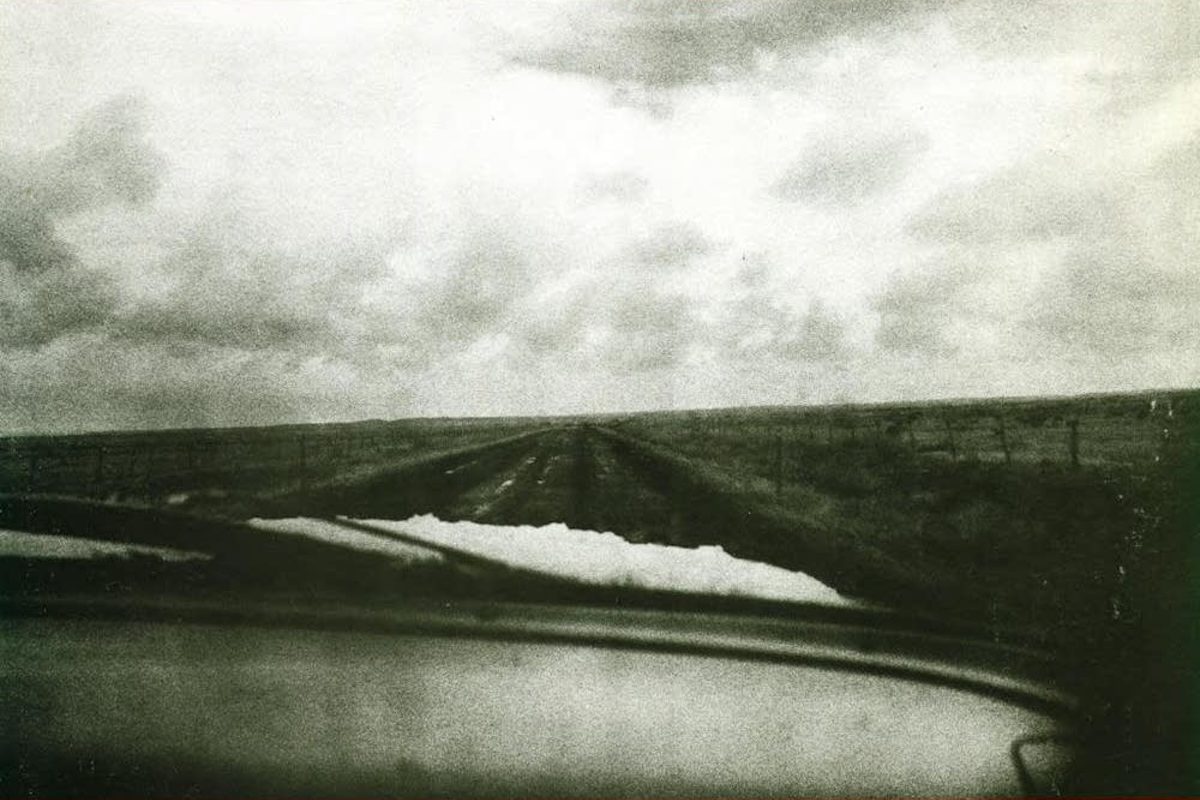
That changed with Nebraska. Alongside American folk and roots music, Springsteen dove headlong into literature of the Southern and Midwest Gothic variety, as well a number of movies within this tradition. The spare, spooky tone of the music was complimented by stories of crime and punishment set along the haunted highways and byways that crisscross the scarred badlands at the—to borrow a title from the writer William Gass, whose fiction covers much of the same terrain (literally and figuratively)—heart of the heart of the country.
Fittingly, the album’s opening title track is a retelling of Terence Malick’s 1973 crime drama Badlands, itself based on the story of Charles Starkweather, a 19-year-old spree killer who murdered 11 people in 1958 (he was accompanied by his 14-year-old girlfriend Carol Anne Fugate, although her complicity in the crimes remains a matter of contention to this day). Despite the song’s true-life origins, Springsteen is clearly working off the impact of Malick’s dreamy thriller (which he caught on television one night), with the first lines of the song lifting the imagery of the first scene in the film:
“I saw her standin’ on her front lawn just a twirlin’ her baton,
Me and her went for a ride, sir … and 10 innocent people died”
Included in the lyrics are references to the fiction of Flannery O’Connor, one of (if not the most) prominent and influential writers in the canon of Southern Gothic. Her harsh, brutal stories, set mostly in her home state of Georgia, chart individuals’ harrowing and usually violent collision with divine grace. O’Connor was a fierce Catholic, something Springsteen related to, as he himself was raised in the church. As he’s said on multiple occasions, “Once you’re Catholic, there is no getting out,” a fatalistic outlook that is simpatico with O’Connor’s. Alongside her short stories, Springsteen was also deeply influenced by John Huston’s adaptation of O’Connor’s first novel, Wise Blood, about an anti-social loner (Brad Douriff), who moves to the big city and starts preaching the gospel of Christ Without Christ.

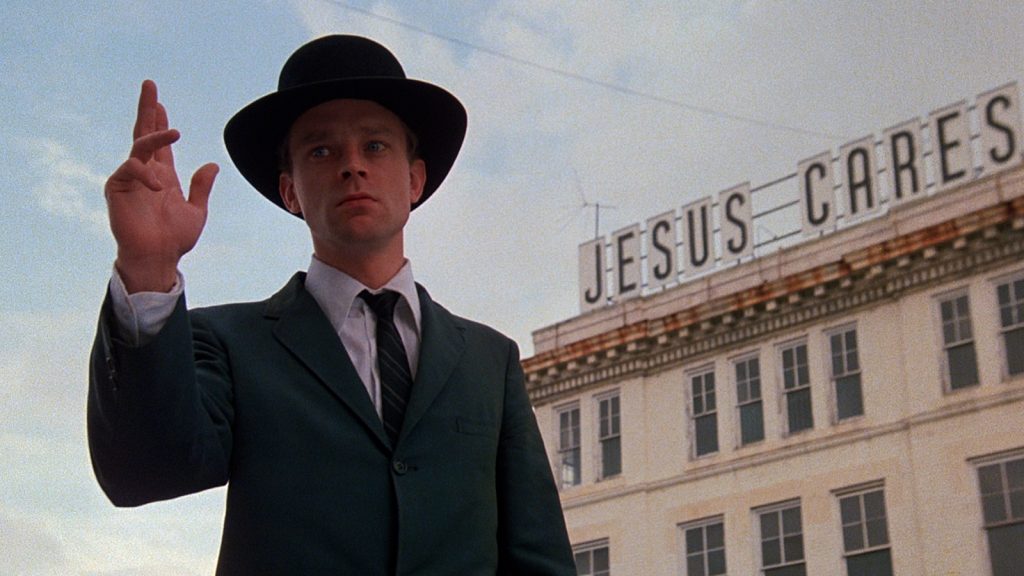
While there is no song on Nebraska that summarizes the story of Wise Blood in the same way that “Nebraska” does with Badlands, its presence can be felt across various songs, including the final two tracks, “My Father’s House” and “Reason to Believe.” The former sees the narrator traveling through a dark wood to his childhood home, only to find his father has passed away;the latter contains heavy religious imagery, including a preacher baptizing men, women, and children in a lake.
Springsteen has also spoken of how two other film adaptations of novels—John Ford’s 1940 take on John Steinbeck’s Great Depression odyssey The Grapes of Wrath and Ulu Grossbard’s 1981 adaptation of John Gregory Dunne’s heavily Catholic crime novel True Confessions—also found their way into the album, and again, the imagery in those last two tracks call up both works (although Springsteen would go on to record a far more direct homage to Grapes with his 1995 studio album The Ghost of Tom Joad, named for the main character of that novel/film).
In keeping with the imagery of the Depression, Catholicism, and crime, Springsteen also drew upon his memories of watching the Southern gothic horror-thriller Night of the Hunter with his father as a child (that film looms particularly large over Deliver Me from Nowhere). The sole directorial effort of actor Charles Laughton, scripted by novelist, poet, and critic James Agee (whose descriptions of desperate sharecroppers in his towering 1941 nonfiction book on the Great Depression, Let Now Let Us Praise Famous Men, would fit right in with the portraits drawn up by Springsteen) and adapted from the novel by Davis Grubb, Night of the Hunter sees a pair of young children flee across the dessicated Southern landscape as their evil preacher stepfather (Robert Mitchum) hunts them down. One can understand how seeing this twisted fairy tale at a young age, with a father with whom he shared a heavily contentious relationship, would have such an impact on Springsteen. His recollection of the film’s imagery and ghostly mood in “My Father’s House” makes for the most emotionally devastating part of Nebraska.
Nebraska’s connection to the silver screen does not begin and end with its influences. It, in turn, would go on to inspire a new film 10 years after its initial release. The story behind the Indian Runner is one of pure Hollywood happenstance: at the same time that Springsteen was filtering his existential crises through this new sound, a young actor named Sean Penn was about to see the release of his first feature film, the 1981 military academy drama T.A.P.S. Penn was living with his then-girlfriend (and later fiance) Pamela Springsteen, Bruce’s younger sister and herself an aspiring actor (the two co-starred in Fast Times at Ridgemont High) in an apartment owned by the singer.
After finishing the initial recording of Nebraska, Springsteen sent it to a few people to get their initial reactions, including his sister. During a long night drinking session, she listened to it with Penn. He was blown away, particularly by the fifth track, “Highway Patrolman”, about brothers on opposite sides of the law, titular highway patrolman Joe Roberts and Vietnam vet and small-time criminal Frankie. The song charts their troubled but close relationships over the years, until the fateful night that Frankie murders a man during a barroom brawl and Joe has to chase him across state lines.


Penn thought the story would make for a great movie. Relying on his liquid courage, he rang up Springsteen at two in the morning and asked for permission to direct it himself. Springsteen, annoyed and thinking it was just some dumb, drunken idea, agreed. Penn and Pamela Springsteen would eventually separate, but the future two-time Oscar winner never let go of the dream of bringing “Highway Patrolman” to the screen for his directorial debut. Eventually, he decided to write it himself. He was initially worried that Springsteen would withdraw his original (hardly enthusiastic) agreement, but the Boss stayed true to his word, with the caveat that if he didn’t like the film, he had the choice of taking his name off it.
But Penn turned in a legitimately great familial crime drama, one anchored by a dark and gritty directorial sensibility reminiscent of his director of the previous year’s Colors, Denis Hopper (who would appear in the film), and bolstered by both outstanding lead performances from the ever-underrated David Morse (as Joe), Viggo Mortenson channeling early DeNiro (as Frank) and supporting turns from Sandy Dennis (in what would be her final role) and Charles Bronson.
Because of Penn’s frequently embarrassing public antics, people tend to forget that through the ‘90s into the Aughts, he was one of our more exciting American directors. His trilogy of bleak crime dramas—The Indian Runner, The Crossing Guard, and The Pledge—as well as his adaptation of CharlesJon Krakauer’s Into the Wild, a true account of Christopher McCandle’s doomed nomadic trek, all share an ethos with Springsteen in Nebraska mode: explorations into a hardscrabble and haunted America where redemption and damnation are often indistinguishable.
That idea is a harder sell to multiplex audiences than a by-the-numbers biopic about one of this nations’ most popular and enduring rock stars. But it’s more true to the spirit and spirituality of Springsteen’s art.