Rita Maricone-Dorsch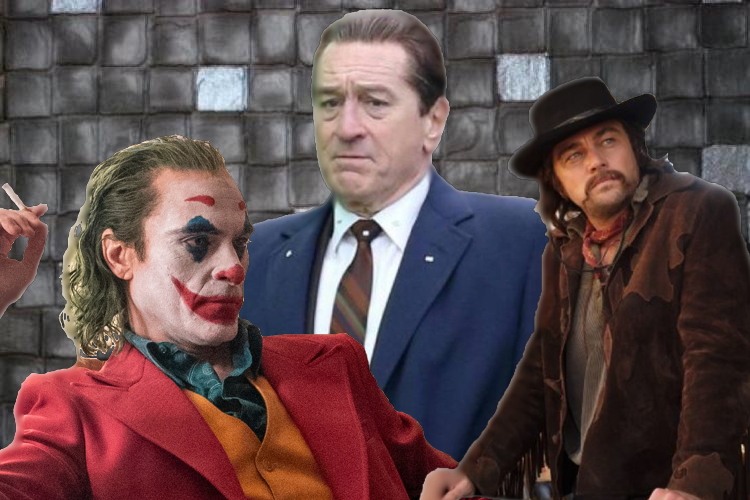
One need only turn on CNN, check Twitter, or look to this year’s Golden Globes nominations to see that the fragility of the male ego is at the front and center of the zeitgeist. That most stories are about men is, problematically, nothing new. What’s new is that their psyches are under the microscope at higher magnification post #metoo and during the tenure of a president who’d rather alter a map with a sharpie than admit to an innocuous mistake. It would be easy to write off such stories as either the last gasps of a culture that’s not long for this woke world, or as evidence of that culture’s unapologetic reemergence. But there’s something more nuanced — and laudable — working itself out on the big screen.
The splashy marquee entries in the fragile male ego sub-genre are Martin Scorsese’s The Irishman and Quentin Tarantino’s Once Upon a Time in Hollywood. Both directors are known for stylized machismo, and both films function on two levels because of it, in that we cannot help but contemplate the evolution of the aging auteur alongside the evolution of his aging protagonist. All four aforementioned men are ostensibly coming to terms with the record of their life’s work.
In The Irishman, Robert DeNiro’s Frank Sheeran commits a bunch of mindless crimes and then maybe feels bad about it. The front half of the movie — all slick and short tempered — is so of another time that it borders on Scorsese fan-fic until everyone’s gumming at bread, and the viewer finds themselves rethinking the point of the whole project. Alone at the end of a long and not very meaningful life, Frank is a man still developmentally stunted in early adulthood.
Conversely, most of Once Upon a Time in Hollywood is marinated in an original and complex flavor of middle-aged white guy ennui, then its too-clever ending lets Leonardo DiCaprio’s Rick Dalton off the emotional hook. The best scene comes near the halfway mark when Dalton cracks open the brittle leading man veneer in the presence of his much more self-possessed grade school costar, to both hilarious and devastating effect.
Even Noah Baumbach’s excellent Marriage Story is mostly about male ego, and the film’s ending is fairly unambiguous in telling us so. At the close, Scarlett Johansson’s Nicole is happy. We’re in her city, in her driveway, with her nice new boyfriend on the periphery as she gets home from a job she enjoys. Adam Driver’s Charlie is the one stranded and left to wonder.
The brilliance of Driver’s performance is that we see the growing dread as he confronts the fact that his version of reality might not be the objective one. The slow reveal works a little better here because Charlie is supposed to be a genius; Frank and Rick were more brawn than brains from the start. But all three are men of stature facing the most existentially terrifying thought: what if I’m bad and wrong?
The swing and miss is Todd Phillip’s Joker. It’s telling that the movie many worried would inspire incels to action will instead be remembered for the wannabe influencers who take dancing selfies on a now-famous set of stairs. There are compelling stories to be told about people who don’t fit neatly into society, but Joker’s thesis seems to be: better awful than pathetic. Which is a shame. Phillips made a good movie about the fragile male ego back in 2009 with The Hangover. It’s by no means a feminist masterpiece, but with its beta-male heavy roster of characters and its baby-carrying antics, The Hangover draws its humor from the ridiculousness of performative masculinity. It laughs with us. Joker sneers at us for laughing.
Awkward laughter is essential to my favorite movie of the year, Taika Watiti’s Jojo Rabbit, a movie that is literally about the fragile psyche of a preteen boy. With a tone that plays like a toy xylophone looped over a cassette of Bach, maybe it’s not for everyone. But Jojo isn’t to Nazis what Green Book was to racism. It’s also less provocative and more instructive, about how to change the mind but retain the self.
If a bunch of Marvel fans leave Jojo Rabbit having subconsciously reckoned with their own fallibility and vulnerability, the world will be better for it. Because, as we see in The Irishman, Hollywood, Marriage Story, and Joker, even if they have that epiphany, they often don’t know what to do with it.
Only Jojo Rabbit provides a clear resolution of the ailment of fragile male ego. The final shot is so satisfying because as the little boy dances in the street, we have hope that he’s been set on an alternate path than the ones taken by Frank, Rick, Charlie, or certainly the Joker. JoJo has learned the vital lesson early: that admitting to one’s mistakes or wrongheaded ideas does not require the sacrifice of one’s identity or power. He was awful and pathetic as he set off for Hitler youth camp; by the end, he is neither. If only so many men on the other side of the screen — and in our seats of power — could absorb that wisdom.
There’s a tragic algebra at work in all but one of these movies, though. For every self-righteous but morally corrupt leading man, there’s a too-hesitant but actually-in-the-right supporting woman. In Marriage Story, Nicole uses the word “gaslighting” to describe her predicament. Margot Robbie’s Sharon Tate has imposter syndrome about her stardom and Stockholm syndrome about her relationship. And a generous interpretation of Anna Paquin’s appearance in The Irishman is that someone needed to realize and reflect on what trash Frank was, since he wasn’t capable of introspection himself.
One of the most successful parts of Jojo is that the girl in the attic (who could have easily been a real wet blanket of a symbol) is a fully developed person…one who owns and displays the full range of her teenage emotions. But still, it’s Jojo’s movie, even as it’s her task to see him through his character arc. At least Frozen 2 — which revolves around our heroines discovering and correcting the sins of a toxic male ancestor — puts the female journey front and center. So, while it’s healthy that we’re addressing the psychological growth of defensive white men, it’d be even better if we championed more stories about women’s experiences — as Elsa puts it — stepping into their power.
Movies win you over for one of two reasons. Either they’re about people who are different than you, plopped into a curious fishbowl. Or they’re about you so much that it hurts. I suspect that how a lot of men will respond to any of these mostly very good, awards-worthy movies depends on whether they see themselves as inside or outside of the fishbowl. But as they say, admitting you have a problem is the first step.