Jeremy Herbert
In a 2016 interview with Deadline on authors and their adaptations, master of dog-eared horror Stephen King was asked to name his least favorite. He did not, despite his legendary animus, cite The Shining. He also didn’t assign the dishonor to the one about the killer laundry press, the one that convinced him never to direct again, or the one he successfully sued his name off of. Instead, King blamed Graveyard Shift: “Just kind of a quick exploitation picture.”
The 1990 film is guilty on both counts – quick and exploitative – but his vitriol may have more to do with the material than mismanagement. Discounting a few novels he was already chipping at, “Graveyard Shift,” an 18-page short first printed in a 1970 issue of Cavalier, remains the earliest Stephen King story adapted to date, written by a very different Stephen King.
After a star-studded first attempt – directed by Tom Savini, rewritten by Clive Barker, produced by Roger Corman – fell apart in the late 1980s, the rights reverted to King, who then shrugged them off to location manager Bill Dunn on the set of Pet Sematary for a measly $2,500: “You pay as you go, as far as I’m concerned.” On its face, the bargain was a favor to Dunn for helping him found the Maine Film Office, but his complete non-involvement, despite requiring they shoot it less than an hour from his house, tells a different story; King was only around to sell the option in the first place because he volunteered himself on constant call for Sematary.
Another serendipitous presence on that set, however, was associate producer Ralph S. Singleton, who cut his production management teeth on five seasons of Cagney & Lacey. For an independent, effects-heavy shoot, Dunn needed a director used to surviving tight schedules, and Singleton wrote the book on it. Paramount agreed to distribute Graveyard Shift as the hot Halloween ticket of 1990 and cameras started rolling on June 14th; from the word “action,” the film was a desperate measure in a desperate time.
Stephen King wrote “Graveyard Shift” during his last semester at the University of Maine’s College of Education, unaware he was halfway between textile jobs. The first helped him save for college during and after his senior year of high school, working from 3:00 p.m. to 11:00 p.m. at a mill eulogized in On Writing as “a dingy fuckhole overhanging the polluted Androscoggin River.” That Fourth of July, the foreman offered time-and-a-half to anyone willing to help clean the ‘hole, including a basement infested with rats “big as dogs.” He missed out on the shift, but earned $200 for imagining what could’ve been. It doubled as a consolation prize; finding no teaching positions after graduation, King worked at an industrial laundry making $1.60 an hour. Another time, another measure.
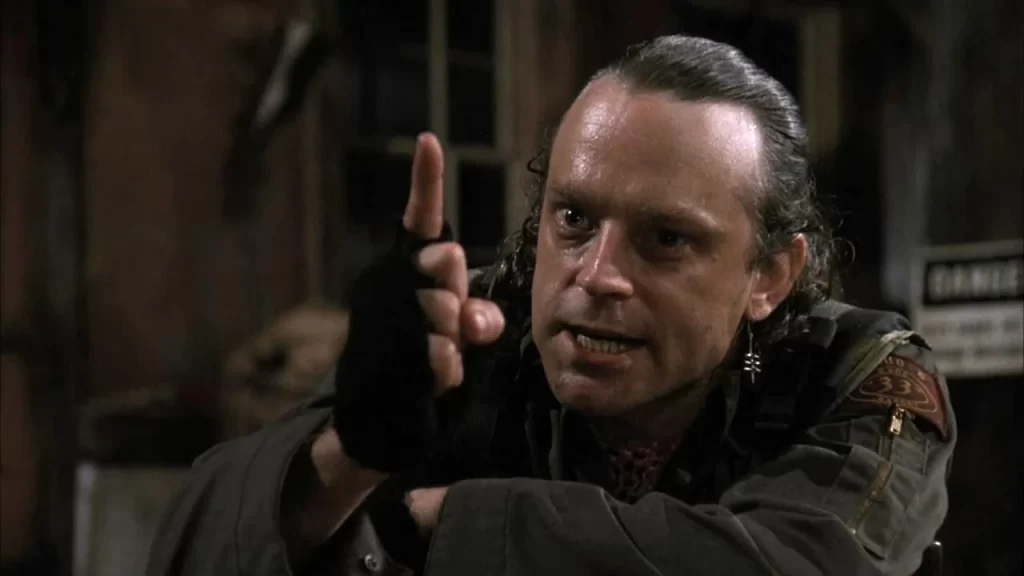
The only concession between Shifts is a thinning of the mutant rat herd since $10.8 million only allowed for one animatronic star – a 20-foot-long, 320-pound bat-thing lovingly nicknamed “Arlene the Cuisinart” by FX designer Gordon Smith. Otherwise, the film preserves most of King’s sparse story, to the fault of not larding enough slimy meat on the bones.
“Drift-ah” John Hall hitches into a sleepy town in rural Maine – not Castle Rock, although it is mentioned – comprised entirely of three locations at the same intersection: the rat-infested Bachman (natch) Textile Mill, its adjoining Gothic cemetery, and a greasy spoon across the street. The film gives him a dead wife and a Save-The-Cat payoff to his accuracy with sling-shot Pepsi cans, but “boy scout” David Andrews gets nuked off the screen before the opening credits are over; never was a death knell so sweet as “And Brad Dourif As The Exterminator.” He is the Quint of rats, down to a USS Indianapolis speech about how his vermicidal tendencies stem from the traitorous Rodentia of Cồn Tiên that betrayed our boys to work with the V-C, although he “ain’t one of them burning-baby, flashback fuck-ups you see Bruce Dern playing.”
Shift never fully recovers when Dourif’s character, the best addition to the short story by a mile, pointlessly clocks out, as if Robert Shaw tripped overboard and drowned before ever seeing a shark. Fortunately, Stephen Macht unhinges his jaw wide enough to swallow the remaining scenery whole as the despicable Foreman Warwick. To compensate for the rest of the cast shrugging off accents, he speaks in Maine, Scottish, and Jamaican drawls simultaneously, inventing a dialect like an alien that learned phonics from a lobster house; in regards to stale coffee: “Cahn’t be moore than an inst’nt enem-ah by now.” He has no redeeming qualities, no wants at all besides at least two mistresses and the blood of any employee who flirts with runners-up. His is the soul of the film, grotesque and unrepentant.
In Danse Macabre, Stephen King broke down his triune hierarchy of genre provocation, citing “the gross-out” as the last act of a desperate author: “I’m not proud.” Just when his adaptations were trending classy again, a month before Misery and the It miniseries, Graveyard Shift delivered a King story without any. Minus credits, it’s 83 minutes of sweat, piss, blood, ooze, and not much else, humble grist for basic cable Halloween marathons; you already missed it in this year’s FearFest. The film does not deserve a six-way tie for worst Stephen King adaptation by Rotten Tomatoes metric or the ire of its originator. In defiance of the ongoing arms race for his tonier material to adapt and adapt again, Graveyard Shift, in both forms, is a shameless geek show of Stephen King’s cheapest and ugliest tricks, from a period when he had to make his audience squirm by any means necessary. That’s still worth its weight in rat shit.
But for now, show’s ovah.
“Graveyard Shift” is streaming on Hoopla and AMC, and is available for digital rental or purchase.