Zach Vasquez
When it comes to modernized remakes of classic films, most fail to replicate the success of the original. This is certainly the case with the 1994 version of The Getaway, directed by Roger Donaldson, which was so poorly received upon release that star Alec Baldwin was still calling it “a bomb” almost 15 years later.
In most cases, the gulf in quality between original and remake is so wide as to leave no question as to why the latter flopped. But with The Getaway, it’s not so simple. If Donaldson’s slick, fast-paced picture lacks the slow-burn tension and gravitas of Peckinpah’s original, it still makes for a rollicking entertainment on its own. Its greatest flaws are evident in the Peckinpah, too, most of which come down to the changes made to the original source material.
Said source material is the 1958 novel of the same name from America’s “Dimestore Dostoevsky” Jim Thompson. The story follows career criminal and recent parolee Doc McCoy and his bombshell wife Carol who, following a successful but bloody bank heist, find themselves on the run to Mexico, fleeing cops, a larger criminal syndicate, and a backstabbing third partner they left for dead.
Thompson, who along with publishing dozens of crime novels also dabbled in screenwriting—most famously penning the scripts for two Stanley Kubrick pictures: The Killing (1956) and Paths of Glory (1957)—had twice been hired to write an adaptation of his own novel, initially for Sam Fuller, and then, in the ‘70s, for Peter Bogdonovich, himself brought on board at the behest of star Steve McQueen.
Thompson’s experience as a screenwriter was a mostly unhappy one, and this project would prove no different. After Bogdonovich was booted from the picture by McQueen, Sam Peckinpah, in desperate need of a hit following a number of flops, took his place, while a young Walter Hill—recommended by Bogdonavich’s wife and creative partner, Polly Platt, and fresh off his critically-acclaimed script for the detective thriller Hickey & Boggs—took over scripting duties. Thompson felt that Hill’s final script used enough material from his versions that he deserved co-writing credit, which he unsuccessfully sought via arbitration through the Writers Guild.
Ultimately, Peckinpah’s film ended up proving the biggest financial success of his career, cementing McQueen’s status as the biggest movie star of the day while also solidifying costar Ali MacGraw’s reputation following her breakthrough in the smash hit Love Story from two years earlier (this despite the fact that MacGraw felt, rightly, that her performance in The Getaway left a lot to be desired). Part of the film’s success was no doubt owed to the behind-the-scenes drama surrounding it: McQueen and MacGraw fell in love on set, leading the actress to ditch her husband, megaproducer Robert Evans, for her co-star.
Cut to 20 years later: Hill, who in the intervening decades had become a two-fisted auteur in the Fuller/Peckinpah mode, as well as a highly successful screenwriter and producer, brought his original Getaway script to Baldwin (with whom he’d attempted to make a feature-length version of the ‘50s television show The Fugitive, before Andrew Davis and Harrison Ford took over that property). Hill, while having enjoyed his experience with Peckinpah and being proud of the film they’d made, nonetheless wanted to see a version that hewed closer to his initial script. He developed an updated remake with the intention of directing it himself, although he ultimately stepped aside with no hard feelings when budgetary issues couldn’t be resolved.
Enter Donaldson, an Australian/New Zealand filmmaker whose 1977 debut, the gritty thriller Sleeping Dogs, helped establish that latter nation’s emergence on the global cinema landscape and led to a long career directing glossy, mid-to-large budget movies for Hollywood, including the ridiculous Tom Cruise bartending drama Cocktail (1988), as well as the highly-underrated Kevin Costner mystery No Way Out (1987). It, like The Getaway, was a remake of an older crime film (1948’s The Big Clock) based on a classic, if mostly forgotten, work of noir fiction.
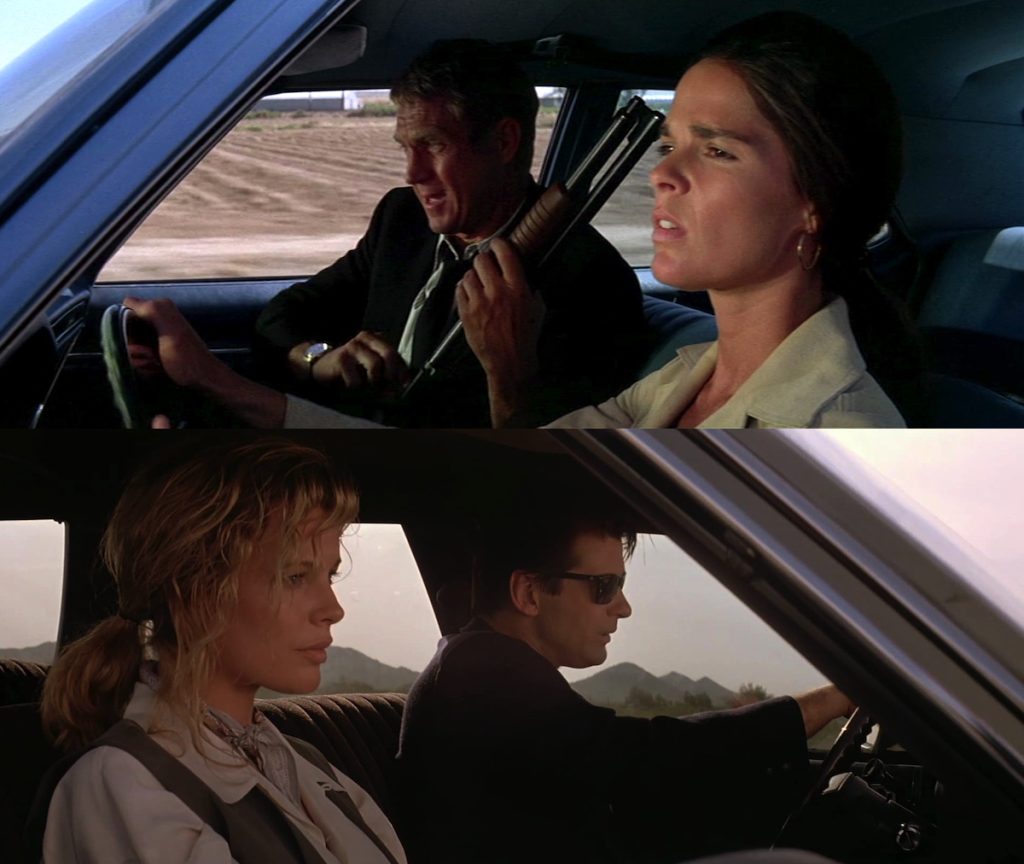
As with the 1972 movie, this iteration of The Getaway would star a real-life couple, with Kim Bassinger, then married to Baldwin, taking on the role of Carol. Initially skeptical of the material, and wishing to flesh her character out more, she had Amy Holden Jones—best known as the writer of Mystic Pizza, but more deservingly recognized as the director of the slyly satirical slasher Slumber Party Massacre—brought in to beef up her part.
Both Baldwin and Bassinger make for a sexy criminal pair, although no one would ever chalk up their performances as amongst their best. Hill has admitted that, in both scripts, he had to sand some of the rougher edges off of the characters, as in Thompson’s skeevy classic they are far more sociopathic and remorseless. By the end of the novel, they’ve each reverted to their most base and depraved forms (more on this later), but the signs are there all along. These are not easy characters to root for, and hardly the type that vain movie stars are keen to play.
But some of the best things about both versions are their supporting casts. The original featured Peckinpah regulars Ben Johnson, Bo Hopkins, and Slim Pickens, as well as Al Lettieri and Sally Struthers. Great as they all are, this is the one area that the remake might have the upper hand. Donaldson put together an incredible ensemble. James Woods makes the most of his small but important role as a mobster whose obsession with Bassinger leads to his downfall. Baby-faced Philip Seymore Hoffman’s turn as a nervous heist man shows early signs of his brilliance. David Morse cuts an imposing figure as the smarmy hitman heavy, Burton Gilliam turns in another in a longline of loveable peckerwood dumbasses, and Richard Fanrsworth, as the duo’s unlikely, last-minute savior, is the perfect person to step into Pickens’s cowboy boots. But if anyone steals the show it’s Michael Madsen, rocking an all-time dirtbag mullet, as the McCoys’ ex-partner looking for payback, and Jennifer Tilly as his sexpot hostage turned more-than-willing accomplice. In fact, the biggest flaw of the ‘94 Getaway is that the viewer really wishes they were watching their movie, instead of Baldwin and Bassinger’s.
If Donaldson is not on the same level of Peckinpah or Hill, he’s still an exceptionally talented journeyman, and with The Getaway, he crafted a relentlessly entertaining, endlessly rewatchable bit of popcorn pulp. His action scenes can’t match the balletic beauty of the original, but they are tight and vicious, and when he does throw in some extra flourishes like slow motion, he acquits himself as a worthy student of Bloody Sam. Meanwhile, he and cinematographer Peter Menzies Jr. bring a sunlit menace to every frame. The ‘90s saw a deluge of daylight-soaked desert neo-noirs—a sub-sub genre later dubbed film soleil—and while The Getaway isn’t as strong as others from around the same time—such as fellow Thompson adaptations The Grifters or After Dark, My Sweet, both from 1990— it’s still a key title in the larger movement.
(Along with these films, the ‘90s also saw the release of three more Thompson adaptations: The Kill-Off, This World, Then the Fireworks, and Hit Me. The prevalence of these pictures, combined with publisher Black Lizard putting a number of his books back into print during the previous decade, led to his posthumous rediscovery and recognition.)
Despite a whole new first act and some new side-plots, the general narrative of Donaldson’s movie doesn’t stray too far from Peckinpah’s. This makes for the greatest disappointment, as both versions do away with the final—and by far most memorable–chapter of the book, in which the McCoys, after managing to successfully evade capture, wind up buying entry into the criminal kingdom of El Ray, Mexico. But what first appears as a safe haven for fugitives turns out to be a Kafka-esque hellscape, a pit of depravity and suffering where its denizens are reduced to the most heinous of human taboos in order to survive. It’s this chapter that establishes the novel as Thompson’s pitch-black masterpiece, and yet, it’s entirely absent from either film version.
Quentin Tarantino’s script for From Dusk Till Dawn references El Ray, and in the commentary track on that film’s DVD, he expresses his disappointment at the filmmakers behind both versions for chickening out of giving us that ending. Tarantino is known for his outre and often laughable opinions about other people’s films, but in this case, he’s not wrong.
It’s understandable that the team behind the initial The Getaway were reluctant to include this ending. They were all looking for a big hit and they got one. That ending probably would have killed its success, as even by the bleak standards of ‘70s cinema its extreme. But the ‘94 version may as well have included it, since it could hardly have done the film any extra harm. Donaldson’s The Getaway bombed at the box office before racking up a couple of Razzie nominations on its way to being mostly forgotten. None of this is deserved—while his film doesn’t match, let alone supplant Peckinpah’s, it’s still a handsomely-made, good-time watch. Obviously, recognition from the submoronic Razzies is not something anyone should care about, but the hate this received from more respectable critics at the time is equally baffling.
Today, 30 years after the second film’s release, The Getaway remains a strange case of two good films with a shared source and a shared pedigree that still, somehow, feels incomplete. Thompson’s novel deserves a truly faithful adaptation. Hopefully, someone, some day is crazy enough to deliver it.
The 1972 version of “The Getaway” is available for digital rental or purchase. The 1994 version is streaming on Peacock, as well as several ad-supported services.