Guy Davis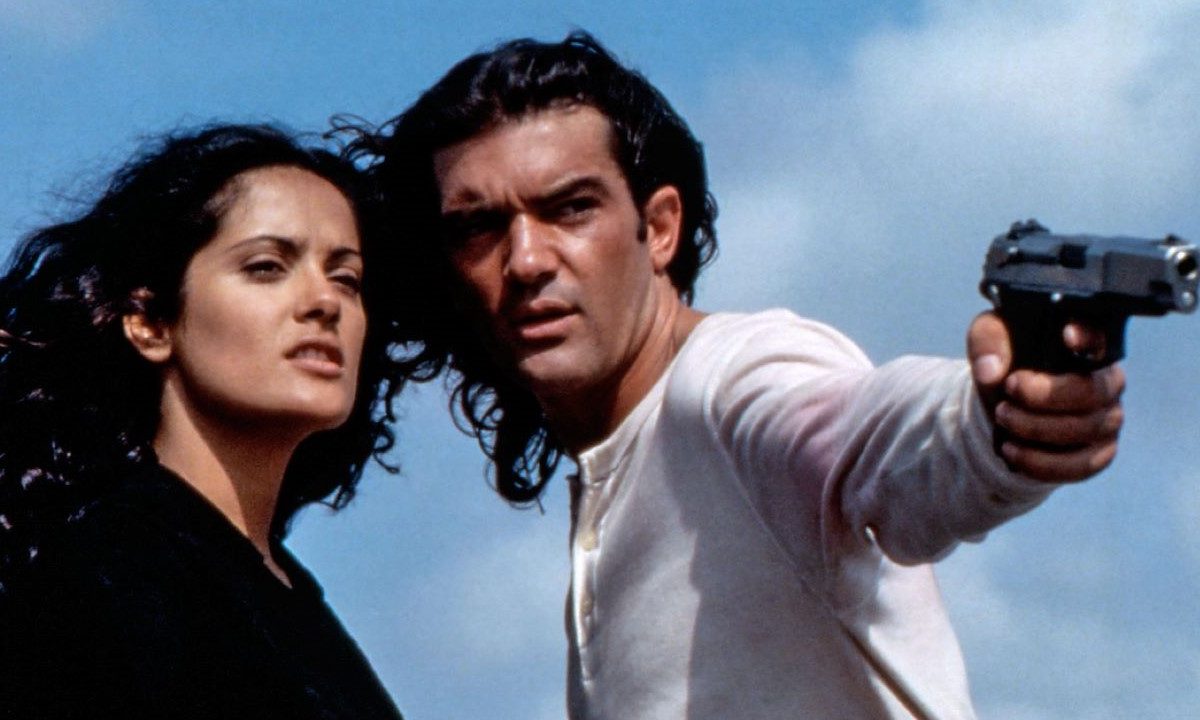
We all love a bold, bracing debut from an artist, right? To borrow a phrase from Tim Robbins’s Bull Durham character ‘Nuke’ LaLoosh, it’s a joy when someone announces their presence with authority. And for moviegoers in the 1990s, it felt as if we were receiving such announcements month after month… almost week after week.
That was exciting, for sure. But what was thrilling was that many of the filmmakers who made great impressions from the jump then made good on the promise they displayed, their follow-up films showing deeper understanding, greater range or – perhaps best of all – heightened ambition.
Despite the clearly evident directorial rigor and flair shown in Alien 3, for instance, David Fincher wasn’t David Fincher until Seven. One could say the same for Wes Anderson following Bottle Rocket with Rushmore, which offered a sharpening, a refinement of his voice and aesthetic.
It’s the opposite of sophomore slump. It’s a blooming, a becoming, a confirmation that this artist is abundant in both talent and brio. And it gives those of us appreciating their art not just a sense of pleasure in the moment but an optimism that there’s more in store. Desperado, Robert Rodriguez’s 1995 quasi-sequel/semi-remake/sorta-expansion of the multi-hyphenate filmmaker’s micro-budgeted 1992 debut feature El Mariachi, sits squarely in this framework.
From a storytelling standpoint, Desperado saw Rodriguez establishing his own cinematic universe in the way contemporaries such as Quentin Tarantino and Kevin Smith were, with callbacks, shoutouts, and Easter eggs connecting their existing works and hinting at further exploration in future projects.
However, it’s in the spectacle sense that Rodriguez’s second movie is a true declaration of intent. If he wanted to make El Mariachi look like a $7 million movie made for $7000 (a portion of which the filmmaker famously scratched together by subjecting himself to experimental medical trials, as he recounts in his book Rebel Without a Crew), with Desperado he’s out to make the $7 million given to him by Columbia Pictures look like $30 million. (By the way, listening to Rodriguez’s audio commentary for Desperado’s home-video release offers a nostalgic charm as he talks about the skyrocketing cost of making a Hollywood action movie in the 1990s, citing $50 million as the new average.)
The filmmaker’s trademark buck-stretching ingenuity in definitely on display on Desperado, and Rodriguez himself has been delightfully frank when it comes to sharing cost-cutting measures like “use the same two stunt guys over and over again,” but the payoff is certainly on the screen. The ramshackle energy of El Mariachi is not so much replaced as augmented by the kind of swagger that a few extra days of shooting schedule and a few more bucks in the kitty will provide.
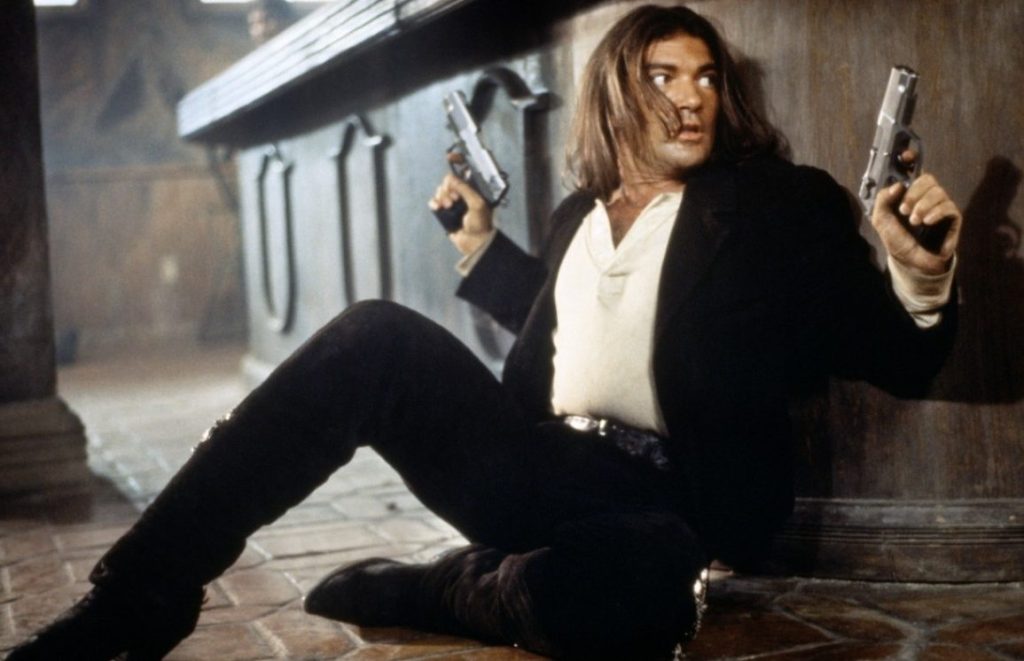
The film is certainly a showcase for Rodriguez’s virtuosity behind the camera and in the editing suite, although he wasn’t yet audacious enough to give himself the ‘shot, chopped and scored’ credit that would be found on later projects like Once Upon a Time in Mexico, the third part of his Mariachi Trilogy.
The grace and gusto of the shootouts and fight scenes evoke the Hong Kong actioners of John Woo, Tsui Hark, and Ringo Lam being mainlined at the time by filmmakers and film fans alike, and Rodriguez imprints them with enough of a sweaty, gritty signature to make Desperado feel like the work of a potential successor, not a slavish acolyte. Astutely, though, Rodriguez takes another lesson from those Hong Kong masterworks – the need to balance the brutality with beauty. And casting two of the most beautiful people to grace movie screens in the last half-century or so is what elevates Desperado to another echelon.
(And no, this is not referring to Quentin Tarantino, deep in his ‘I also act, just so you know’ period here as ‘Pick-up Guy’, who enthusiastically tells an off-color joke before meeting an untimely demise. Having said that, Tarantino is framed and shot by his friend and collaborator in a most flattering fashion, the Pulp Fiction filmmaker looking… well, handsome in a rough-hewn way.)
“The studio didn’t want her,” Rodriguez says on the Desperado commentary as leading lady Salma Hayek saunters down the street. “They wanted a blonde.” Hearing such nonsense as the very presence of Hayek’s curvaceous Carolina literally causes a traffic accident the moment she appears onscreen is enough to make one call for the downfall of the studio system. She’s breathtaking, and the spirit and sly wit with which she imbues the potentially one-note character adds immeasurably to her appeal.
And then there’s the star. Familiar to arthouse patrons from his appearances in Pedro Almodovar films like Matador, Women on the Verge of a Nervous Breakdown and Tie Me Up, Tie Me Down, Antonio Banderas was making Hollywood inroads in the early 1990s thanks to supporting roles in Philadelphia and Interview With the Vampire. The true test of whether an actor can cut it in mainstream motion pictures, however, is how convincing they can be swinging a punch or shooting a gun, and for someone appearing in their first action movie Banderas is not merely convincing but compelling, moving through scenes with barely contained ferocity and balletic grace. But Rodriguez is clever enough to recognize that when his film needs to slow down, take a breath and give the audience a chance to catch its breath, simply letting the camera rest on Banderas’ impossibly handsome face provides the perfect placeholder.
So while Robert Rodriguez may have an amazing knack for composing and choreographing cinematic carnage, and bless him for it, he also realized the most vital filmmaking lesson early on: give your audience every chance to gaze upon the gorgeous.
“Desperado” is available for digital rental or purchase.