Mitch Ringenberg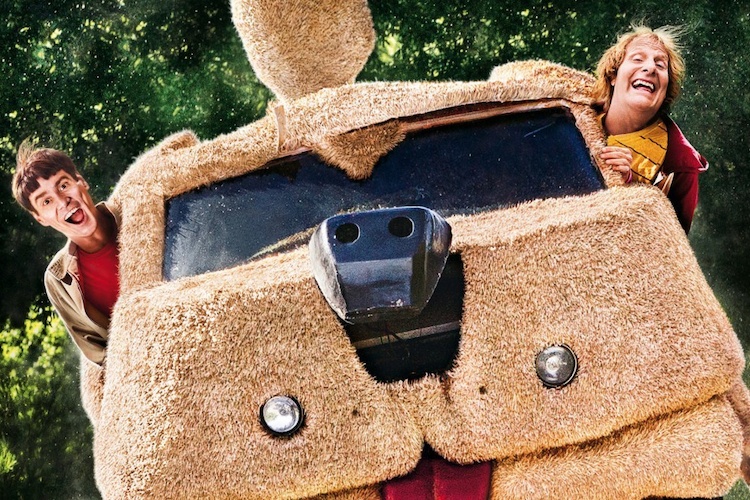
Road trips have long been a fixture of the comedy genre. From the Frank Capra masterwork It Happened One Night (1934) to arthouse fare like Alvin and the Chipmunks: The Road Chip (2015), the formula continues to be an effective way to string together a series of comic set pieces. Perhaps no filmmakers have molded their artistic sensibilities around said formula more than Bobby and Peter Farrelly, whose debut Dumb and Dumber was released 25 years ago and set the template for their loose road trip quadrilogy.
While it could be argued the writer-directors use the road trip motif in nearly all their films — There’s Something About Mary (1998) and the 2007 The Heartbreak Kid remake spring to mind — Dumb and Dumber, Kingpin (1996), Me, Myself & Irene (2000), and Peter’s solo endeavor Green Book (2018) remain the purest examples. Their first entry established the quadrilogy’s trademarks: an earnest buddy dynamic, seedy criminal threats, and alternately embarrassing and empathetic handling of social issues.
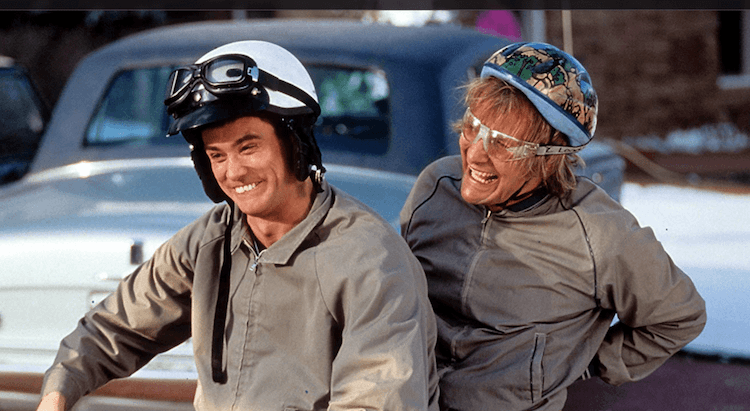
Featuring extended sequences in which Jeff Daniels suffers noisy, debilitating diarrhea and a police officer accidentally drinks another man’s urine, it goes without saying Dumb and Dumber is a triumph of American cinema. Harry Dunne (Daniels) and Lloyd Christmas (Jim Carrey) are the titular dum-dums whose utter incompetence and lack of wherewithal have landed them jobless for the umpteenth time. When Lloyd has a missed romance connection during a limo-driving shift, he convinces his pal to embark on a cross-country road trip to find her and return the briefcase she left behind.
“I’m sick and tired of having to eke my way through life. I’m sick and tired of being a nobody. Most of all, I’m sick and tired of having nobody.” Lloyd’s plea to Harry prompts their journey to Aspen, Colorado in motion, and it’s also an example of how the Farrellys love to turn outright despicable losers into sympathetic protagonists. Not many scripts with such a heightened, slapstick world would pause to inject their characters with that kind of pathos, and thanks to the commitment of Carrey and Daniels, it works.
The criminal elements are usually the least engaging aspect of any Farrelly picture, yet the crime subplot in Dumb and Dumber serves to juxtapose Lloyd — Carrey is as elastic-faced as he’s ever been — against a group of exasperated lowlifes trying to snatch their briefcase full of cash. The hitman assigned to take care of them, played with a deft balance of rage and befuddlement by Mike Starr, is pushed to the brink of insanity and eventually dies as a result of Harry and Lloyd’s buffoonery. The scene in which the Lloyd belts out “the most annoying sound in the world,” ranks among the most memorable in the Farrellys’ oeuvre and enough to warrant the movie’s inevitable Criterion reissue.
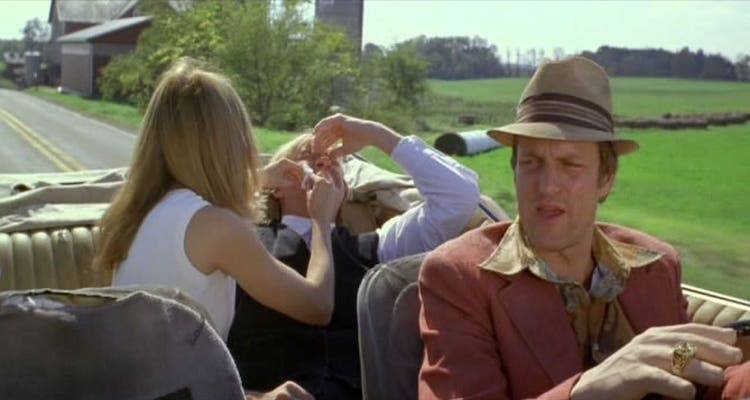
What makes Kingpin, the Farrellys’ sorely underrated follow-up, work so well is how it doubles down on both the earnestness and haplessness in Woody Harrelson’s Roy Munson, a disgraced and disfigured former bowling prodigy. The moment he sees promise in a naive Amish amateur, they hit the road for a $1 million bowling championship in Reno, Nevada. Unlike Harry and Lloyd, Roy is a character with enough self-awareness to achieve redemption, one that comes in the form of his friendship with that fresh-faced Amish lad (played by America’s sweetheart Randy Quaid) and Claudia (Vanessa Angel).
Sporting the worst haircut in a movie filled with them, Roy hits rock bottom after sleeping with his elderly landlord (in a typical Farrelly touch, it’s implied she lost control of her bowels mid-coitus). It’s a testament to the filmmakers’ knack for casting, along with the pathetic depths Harrelson is willing to take his character, that Roy never rises to Kenny Powers levels of obnoxiousness.
Kingpin is also where the Farrellys began incorporating social groups in ways that would be heavily scrutinized in today’s climate. For whatever reason, there hasn’t been much outrage over the lack of Amish representation in American cinema, but don’t worry Film Twitter, the Farrellys have you covered. Rather than take cheap shots at the religious sect, a montage of Roy struggling to help the members in their day-to-day labor is used to highlight his own idiocy. It’s that gentle nature which permeates Kingpin, and while it may not be as riotously funny as Dumb and Dumber, it’s definitely sweeter.
The criminal element here comes in the form of Stanley (Rob Moran), a generic sleaze-ball / mob-type whose sole purpose is to introduce us to Claudia, the final member of the road trip trio. Once she enters the picture, the characters’ chemistry sings. Initially, it seems like she’s only there to add cheap sex appeal, but it’s soon clear she has more street smarts than the other two combined. Vanessa Angel has all the comic timing of Harrelson, particularly during a slapstick brawl between the two. Giving an actress time to flex her skills and some autonomy over the narrative is becoming increasingly par for course, however in 1996, I imagine it felt downright refreshing.
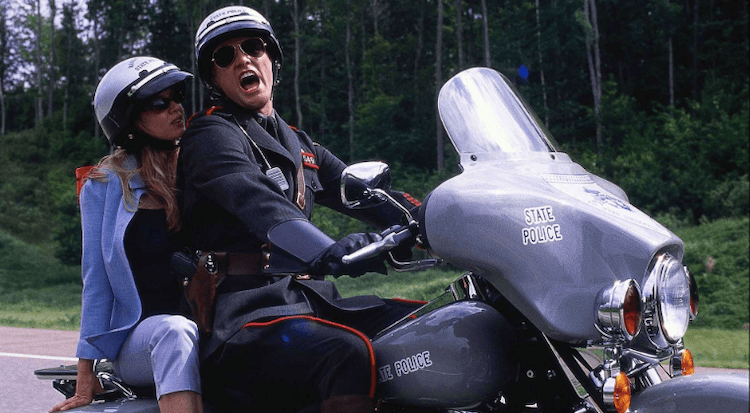
That subversive sweetness and delicate handling of representation isn’t quite achieved in Me, Myself & Irene, a tonally-confused road flick that’s easily the strangest of the Farrellys’ career (and yes, I’ve seen The Three Stooges). The passengers are again a trio, but of a more unconventional sort: with Jim Carrey playing a state trooper with two split personalities, Charlie and Hank, and Renée Zellweger (given little to do) as the love interest Irene.
The narrative revolves around a police escort gone awry, where Irene turns out to be under contract by her mob boss ex-boyfriend, and Carrey is compelled to protect her and go on the run. The mob characters are flimsy at best, an excuse to force our heroes onto the road. What sets M,M&I apart, for better and worse, is Carrey’s manic performance and a near-disastrous portrayal of minorities.
Carrey plays state trooper Charlie like an even more blissfully unaware version of Truman Burbank, who steadfastly refuses to believe that anyone would harbor ill will towards him, until his wife leaves him for a black man of short stature (Tony Cox), and his worldview begins to split. Supposedly, the audience is meant to laugh at a gorgeous white woman finding a man like this attractive. Hilarious! As for Charlie’s sons (who, given their African-American heritage, are not his), I hardly feel qualified to comment on them. Every word of dialogue out their mouths is an exaggerated form of ebonics, yet, they’re also mathematical and scientific geniuses! I guess that contrast is intended to be amusing, but it comes off as a case of shockingly poor taste.
A series of minor annoyances then cause Charlie to crack, and Hank, his alter ego, emerges. Hank is, obviously, a total monster, and Carrey’s execution borrows more than a little from Clint Eastwood, squinting and growling at those receiving their comeuppance. Unfortunately, these acts of vengeance include suckling the breast of a woman feeding her infant in public (how dare she!) and taking a dump on his neighbor’s lawn. Carrey’s bravura acting deserves a better set of jokes, as these are surprisingly uninspired, and coming from the Farrellys, atypically mean-spirited.
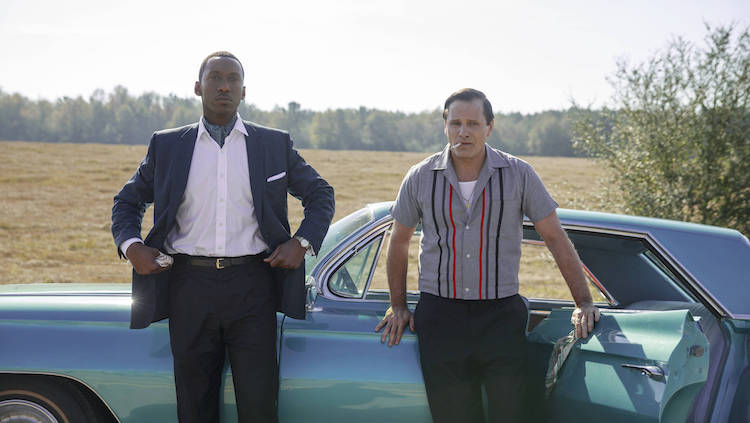
Peter Farrelly rode alone for a little picture called Green Book, whose Best Picture win at the 2018 Academy Awards caused absolutely no controversy. Despite the shift in tone, this ‘60s-set tale of road trips and racism doesn’t stray far from the formula. Viggo Mortensen’s character Frank “Tony Lip” Vallelonga is, if anything, even broader than any of the leads in the aforementioned films, an aw-shucks racist who learns tolerance remarkably fast when he drives piano genius Don Shirley (Mahershala Ali) on a tour through the South, with the criminals to avoid this time around being violent, uneducated rednecks.
Green Book’s antiquated approach to racial politics, along with Mortensen’s muy Italiano performance, ironically makes it the weakest of the quadrilogy. There’s plenty of earnestness to be found, yet Shirley and Tony Lip are too thinly sketched for their transformations to come off as anything but pandering. Still, it’s apparent for his first foray into (ahem) prestige filmmaking, Peter didn’t want to abandon the recipe that made his movies work so well in the first place, and if there’s any saving grace in Green Book, it’s the driving conversations between the two. But of course they are; Farrelly’s a pro at this thing by now. Maybe next time, he should remember the spirit that made these road trips soar in the first place.