Sean Burns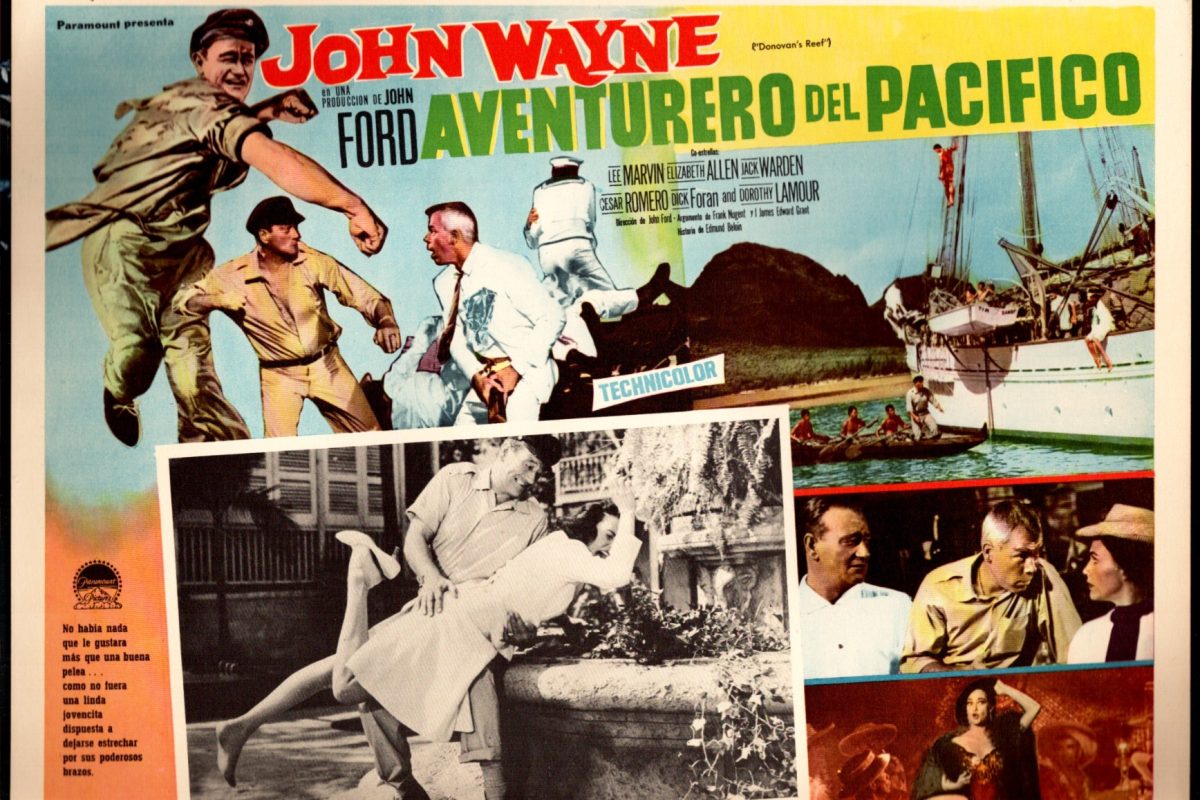
Both an embrace and debunking of frontier myths ending with a literal funeral for an icon of the old west, The Man Who Shot Liberty Valance feels like such a perfect capstone to the collaboration between director John Ford and star John Wayne that it’s easy to forget that it wasn’t their final film together. The duo’s actual curtain call came a year later with 1963’s Donovan’s Reef, a knockabout comedy about expat WWII vets clowning around in French Polynesia. Shortly before it opened, Ford described the film to The New York Times as “a spoof picture – a crazy whammy sort of thing. We’re not trying to win any prizes.”
Shot on location on the Hawaiian island of Kauai, the ramshackle picture has the feel of a project engineered so some friends could have a vacation together on the studio’s dime. Indeed, Ford had been struggling financially with the maintenance and upkeep of his beloved 106-foot yacht, the Araner, which had served as a vacation home and party central for the director since 1934. So he wrote the boat into the picture as the property of Wayne’s character, then leased it to Paramount Pictures to be used in the movie for a considerable sum. (Knowing this backstory makes the brevity of the Araner’s belated onscreen appearance one of the funniest jokes in the film.)
Yet for a silly comedy contrived as a way to make boat payments and drink on the beach, Donovan’s Reef is nonetheless fascinating on several fronts, not the least of which is its fantasy of benevolent colonialism in a tropical Valhalla. Wayne stars as Michael Patrick “Guns” Donovan, who during the war wound up shipwrecked on the island of Haleakaloa alongside pals Thomas Aloysius Gilhooley (Lee Marvin) and Dr. William Dedham (Jack Warden) after their destroyer was sunk in a naval battle. The island was under Japanese occupation, and the three brawling Yanks teamed up with local guerilla resistance fighters to become the stuff of legend. “Tossed a few monkey wrenches into their machinery,” Wayne explains as only he can, “Threw ’em a few spitballs.”
A couple of decades later, Dunham runs the island hospital and cares for the three children he had with a Polynesian princess who died in childbirth. Donovan owns a profitable shipping interest as well as a saloon from which the film takes its title. Gilhooley still gets back to Haleakaloa every December 7th. Not for Pearl Harbor day, but because it’s he and Donovan’s shared birthday — which the two hellraisers celebrate by annually getting loaded and beating the crap out of each other. The paradise is presided over by Cesar Romero’s oily French governor, who writes letters to his superiors lying about how horrible conditions on the island are so nobody else will try to take his post.
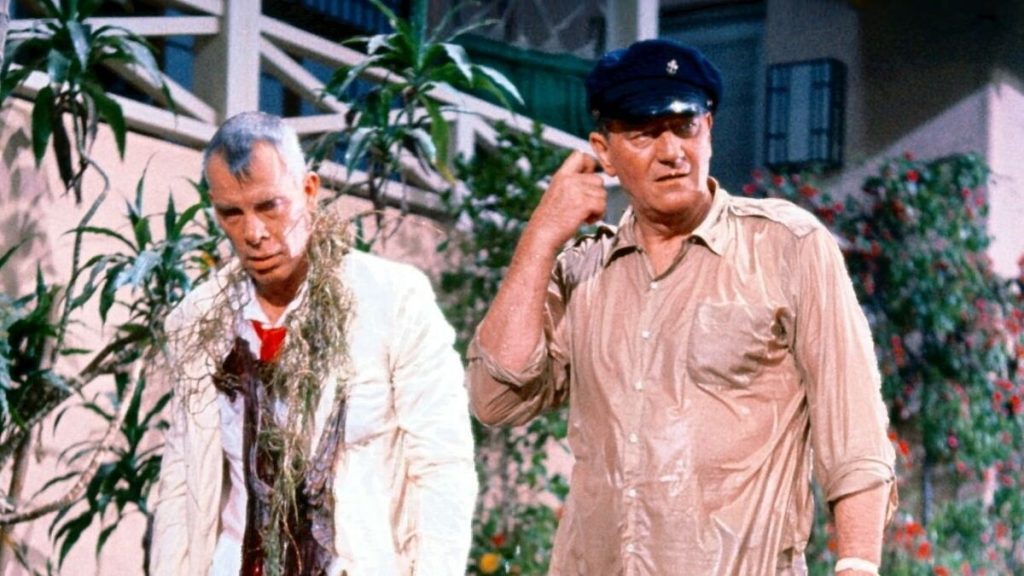
There’s been a death in the wealthy family Dunham left behind in Boston, and an adult daughter he never met is headed for Haleakaloa to sort out some inheritance matters and hopefully trigger a clause in the will that will disqualify her estranged father from the family fortune if he’s caught not living up to “the moral standards of Boston.” (This made me laugh for many reasons.) The doc is temporarily off the island on hospital business, so Wayne panics and pretends Dunham’s children are his, leading to a fair amount of slapstick since saloonkeeper Donovan doesn’t exactly lead a kid-friendly lifestyle.
Winningly played by Elizabeth Allen, Amelia Dunham isn’t the stuffy Boston Brahmin our boys were expecting. She can give as good as she gets, and is flummoxed to find herself falling for Donovan’s boorish charms. As the film’s screenwriter James Edward Grant said to Frank Capra, “All you gotta have in a John Wayne picture is a hoity-toity dame with big tits that Duke can throw over his knee and spank, and a collection of jerks he can smash in the face.” All these elements are accounted for, yet Ford also called in his regular screenwriter Frank S. Nugent, who presumably punched up the film’s frequent donnybrooks to be more like The Quiet Man, with a late-movie highlight finding Wayne and Marvin taking on an entire contingent of Australian soldiers (and each other) on Christmas morning.
As Amelia, Allen is too sophisticated and appealing for the film to make much sense. The plot hinging on her presumed prejudices quickly collapses like a house of cards, and Wayne’s incorrect assertion that through his rude badgering “I made you into a human being” feels like a sop to the star’s vanity. Her de rigueur spanking scene is hardly merited. Allen and Ford would remain close friends for the rest of the filmmaker’s life. (She called him “Sean.” He called her “Stinky.”) Yet for all the caveman behavior, there’s an undeniable warmth to the picture. Nobody was ever better than Ford at depicting community, and the film’s centerpiece Christmas pageant sequence – which somehow hilariously includes Lee Marvin as one of the three wise men – is quite moving in its depiction of a multicultural melting pot coming together against adversity.
Donovan’s Reef is full of moments that may make modern viewers cringe, and watching Ford films today often requires a historical imagination. You need to remember that this is a movie made 63 years ago by a man who was born during the 1800s. In that regard, it’s pretty progressive, despite a few glaringly obvious blind spots. The film speaks out earnestly against racism while depicting the Polynesian servant class as chattering buffoons. Haleakaloa is presented as a utopia lorded over by aging white warriors, but I guess it’s lucky for all of us that their hearts are in the right place.
“Donovan’s Reef” is streaming (with ads) on Amazon Prime and YouTube. It’s also available for digital rental or purchase.