Josh Bell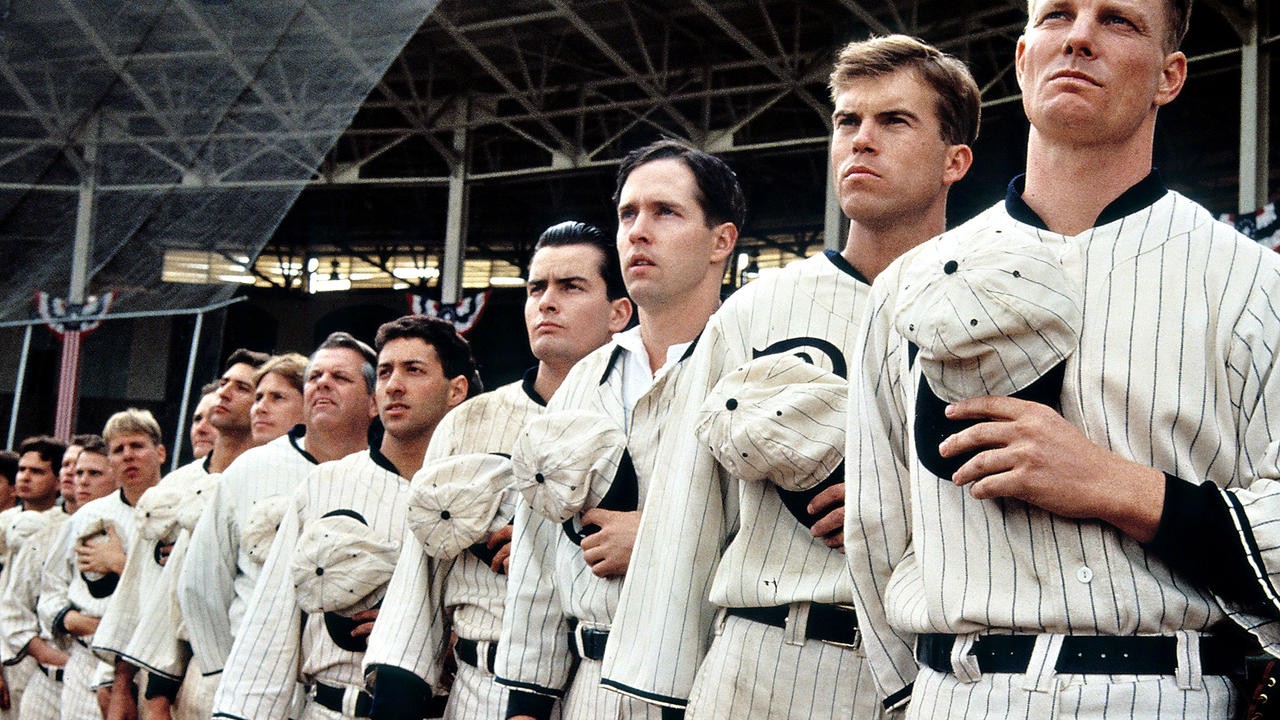
In most sports movies, winning is everything. There may be important personal and professional obstacles to overcome along the way, but the inspirational moment is almost always the victory on the field or in the ring, when that character growth is channeled into triumph over a rival. There’s no such triumph in writer-director John Sayles’ Eight Men Out, which may be why it failed at the box office when it was released this week in 1988, and was easily overshadowed by the following year’s Field of Dreams, a rousing, feel-good movie featuring some of the same sports figures.
Those figures are the members of the 1919 Chicago White Sox, nicknamed the “Black Sox” for their participation in a scheme to deliberately lose that year’s World Series to the Cincinnati Reds. Eight Men Out is one of the best baseball movies ever made, and it features its share of moments celebrating the beauty of the game. But it’s not a movie to watch if you want to hang on to the image of baseball as a pure American pastime, in the mythical way it’s represented in movies like Field of Dreams.
Sayles views baseball as yet another American industry in which the working class is exploited by capitalist overlords, and the Black Sox scandal is the result of that exploitation. The settings are quite different, but Eight Men Out carries on the themes of Sayles’ previous film, 1987’s Matewan, another true story about workers rising up against their wealthy oppressors. Baseball players may seem less sympathetic than coal miners, but White Sox owner Charles Comiskey (Clifton James) is just as ruthless and underhanded as the owners of the Stone Mountain Coal Company.
It’s only because Comiskey treats them with such open contempt that the players contemplate cheating in the first place. “You will get only the money you deserve,” Comiskey tells veteran pitcher Eddie Cicotte (David Strathairn) when denying him a promised bonus, in a tone that indicates Comiskey doesn’t think that Eddie and his fellow players deserve anything. The team’s reward for securing a place in the World Series is bottles of flat champagne.
Sayles masterfully lays out this dynamic via deft cross-cutting in the movie’s opening scenes, as Comiskey regales a room full of fellow tycoons with brags about the White Sox players’ prowess, while gamblers Bill Burns (Christopher Lloyd) and Billy Maharg (Richard Edson) make their own assessments, evaluating the likelihood that each player can be bribed. It’s an efficient and insightful way to introduce a large number of characters, and Eight Men Out’s substantial ensemble almost never feels unwieldy. Sayles takes the lessons of his early character-driven indie dramas like Return of the Secaucus 7 and Lianna and applies them to Eight Men Out’s vast historical canvas.
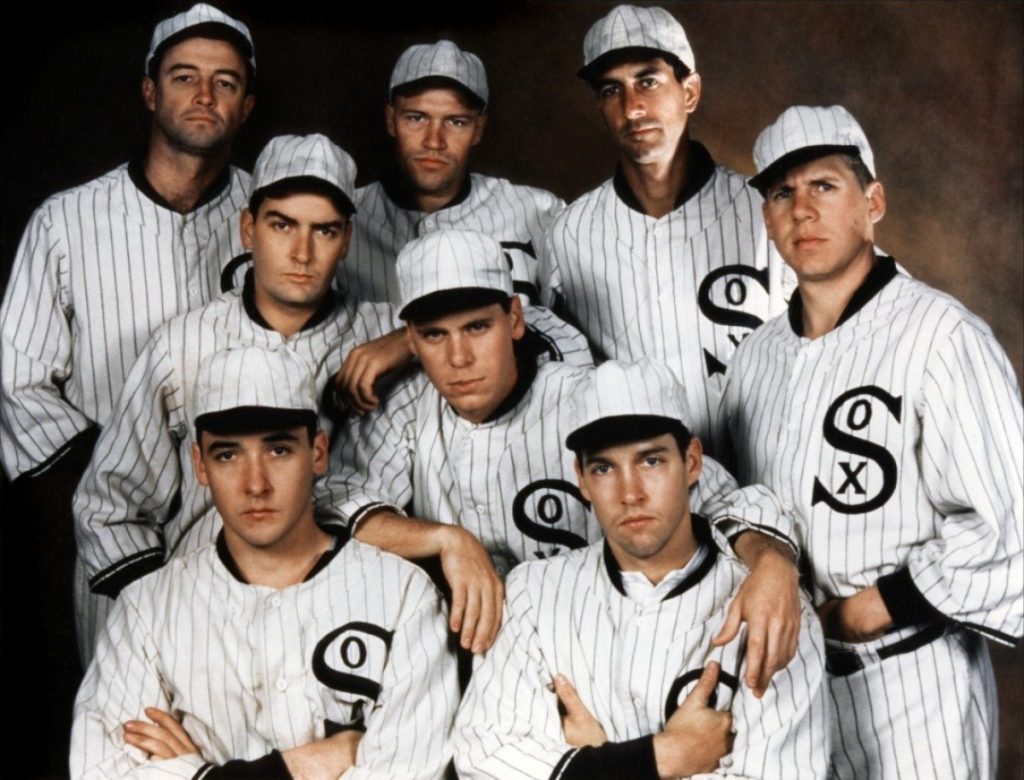
Working from Eliot Asinof’s nonfiction book, Sayles follows the facts but still focuses on the people at the heart of the scandal. These players may be the best in professional baseball, but they’re barely making enough money to live on, and they have no job security or healthcare. If Eddie’s deteriorating arm doesn’t hold up long enough, he won’t be able to support his family. Slick first baseman Chick Gandil (Michael Rooker) spearheads the plan and seems to take pleasure in breaking the rules, but most players go along because they need the money, and they aren’t going to get it from Comiskey.
The sad thing is that they aren’t going to get it from the gamblers, either. Everyone is playing their own angle: Chick and his co-conspirator Charles “Swede” Risberg (Don Harvey) make deals with two sets of gamblers to double their paydays, and those gamblers both appeal to mobster Arnold Rothstein (Michael Lerner) to bankroll their schemes. Rothstein’s associate Abe Attell (Michael Mantell) makes his own deal separate from Rothstein, and almost none of the money actually makes it to the players. They go from being exploited by Comiskey to being exploited by their underworld connections.
Later, when the scandal is revealed in the press and Comiskey and his fellow team owners scramble to save face, the players get exploited by a phalanx of lawyers. There’s no justice for anyone in Eight Men Out, least of all for players like Buck Warner (John Cusack) and Shoeless Joe Jackson (D.B. Sweeney) who care only about the joy of baseball. When there’s a trial, it’s not the gangsters or gamblers who stand charged with crimes, it’s the players. Buck keeps his integrity, refuses to be bribed, gives his all on the field, and still gets banned from baseball for life.
Cusack gives one of his best performances as the earnest, wistful Buck, who continues to believe that his dedication to baseball will save him. He has a sweet relationship with a pair of neighborhood kids, effectively setting up the iconic (but likely apocryphal) moment as one of them confronts Shoeless Joe outside the courthouse, pleading, “Say it ain’t so, Joe!” Buck and Shoeless Joe, along with Eddie and team manager Kid Gleason (John Mahoney), are the story’s most heartbreaking figures, whose idealistic view of baseball is destroyed by the greed and callousness around them.
Sayles casts himself as jaded reporter Ring Lardner, a fellow writer who’s skeptical of powerful institutions. Sayles’ progressive perspective infuses Eight Men Out, although bringing those values to a mainstream historical drama failed to translate into mainstream success, and he returned to smaller-scale films. Still, those values are an essential part of what makes Eight Men Out a great movie, and not just a great baseball movie. In a genre filled with pseudo-authorized, boosterish biopics, Eight Men Out is a bracing reminder that the real winners are rarely the people who play the game fairly.
“Eight Men Out” is streaming on Amazon Prime Video.