Sean Burns
A stark, sociological study tucked neatly inside a manhunt movie, director Robert Hamer’s It Always Rains on Sunday uses crime story trappings as the front for a panoramic portrait of postwar London muddling through an age of austerity. It’s 1947 in the East End neighborhood of Bethnal Green. Amid the rationing and rubble of a slow recovery from the Blitz, we follow 20-odd characters for 24 hours, their sleepy sabbath galvanized by the return of local legend Tommy Swann. Played by the dashing Australian actor John McCallum, he’s a small-time gangster who got sent up four years ago for robbery after abandoning his beautiful blonde bartender moll Rose (the exquisitely named English entertainer Googie Withers). After busting out of Dartmoor Prison, Tommy’s on the lam and back in the old neighborhood. He needs Rose’s help, but she started a new life long ago.
Now a brunette, unhappy housewife, Rose is married to the much older George Sandigate (Edward Chapman) and has her hands full tending to his two almost-grown daughters Vi (Susan Shaw) and Doris (Patricia Plunkett) as well as adolescent Alfie (David Lines), a budding juvenile delinquent. George is a good provider in tough times, if not particularly attentive. There’s little love lost between the kids and their stepmom, and all told, life seems pretty dreary for our heroine—which might be why her heart skips a beat at the sight of her grimy ex-lover shivering in the family’s air-raid shelter.
It’s crazy for Rose to think about concealing him from the cops, but she can’t help herself. Tommy Swann brings with him memories of a more romantic time – conveyed in swoony flashbacks where Withers and McCallum look gob-smackingly gorgeous compared to their broken-down, present day counterparts. It Always Rains on Sunday is suffused with that kind of melancholy longing for days gone by, a yearning for past glories in the face of a morose, mundane present full of limited options and lousy weather. In the guise of a film noir, it’s actually a precursor to the early 1960s British kitchen sink dramas, one crime plot away from This Sporting Life or Saturday Night and Sunday Morning. (I’m guessing this was an important film for a young Mike Leigh.)
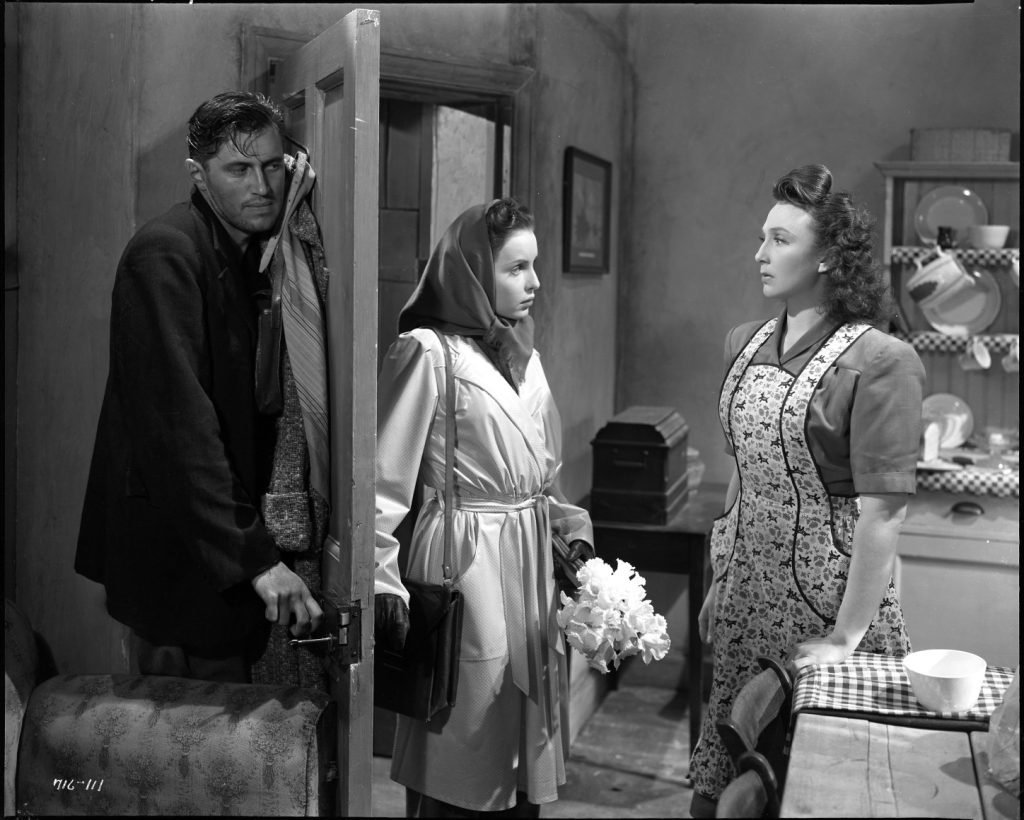
There’s not much urgency to this particular manhunt. Tommy spends a fair amount of the movie napping inside Rose’s house while we follow the twin travails of the Sandigate sisters, both taken in and teased by the false promises of brothers Lou and Morry Hyams. The former (played by a reptilian John Slater) is a gangster-adjacent arcade owner who gambles on fixed fights and makes a big show out of making splashy donations to local charities that don’t want his dirty money. Lou toys with the naïve, virtuous Doris, dangling a job in front of her that may or may not come with other strings attached, for seemingly no other reason besides sadistic sport.His clownish bandleader brother Morry (Sydney Tafler) at least has more recognizable motives, leading on the gullible, moderately-talented Vi with the promises of a singing career he never has any intention of delivering. It’s a sleazy gambit but not unamusing when his wife lets him know his fumbling infidelities have not escaped her notice.
Everything in the picture feels similarly hollow and desperate. They’re all dead-enders grasping at a piece of the pie that’s a lot smaller than it used to be. Even the movie’s Greek chorus of criminals is trying in vain to unload a chintzy bounty of stolen roller skates. Surrounded by such drudgery, Rose’s rekindled affair with Tommy Swann feels positively epic, even if he’s covered with filth in the basement. (Cinematographer Douglas Slocombe would use some of the same dramatic lighting tricks 40 years later when shooting the first three Indiana Jones pictures.)
Their chemistry was no fluke. Withers and McCallum married the following year and moved to Australia. They stayed together until his death in 2010, a far happier ending than for Rose and Tommy Swann, whose dual suicide attempts are purposefully cross-cut as an unsubtle parallel between a prison sentence and life as a housewife. It’s a grim picture, miles away from the comedies for which Ealing Studios would become best remembered following Hamer’s follow-up two years, Kind Hearts and Coronets. But It Always Rains on Sunday was a surprise hit at the British box office, second only to The Best Years of Our Lives on the year’s list of most popular films. (1947 audiences were obviously processing some stuff.) The movie never really found any traction in America until it resurfaced for festival screenings about ten years ago, shocking U.S. critics with its unflinching depiction of postwar malaise. We finish the story feeling like these characters will all still be stuck in the same place next Sunday, and every Sunday thereafter. And it will probably be raining.
“It Always Rains on Sunday” is streaming on the Criterion Channel and Kanopy.