Roxana Hadadi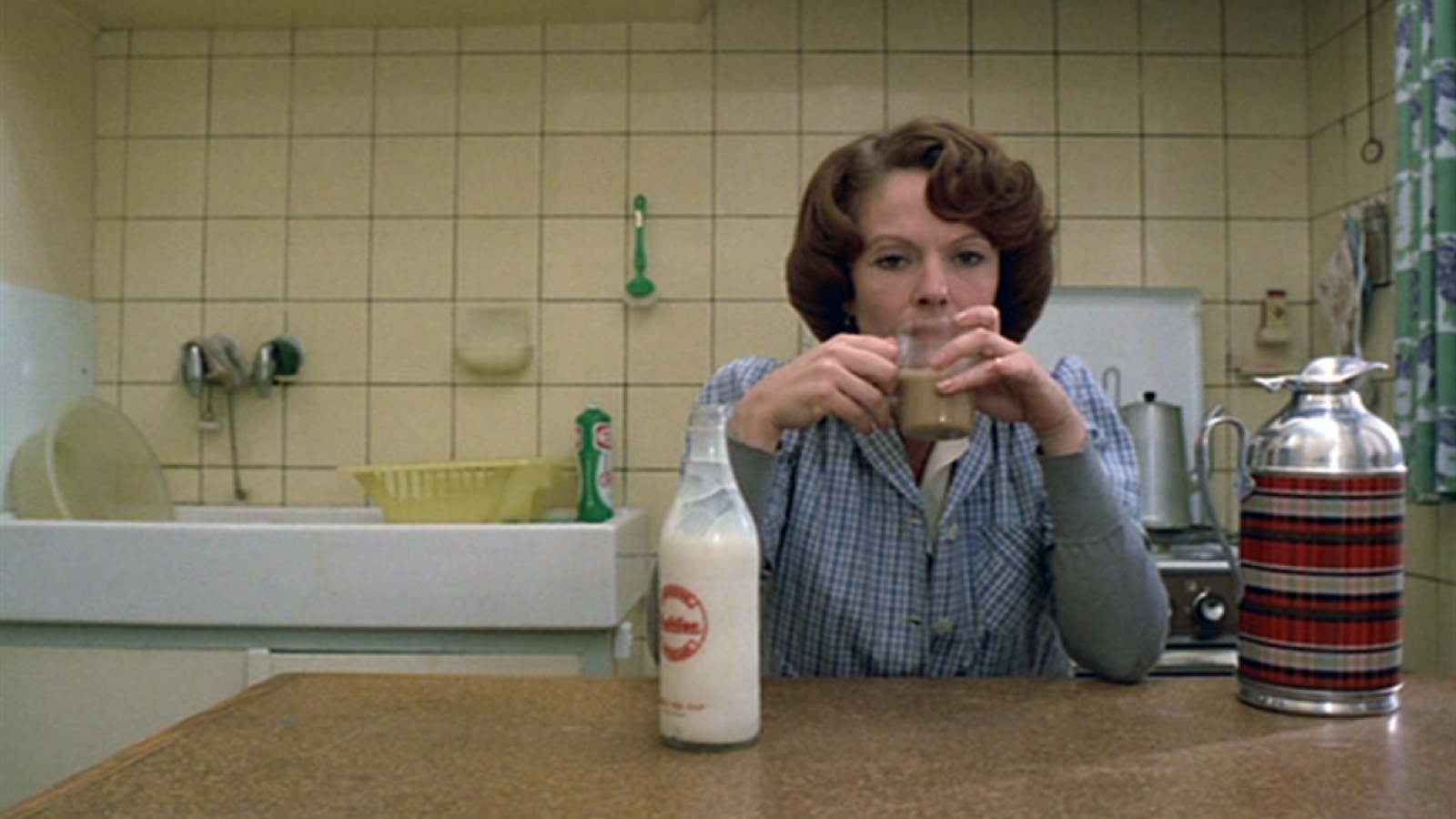
Chantal Akerman was 25 years old when her technically groundbreaking, emotionally devastating, and alternately revered and reviled Jeanne Dielman, 23 Quai du Commerce, 1080 Bruxelles played at the 1975 Cannes Film Festival. Speaking about the film in 2009, Akerman remembers the reaction: “People kept getting up and leaving. You could hear the seats banging. That’s when I realized people couldn’t stand it.” The recipient of extremely divisive takes at the time, Jeanne Dielman—now streaming on the Criterion Channel—has since been recognized as one of the most formative feminist films of the 20th century.
An unflinching portrait of the mundanity of middle-aged womanhood, Jeanne Dielman was subversive from the start. Akerman amassed a majority-female crew for the production (“I wanted to show that it was entirely possible, so we did,” she said in that 2009 interview), cast the internationally acclaimed actress Delphine Seyrig in the lead role, and then buried her under a dowdy uniform of sensible cardigan, sensible blouse, sensible midi skirt, and sensible heels. Seyrig was practically unrecognizable, but her anonymity was the point. For Akerman, the narrative thrust of Jeanne Dielman was to document “actions that are typically devalued,” and then as now, we know this to mean women’s work. Cooking, cleaning, shopping, child-rearing, household management, and—the oldest professional of all for women—prostitution.

Middle-aged widow Jeanne (Seyrig) lives with her teenage son in a tiny apartment in Belgium. Their home consists of four rooms, the paths between them beaten down by Jeanne’s repetitive routine. She gets up early each morning, before her son Sylvain (Jan Decorte), and walks from her bedroom to the small kitchen, where she prepares coffee and lays out his breakfast. When Sylvain leaves for school, Jeanne goes to the living room, where Sylvain sleeps on the foldout sofa bed. She folds his pajamas. She rearranges the bed back into a sofa. She puts the rest of the furniture back in place. Then it’s time to buy whatever groceries Jeanne will need for that evening’s meal, which she’ll prepare for herself and Sylvain. Out to the butcher and corner store for ingredients for beef stew and potatoes on Tuesday, veal cutlets and peas and carrots on Wednesday, and meatloaf on Thursday. And when she’s back from her errands—with the groceries put away, and dinner cooking on the stove—her doorbell rings. A man appears at her door. She collects his hat, his scarf, his jacket, and then leads him to her bedroom. The lights go out in the apartment. When the lights turn back on, she is ushering that same man out. He hands her some cash that she stashes inside a porcelain bowl, and then confirms his appointment for the next week. And so Jeanne’s straddling of the two most ancient expressions of womanhood, the mother and the whore, is made clear.
Jeanne is leading an intensely compartmentalized life, one to which Akerman extends a phenomenal amount of sympathy. Shot nearly entirely in real time, Jeanne Dielman is built by Akerman’s lengthy, static takes, which add up to the film’s 201-minute length. Jeanne boils potatoes. She drains potatoes. She drinks coffee. She brews coffee. She opens the bedroom window to let the smell of sex waft away. She tosses the towel on which she’s sold herself for money to feed her son into the hamper to wash later. She gets into the bathtub. She scrubs her face, behind her ears, her breasts, her stomach, her arms, her back, her feet, her genitals. She cleans the bathtub itself. She sets the table. Her son comes home. In a mimicry of her earlier interaction with her client, she takes his scarf, his jacket, his briefcase. She serves him soup. She clears his plate. She serves him dinner. She clears his plate. Through it all, Sylvain barely says a word, preferring to read his book than pay any attention to his mother. He does his homework. She knits him a sweater. They pull out the sofa bed again. Eventually, Jeanne turns out his light. She retreats to her own bedroom, under the bedspread, where her clients are never welcome to join her. And as Akerman’s intertitle informs us, “END OF THE FIRST DAY”—only for Jeanne to get up the next morning and do it all over again.
In a 1976 interview with journalist Judith Weinraub for the New York Times, Seyrig—an outspoken feminist herself—spoke of her role: “It observes the woman in a loving and generous way, doing the things she has to do every day—the way she cooks, the way she stands over a sink. It has turned out to be quite unbearable to watch. Nobody has really had to watch three and a half hours of housewifing before.” And although Seyrig didn’t say it, no one watched 201 minutes of chores before because women are expected to perform domestic labor quietly, and in the background. Akerman’s audacity was to thrust forward all these menial tasks to the forefront, showing how they add up to a life spent in nearly exclusive service to men, one in which the demarcation of time is centered not on anything Jeanne does for herself but what she does for others. Each day means a different client. Each night is a different dinner for Sylvain. The film’s dialogue is sparse, and sometimes clunkily intentional, but it serves Akerman’s purpose of demonstrating Jeanne’s thorough averageness—all women in the film act this way. In a letter Jeanne receives from her sister in Canada, her sister stops the message with, “Table’s not set yet, so I’ll say goodbye.” A neighbor whose baby son Jeanne sometimes watches complains about her husband’s high demands and her children’s disinterest; “I tell you, if it were up to just me…” the woman says, but there’s no end to her sentence. Such a reality, one in which she would be in charge of her own life, can’t even be imagined.

Perhaps that’s why there’s a prevailing sense of dread throughout Jeanne Dielman, an unsettling tension that increases as Jeanne’s rituals are upset. She wakes up early one morning and finds herself with time to fill. She sits in the apartment and stares off into space. She makes a mistake in her grocery purchasing, realizing there’s only one potato left in the apartment. She makes dinner late. She forgets to turn on the radio for Sylvain after dinner. Akerman keeps her camera steady on Seyrig as we see this incremental unraveling in the kitchen and at the dining room table, and one of the film’s most powerful moments is perhaps what caused this all: Jeanne finding her voice against Sylvain. When her son, ignorant of how his mother supports them, declares with puffed-up pride, “If I were a woman, I could never make love with someone I wasn’t deeply in love with,” Jeanne’s reply is amused, indignant, and swift. “How could you know?” she says to her son. “You’re not a woman.”
Until that moment, Seyrig has played Jeanne as a cypher, a figure who operates nearly as an automaton, moving through her scheduled loops with no question. After that scene, though, Jeanne’s assertion of her own gender—and the myriad responsibilities and indignities it requires—upends her. Who Jeanne is outside of all this, and what happens when she deviates from her expected role, is what Akerman continues to track toward the film’s shocking conclusion. In that 2009 interview, she said of her breakout film, “The day after the [Cannes] screening, I was on the map as a filmmaker, and not just any filmmaker. … It was pleasant and all, but tough too, because I wondered, ‘How to do even better?’ And I don’t know that I have.” Six years later, Akerman would take her own life, but her filmography, and the titanic place Jeanne Dielman, 23 quai du Commerce, 1080 Bruxelles inhabits within that body of work, endures. 
“Jeanne Dielman, 23 Quai du Commerce, 1080 Bruxelles” is currently streaming on the Criterion Channel, and is available on DVD and Blu-ray from the Criterion Collection.