Sean Burns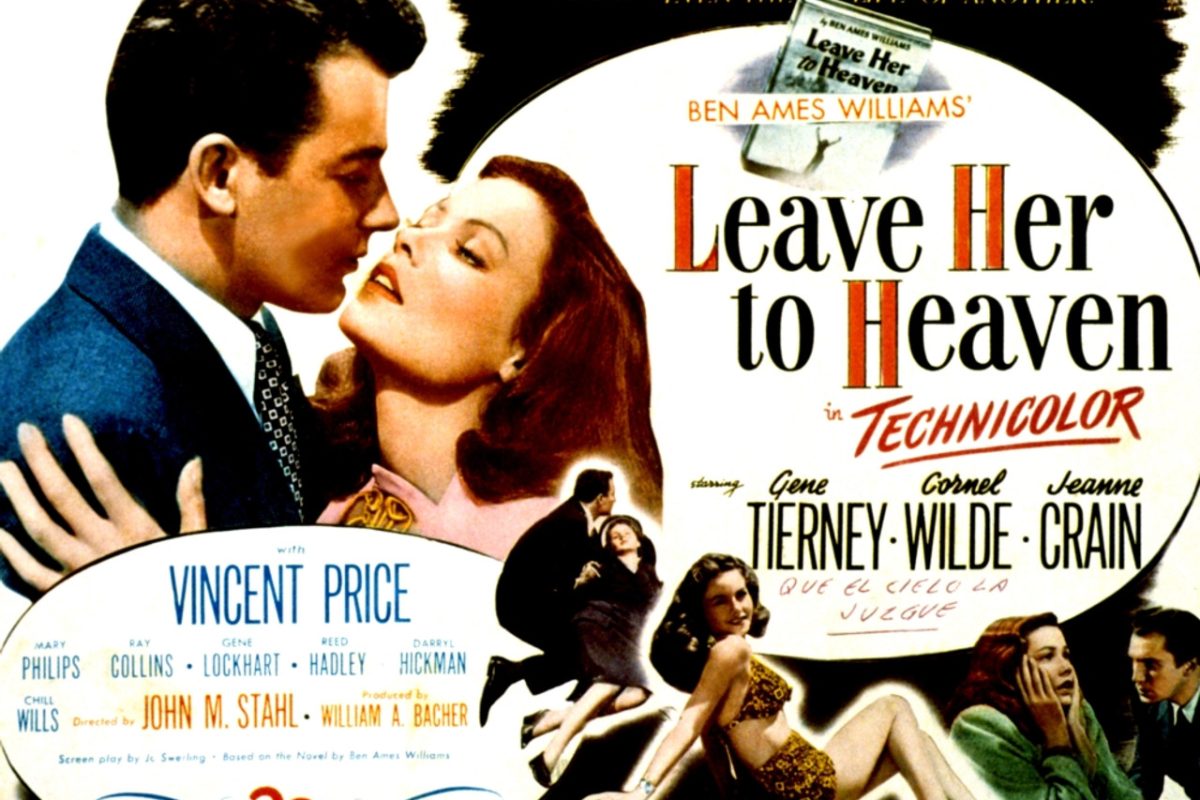
The original Gone Girl, director John M. Stahl’s 1945 Leave Her to Heaven is often called the first Technicolor Noir, a description that sounds like an oxymoron until you actually watch the movie. Hundreds of miles away from the shadowy urban streets populated by private dicks, floozies, and femme fatales, this splashy 20th Century Fox adaptation takes place in sunny vacation resorts and sumptuous lakeside retreats filled with old money heirs and bestselling novelists. The movie looks and sounds like what were commonly referred to as “women’s pictures” back in the day, yet its soul lies in the moody, psychological wreckage of the era’s most remorseless crime stories.
One can see how the bait-and-switch might have been a bit much for some viewers. The oft-befuddled New York Times critic Bosley Crowther noted, “Christmas Day was an inauspicious moment to bring in a moody, morbid film which is all about a selfish, jealous and deceitful dame. Somehow, this hardly seems the season for indulging in that sort of thing.” Crowser called Leave Her to Heaven “plainly a piece of cheap fiction done up in Technicolor and expensive sets,” as if that isn’t what’s so awesome about it.
The writer first spots her on a train. She’s Ellen Berendt—a dazzling beauty with blue-green eyes that bore into the camera lens, played by Gene Tierney at her must angular and unforgettable. He’s Richard Harland, a dapper gent played by Cornel Wilde with a weak chin and a personality in danger of blending in with the wallpaper. She’s reading one of his books, but hasn’t put together yet that the man in the flap-jacket author photo is the one sitting across the aisle. In the first of many blows to the writer’s ego, she nods off while reading it. Everyone’s a critic.
Even less impressive is when he tries to pass off a bit of the book’s banter in conversation, prompting Ellen to quickly flip back to the chapter in which he’d already expended his pickup line. By this point, Richard’s fate is already pretty well sealed, and the whirlwind courtship that ensues is entirely on her terms. The poor schmuck never even gets a chance to ask her to marry him. She takes care of that, assuming his tacit agreement in the midst of publicly humiliating her former fiancée, a district attorney played with simmering menace by Vincent Price. (Watching Price’s cucked, undignified exit, you can’t wait for him to come back looking for vengeance later in the picture.) Members of her family gravely intone loaded compliments that sound more like warnings: “Nothing ever happens to Ellen,” or “Ellen always wins.”
The one hurdle I’ve never quite been able to get over is why such a dynamite woman would fall so hard for such a milquetoast bore. (This could either be the writing or my own Cornel Wilde problem.) The movie makes a big deal out of how much Richard resembles Ellen’s recently deceased father. He and his demise are spoken of mysteriously, with a caveat that Ellen “loved him too much.” Indeed, we quickly come to see how Ellen’s love can be an all-consuming thing. She wants Richard, but she wants him all to herself.
This is easier said than done, as her husband clearly doesn’t prioritize much in the way of “alone time” with his wife. There’s always family around, especially Ellen’s adoptive sister Ruth (Jeanne Crain) a kinder, gentler version of Ellen who big sis clearly doesn’t like very much, though Richard seems unnervingly pleased with her undemanding company. So much of the movie is Ellen seething at perceived slights to which dull others are cheerfully oblivious, the movie more than once brings to mind the famous R. Crumb self-portrait of a man fulminating with rage while regular people happily go about their day. Time Magazine critic James Agee quipped that “Audiences will probably side with the murderess, who spends all of the early reels trying to manage five minutes alone with her husband.”
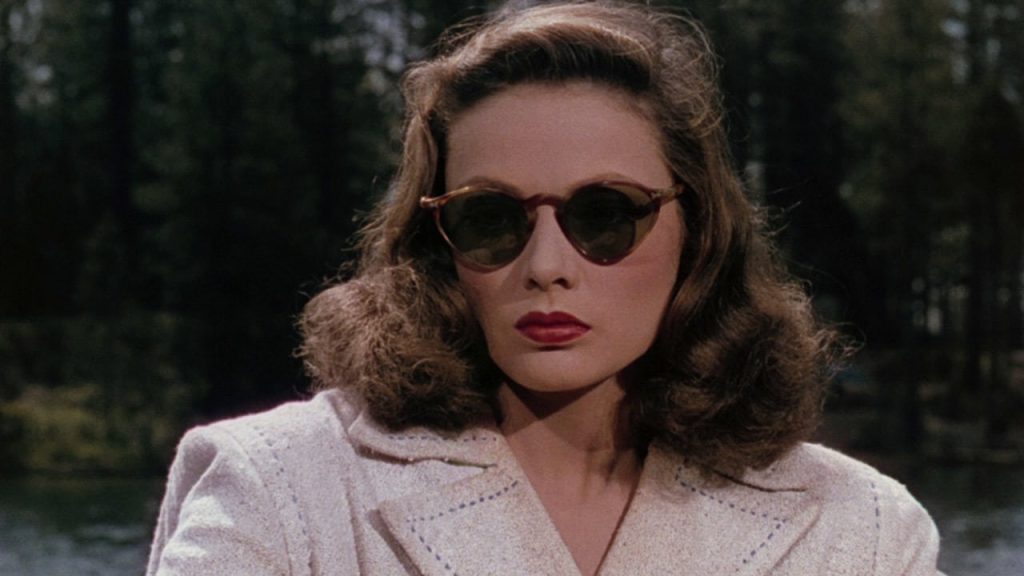
This is bad news for Danny, Richard’s polio-stricken kid brother who’s trying to learn how to swim. The second hour of Leave Her to Heaven include some gasp-inducing measures taken by Ellen to try and get some goddamn quiet time with her man, as well as a barn-burning cross-examination by Price at his hammy, theatrical best. But there’s no scene more memorable than one after Ellen helps little Danny off his crutches and into the water. (You might recognize some of some of the setups that were borrowed by superfan Martin Scorsese for a similar scene in Shutter Island.) It’s not so much an action sequence as it is an inaction scene, with Tierney’s lethal stillness burning a hole through the screen. She’s wearing sunglasses, yet somehow we still know exactly what it looks like behind those blue-green eyes.
“Leave Her to Heaven” is streaming on the Criterion Channel and Plex.