Sean Burns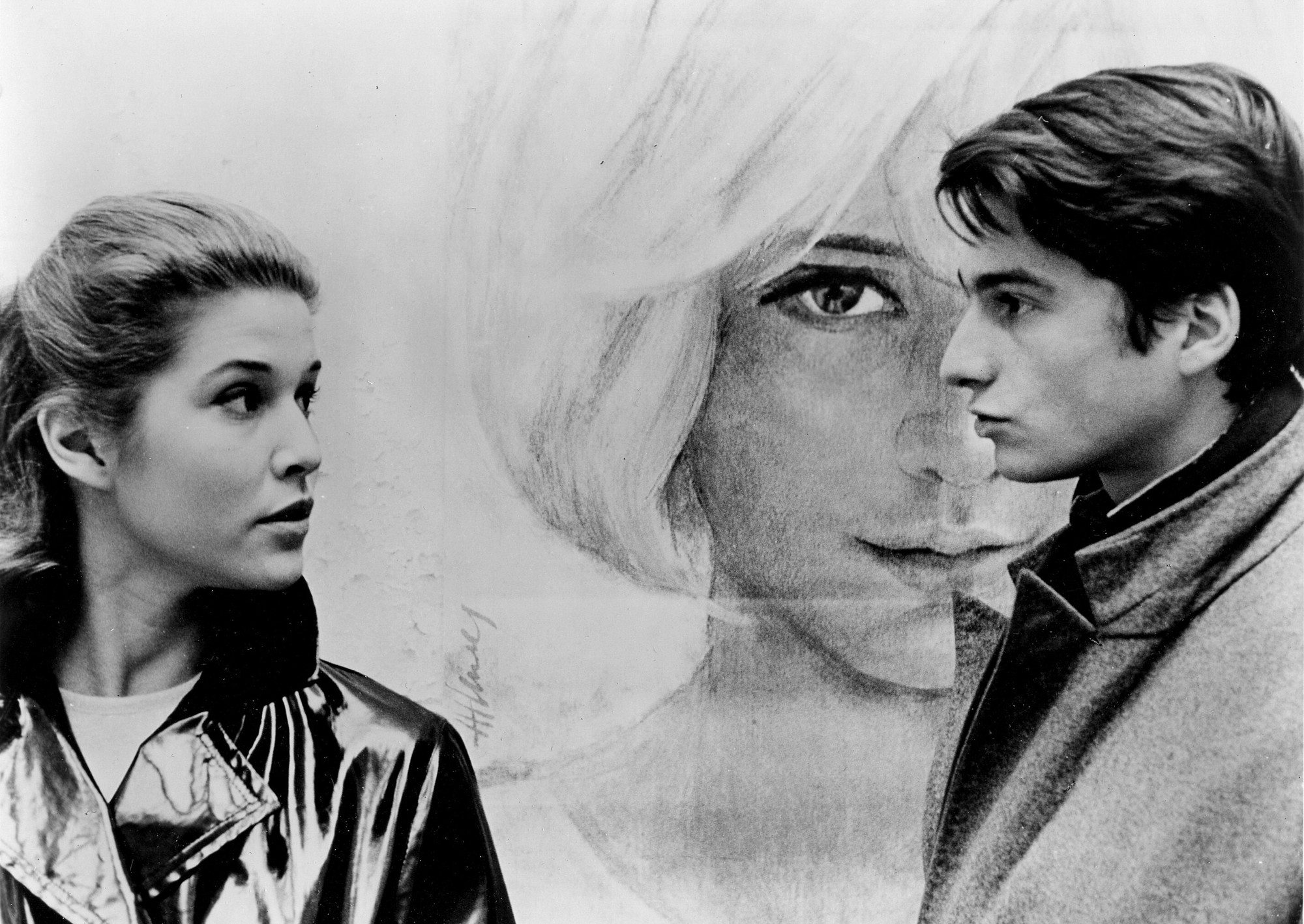
The world’s youngest filmmaker died this week at the age of 91.
Cinema scholar David Bordwell bestowed that nickname upon Jean-Luc Godard when the iconic auteur was a hale and hearty 82 years old, in reference to his radical stereoscopic masterpiece Goodbye to Language 3D, which found the director once again deconstructing the medium and its messages with an irreverent energy running circles around filmmakers a fraction of his age. The delightfully dyspeptic Godard’s public persona was that of film culture’s preeminent old crank, yet his work never lost its youthful vigor or capacity for surprise, remaining insatiably experimental and several steps ahead of his critics (especially this one) all the way to the end. His 1960 Breathless blew up the boundaries of what movies could do. And then Godard kept blowing them up even where you didn’t know they existed, moving into more controversial, less commercial phases of his career as intensely debated as those of his musical counterpart Bob Dylan – two voices of their generation who grew into sardonically gnomish, emphatically unpredictable elder statesmen. Forever young.
Most serious cinephiles seem to get into Godard around their early 20s, and there’s something about that age that makes his films feel especially intoxicating. It’s the sudden eruption of endless possibility one gets when watching a film like Pierrot le Fou or Weekend for the first time, realizing that all the rules you’ve been taught were made to be broken and that movies can be so much smarter, sexier and sillier than you’d ever imagined. In a 2008 interview with the Los Angeles Times, the great screenwriter Daniel Waters (of Heathers, Batman Returns and other perverse provocations) spoke of going to Montreal’s McGill University and seeing his first art films: “I had to make a decision: I was going to learn to love Godard or I was going to drink beer and have sex and have a great college experience. I chose Godard.”
Similarly, I still recall stumbling down the sidewalk dizzy after a double feature of Breathless and Band of Outsiders at the old Theatre 80 St. Marks in Greenwich Village during my own freshman year at NYU, understanding only that all my critical faculties had just been rewired and that I was probably going to be in love with Anna Karina for the rest of my life.
Masculin Féminin isn’t my favorite Godard movie – it might not even crack the top five — but it’s the one I felt most like revisiting after hearing news of the director’s death. I think that’s because it’s a movie about being the age I was when his films first found me: barely out of adolescence and all hopped up on hormones, cinemania, and political fervor, when everything feels like it’s still stretched out endlessly in front of you.
The film follows a handful of young, would-be radicals flirting and trying to talk each other into bed between old movie matinees and protests in 1965 Paris, where there was music in the cafes at night and revolution in the air. But it’s a film made by an older, sadder man (then 35, Godard had just split with Karina the previous year) and he sees these kids – “the children of Marx and Coca-Cola” – with great affection and a wistful clarity they will probably never actually attain for themselves.
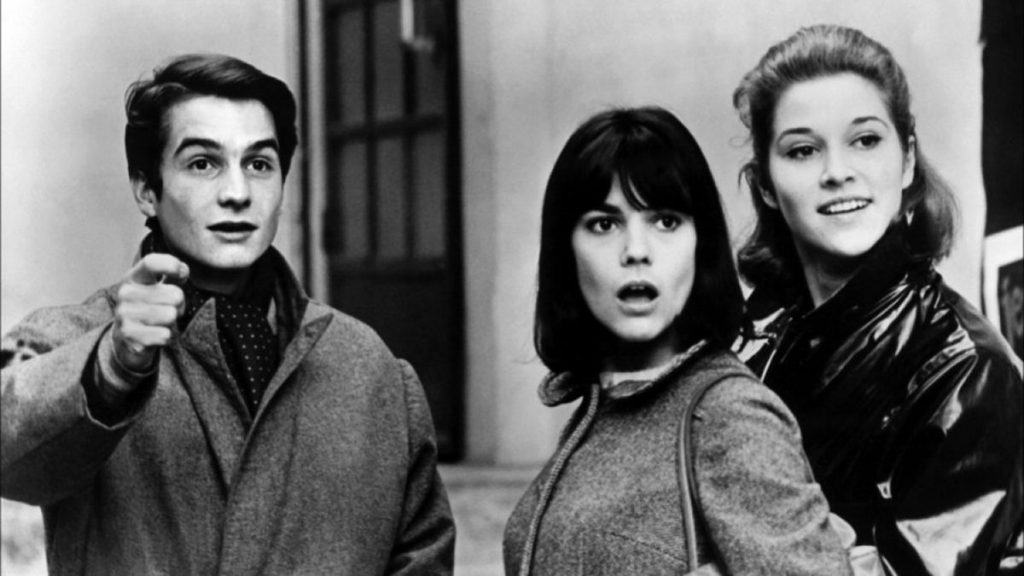
“Never do two gazes meet,” are the first words we hear read aloud by Jean-Pierre Léaud’s Paul, a horny activist fresh out of the army who spends the film trying (and failing) to flip a cigarette into his mouth like Jean-Paul Belmondo in Breathless. Since Belmondo was himself trying to smoke like Humphrey Bogart, we’ve already entered a classically Godardian cinematic hall of mirrors during the movie’s opening moments, but that initial aphorism is worth remembering as the bulk of Masculin Féminin is made up of young men and women talking past each other.
The movie is ostensibly about the often-embarrassing Paul’s floundering romance with an up-and-coming pop star named Madeline (billed as “un petite chanteuse”) played by up-and-coming pop star Chantal Goya. Yet the two are almost always isolated within their own frames, answering inquiries from an off-screen other instead of having what we would call an actual conversation. For all their books and militant political manifestos, these overgrown little boys haven’t the slightest understanding of what women want, confessing that in the word “masculine” they can see both “mask” and “ass,” but in “feminine” they find nothing. (Godard saves his visual rejoinder for the closing credits, and it’s a doozy.)
Split into 15 chapters – though the director plays fast and loose with the numbering – announced by tinny gunshot sound effects from old timey westerns, it’s got all the jump-cuts, epigrammatic asides and abrupt audio dropouts one expects from Godard’s freewheeling ‘60s films, but with a more melancholic undertow. Of course these kids are always talking about movies – the casting of Léaud, who played the filmmaker’s friend and rival Francois Truffaut’s alter ego in The 400 Blows is a form of cinematic shorthand in and of itself, while his girlfriend complains he’s not a romantic like Belmondo in Pierrot le Fou. (An uncredited Brigitte Bardot pops up at one point, almost like a mirage.) Yet there’s also the creeping sensation that this giddy, pop culture oversaturation is no longer sustainable, especially as these characters inch into adulthood.
Late in the film, a voice-over monologue from Leaud’s Paul feels like a fitting farewell, if not to Godard, then at least to this phase of his career: “We went to the movies often. The screen would light up, and we’d feel a thrill. But Madeleine and I were usually disappointed. The images were dated and jumpy. Marilyn Monroe had aged badly. We felt sad. It wasn’t the movie of our dreams. It wasn’t the total film we carried inside ourselves. That film we would have liked to make, or more secretly, no doubt, the film we wanted to live.” 
“Masculin Féminin” is streaming on the Criterion Channel and HBO Max.