Sean Burns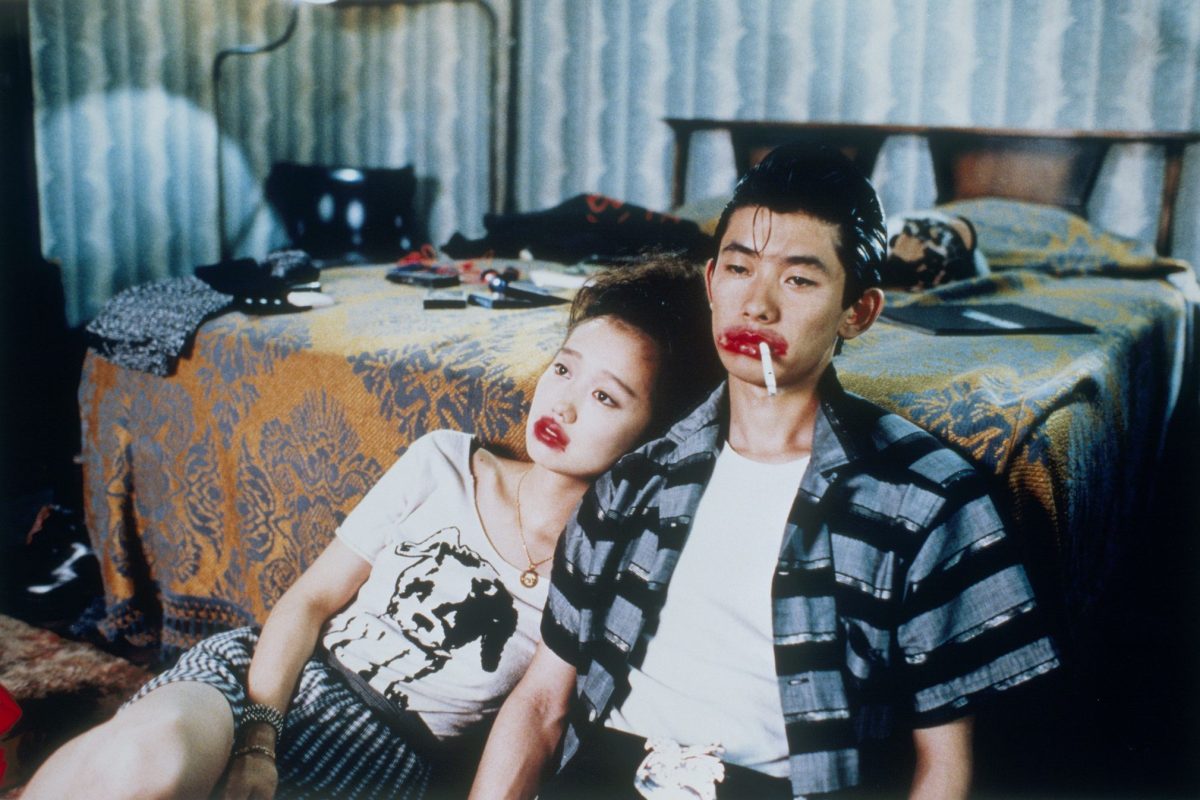
Following his 1984 breakthrough hit Stranger Than Paradise and the 1986 cult classic Down by Law, Jim Jarmusch’s 1989 Mystery Train can be seen as the third part of a loose trilogy observing America from the perspective of strangers in a strange land. The film is itself a triptych, the first time Jarmusch used the anthology format he would return to frequently. (He does so again in the upcoming Father Mother Sister Brother.) Mystery Train follows three lightly intersecting stories that take place concurrently at the same fleabag Memphis motel, though I worry that calling them stories might create an expectation of drama in which the film is profoundly uninterested. Perhaps “interludes” might be more apt.
Jarmusch is cinema’s great hipster poet of inertia. One of my favorite stories that’s passed into film school legend is that when he was at New York University studying under Rebel Without a Cause director Nicholas Ray, Jarmusch turned in a script that the professor criticized for its lack of incident. The young student carefully considered Ray’s critique, then turned in a revised draft in which even less happens. Ray ended up hiring Jarmusch his assistant and a close mentorship ensued.
Many years later, I had a professor at NYU who had been working there at the time. She was a wonderful teacher who was getting on in years and had a metal plate in her head that made her terrible with names. (She also couldn’t stand too close to a microwave because she’d forget what day it was.) She used to refer to Jarmusch as “the Hungarian.” Now, Jim Jarmusch is not Hungarian. He’s from Akron, Ohio, with parents of German-Irish and Czech descent. I think she was confusing him with the Hungarian characters in Stranger Than Paradise. But it’s also sort of understandable because he’s a striking-looking dude with what could easily be read as an Eastern European affect, and Jarmusch has always maintained an outsider’s perspective in his pictures.
Stranger Than Paradise, Down By Law and Mystery Train envision Hoboken, the Louisiana bayou, and downtown Memphis as vast and desolate wonders to be explored. In the latter two films he loves to let the camera track laterally along streets and roads, observing overgrown landscapes and gorgeously crumbling ruins. Shot by the legendary German cinematographer Robby Muller, Mystery Train examines American iconography through the eyes of visitors, allowing us to see the fundamental strangeness of stuff we take for granted. It’s no coincidence that the movie shares its Elvis Presley-inspired title with a Greil Marcus book in which the brainiest of rock critics wrote about “the old, weird America.”
The first chapter follows two young Japanese tourists who are positively besotted with mid-century U.S. pop culture. (For reasons psychologists would probably have a field day unpacking, the American ‘50s were all the rage in Japan during the ‘80s.) Played by the adorable Masatoshi Nagase and Yûki Kudô, the couple has made a pilgrimage to visit Graceland and Sun Studios. She’s crazy about Elvis. He prefers Carl Perkins. They don’t understand much of what anyone says, except for some guy at the train station played by soul icon Rufus Thomas. He speaks their language.
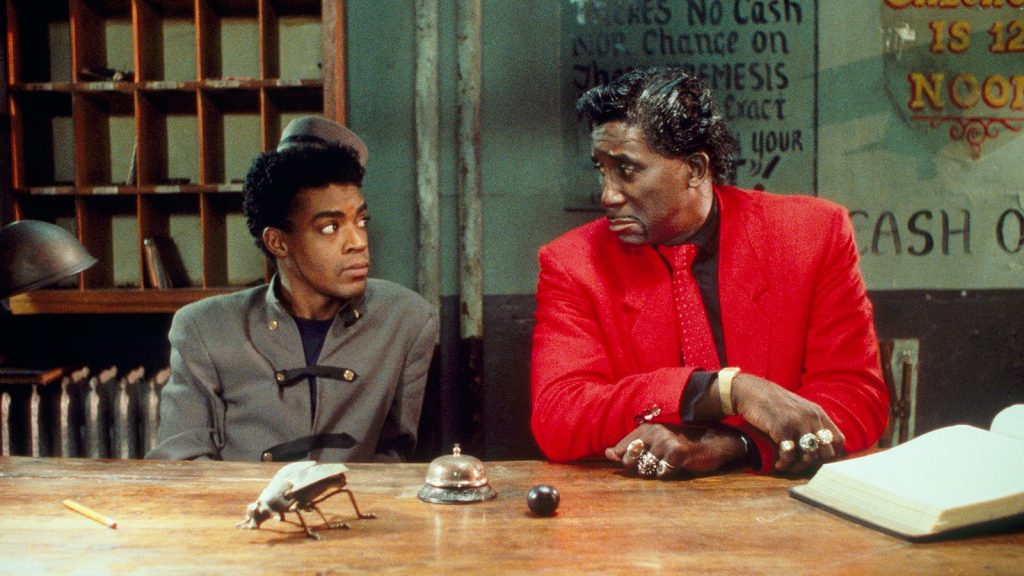
The action — to use the term loosely — happens over one night at a cheap motel run by music legend Screamin’ Jay Hawkins, who sits behind the counter in a blinding red suit, taunting a young bellhop for his lack of style. (He’s played by Jarmusch’s NYU classmate and Spike Lee’s kid brother, Cinque.) The motel will also see the arrival of an Italian widow (Nicoletta Braschi) and her new friend who never stops talking (Elizabeth Bracco) as well as a handful of ne’er-do-well dudes trying to talk down their drunken mess of a pal (The Clash frontman Joe Strummer) who just lost his job and his girl and wants to take it out on the world.
In all three stories, all of these characters will hear local disc jockey Lee “Baby” Sims – the character Tom Waits played in Down by Law – spinning Elvis’ haunting cover of “Blue Moon.” A little later on, they’ll all hear the same gunshot. But only one of them will see the ghost of Elvis Presley, who’s pretty sure he’s wandered into the wrong room. Mystery Train is playful that way, using the overlapping incidents in the three stories not to make one of those grandiose “everyone is connected” statements that became an easy way to get invited to the Oscars in the early 2000s, but rather to reflect how differently we all experience the same things. In other words, some people prefer Carl Perkins.
We’re all headed in the same direction, but everyone’s in different compartments on this train. 16 coaches long.
“Mystery Train” is streaming on the Criterion Channel.