Sean Burns
The second-biggest blockbuster of 1981 was about a couple of old fogeys puttering around a cottage. Ranking just behind Raiders of the Lost Ark as the year’s box office champ, On Golden Pond grossed $119 million in U.S. theaters, which adjusted for inflation would be about $400 million today. Based on a hit play by Ernest Thompson, it’s a cozy, toothless rumination on aging and the passage of time, with two scrappy senior citizens sharing what may be their last summer together in a New Hampshire lake house. There’s not much on the page beyond folksy wisecracks and pat affirmations, and if you threw a couple of TV actors in the cast it’d be the kind of thing that could play forever on the Hallmark Channel. But director Mark Rydell’s big-screen version boasts an alchemical element which makes On Golden Pond far more than the sum of its treacly parts. The leads aren’t just movie stars, they’re movie legends.
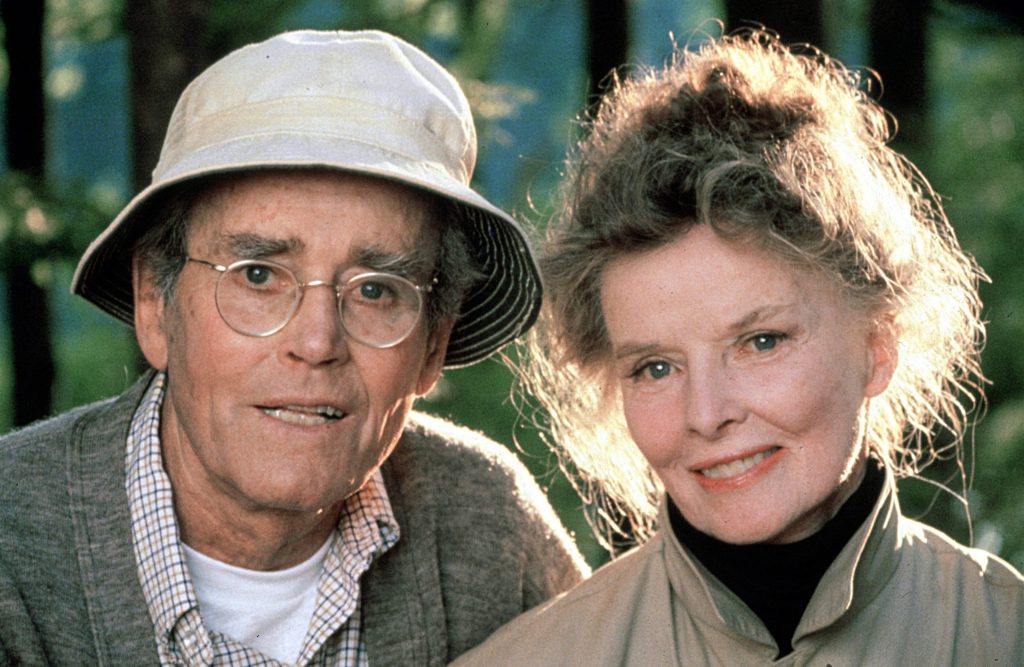
Henry Fonda and Katherine Hepburn both won Oscars (his first, her fourth) for their performances as Norman and Ethel Thayer, a couple entering their sunset years together with fortitude and good humor. He’s irascible and a bit of “a poop,” she’s one of those wives who’s gotten good at handling everything while letting her husband think he’s running the show. They have such a comfortable rapport together it’s surprising to learn that this wasn’t just the first time the two screen icons had ever worked together, but that they’d never even met before the production. (Hepburn gifted Fonda with one of Spencer Tracy’s hats, which he wears during the movie.)
The film has often been referred to as a lifetime achievement award ceremony for these two performers, whose outsized Hollywood histories dwarf anything in Thompson’s screenplay. We can’t help but bring decades of our own associations with Fonda and Hepburn to this quaint little cabin. At the time, Boston Globe critic Michael Blowen complained “Henry is never Norman, Katherine is never Ethel.” I would argue that’s the film’s entire appeal. A movie about Norman and Ethel would be pretty boring. The power of the picture is that we’re watching Henry Freakin’ Fonda and Katherine Goddamn Hepburn realize that their time is running out. It’s twilight not just for the Thayers, but for an entire era of Hollywood.
However thin the material, these are fantastic performances. At first it’s shocking to see Fonda so frail. After all, this is Wyatt Earp, Tom Joad, and Abraham Lincoln we’re looking at here — and those are just the John Ford films! But we’re quickly reassured that Norman is still wily and always ready with a one-liner, tormenting the poor mailman for yuks. Fonda occasionally lets us glimpse something behind the script’s curmudgeon schtick, not just a fear in his diminishment but an anger as well. Hepburn makes us privy to flashes of the same as perpetual caretaker Ethel, a starchy old Yankee who acts like everything is okay, until it’s not. The then-74-year-old actress even did her own stunts, jumping into the lake and swimming to her husband’s rescue in a boating accident sequence. Take that, Indiana Jones.
On Golden Pond is about as sappy as the title makes it sound, beginning with a tinkly piano and idyllic nature shots that look like paintings from a dentist’s office waiting room. (The film was shot on New Hampshire’s Squam Lake, with Lake Winnipesaukee doubling for some of the boating scenes.) Few credits inspire more dread than “Music by Dave Grusin,” and the film’s lachrymose score is slathered over scenes like lard. Yet this very phoniness is what makes the picture so palatable. An honest film about the ravages of old age would have to be a horror movie — or Michael Haneke’s “Amour” — and nobody wants to watch that. Especially not with Hank Fonda and Kate Hepburn.
The processed cheese of the production is why it’s so pleasant to watch these icons of the screen going gently into that good night. When the Thayer’s daughter Chelsea — played by Fonda’s own daughter and fellow Hollywood legend Jane — arrives for a visit dragging a new boyfriend (Dabney Coleman) and his teenage son in tow, the stage is set for some family therapy amongst the loons on the lake. Entire lifetimes of resentment are resolved with easy, symbolic gestures, like Chelsea finally being able to impress her dad with a backflip dive she could never pull off as “a little fat girl.”
(I’ve always assumed that bit of backstory was thrown in as explanation for how much of the film the younger Fonda spends parading around in a bikini and cutoff little denim shorts that made an indelible impression on this young critic during the film’s incessant HBO airings. She was a year away from establishing her fitness empire, in the kind of peak physical condition you can’t blame someone for wanting preserved forever on film. Audiences certainly didn’t mind.)
In her 2005 memoir My Life So Far, the actress writes quite movingly about optioning Thompson’s play as a way to work with her father and force an emotional connection that had eluded them in real life. Unlike his warm, avuncular screen persona, the elder Fonda was famously cold and aloof. Her plan didn’t quite work out, as according to Jane, their characters’ catharsis remained a strictly onscreen phenomenon. But something does happen in that scene, something undeniably moving that feels like more than just a matter of an actor’s craft. Amid all the schmaltzy Hollywood trappings of On Golden Pond, it feels like we’re witnessing something real.
“On Golden Pond” is streaming on Amazon Prime, Peacock, Kanopy, and several ad-supported streamers.