Sean Burns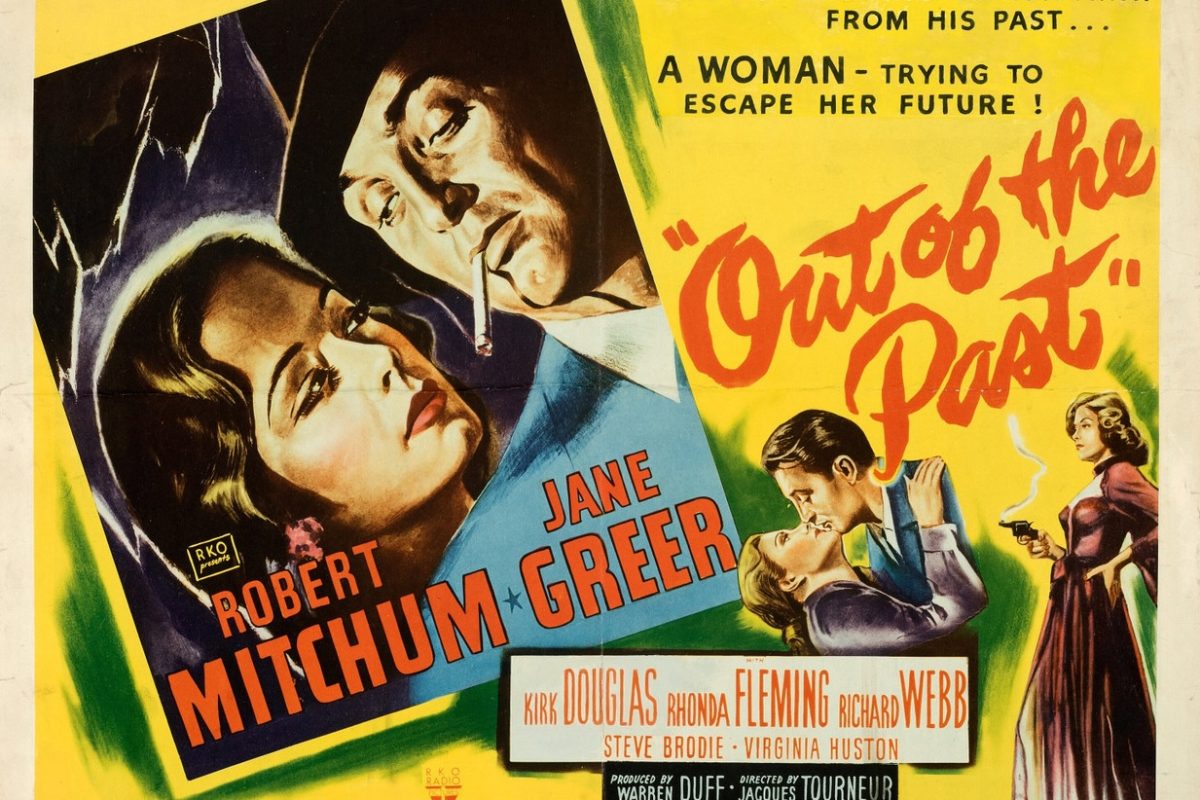
Roger Ebert liked to call Jacques Tourneur’s Out of the Past the best cigarette-smoking movie ever made. Personally, I’d go with To Have and Have Not, which made the era’s hottest sex scenes out of Bogie and Bacall lighting each other’s butts. But for sheer volume, Tourneur’s 1947 film noir probably has the most ubiquitous use of tobacco products, with characters smoking so much that co-star Kirk Douglas famously offers a cigarette to Robert Mitchum while he’s already got one burning in his hand.
“Cigarette?” Douglas asks.
“Smoking,” Mitchum replies, lightly gesturing with the lung dart.
Douglas’ seriously sketchy captain of industry is in the process of hiring Mitchum’s slightly shady San Francisco private eye to track down a dame that shot him and ran off with 40 grand. He doesn’t care about the money, he just wants the girl back. “When you see her, you’ll understand why.” And he does. We all do. She’s played by Jane Greer as an irresistible bundle of bad news. The detective tracks her down in Acapulco, and Douglas quickly realizes that maybe it wasn’t the wisest idea to send Robert Mitchum to go find your gorgeous girlfriend. But all of this happened a long time ago.
Out of the Past begins in the present. It’s five years later and Mitchum’s character is running a small town gas station under a fake identity. He’s got a cute deaf kid sidekick and the sweetest gal in Bridgeport only has eyes for him. But one day Douglas’ loyal, long-suffering henchman (Paul Valentine) comes rolling up to the service station. His boss once said he “couldn’t find a prayer in the Bible” but he’s managed to find Mitchum, and now they’ve all got some old business to settle back in Tahoe.
As with most great noirs, the particulars of the plot are largely inessential to enjoying Out of the Past. There’s an awful lot about ledgers and affidavits that I’ve never really cared to understand. (Mitchum himself liked to joke that some of the script’s pages got lost in the mimeograph machine.) As with all great noirs, the movie is more about a feeling, about being doomed by dumb decisions and bad girls that have come back to haunt you. What makes this one unique is the breezy insouciance with which Mitchum faces his fate, the unflappable hepcat coolness of a movie icon being born. When a woman tells him that she doesn’t want to die, Mitchum responds, “Neither do I, baby. But if I have to, I’m gonna die last.”
He’d been a star for some time, but this was the role where it really all came together for Mitchum. The fedora, the trench coat, the omnipresent cigarettes, and most of all the attitude all clicked into place. When Greer protests her innocence before a kiss, his immortal reply “Baby, I don’t care” became not just the quintessential Mitchum line reading but also the title of his 2001 biography. Film critic James Agee, who would go on to write the screenplay for The Night of the Hunter eight years later, said of the star, “Mitchum is so very sleepily self-confident with the women that when he slopes into clinches you expect him to snore in their faces.”

He almost didn’t play the role at all. As presumably was the case with any sardonic detective role back then, the part was offered first to Humphrey Bogart. Then disaster very nearly struck when the four-seater plane transporting Mitchum to the movie’s Bridgeport location lost its brakes and crashed through a fence into an outhouse. The actor climbed out of the wreck and hitchhiked to set. The panicked production team had just heard news of the plane crash and were scrambling for details when a scuffed Mitchum sauntered up and asked if anybody had any weed. (He called it “gage,” the preferred term for marijuana among Black jazz musicians at the time.)
Greer said that Mitchum would show up every morning, perusing the script as if for the first time and asking, “What are the lyrics?” She theorized that the actor’s trademark nonchalant delivery was a result of having just learned his lines minutes before the camera started rolling, though this could also be a part of the elaborate ends Mitchum often went to in order to make it appear that he didn’t give a damn. His brand of cool relied on being as laid-back as possible, which makes for a fascinating contrast onscreen with the famously intense Douglas, who’s all gritted teeth and seething sinew. By many accounts, theirs was a playfully competitive relationship that did not translate to affection offscreen. Ebert pointed out how the two often seem to be smoking at each other. This was only Douglas’ third role in a movie, but he makes such a strong an impression I’m always a little disappointed by his unceremonious exit.
Out of the Past is so foundational a film noir it’s easy to forget how atypical it is in some respects. Most of the story takes place not on the mean streets of a seedy city but in the Sierra mountains, with lots of bright, wide-open vistas. Tourneur’s Cat People cinematographer Nicholas Musuraca compensated by keeping the interiors so shadowy people were reportedly tripping over each other on the set. Greer would reunite with Mitchum two years later in Don Siegel’s The Big Steal, and then again in 1987 when he hosted Saturday Night Live. She dropped by for an Out of the Past parody sketch called Out of Gas, which I rather infuriatingly haven’t been able to find online. Simply Red was the musical guest that night, and it’s kind of mindblowing to realize that folks from such distinctly different eras were all famous and on television at the same time.
“Out of the Past” is streaming on HBO Max.