Sean Burns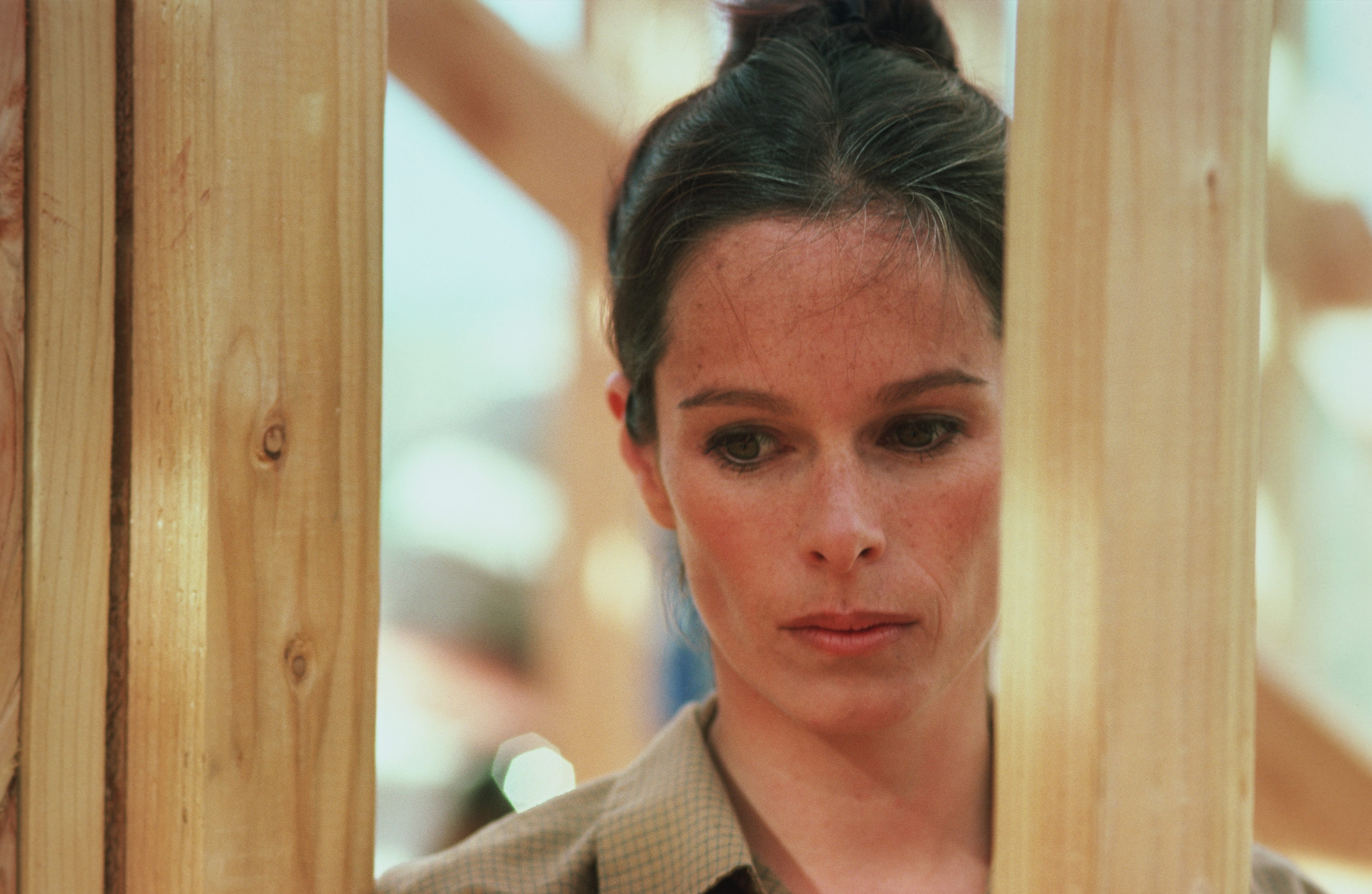
The construction site that serves as a central location in Remember My Name is a wooden skeleton of a house. Workers walk freely through big gaps where walls are soon to be, but looked at from a certain angle – particularly in the crushed, telephoto compositions of cinematographer Tak Fujimoto – the structure can resemble the bars of a prison. That’s how we first get used to seeing Anthony Perkins’ Neil Curry, a leather-jacketed day laborer who doesn’t seem to quite fit in with the other fellas. (As if Anthony Perkins could fit in anywhere?) We watch Neil from a remove. He’s being spied on by a woman named Emily. She’s played by Geraldine Chaplin in a performance of jangled nerves, anxious energy and endless cigarettes. She lights one off the end of the other while she watches Neil. She’s waiting, but for what?
Written and directed by Alan Rudolph, 1978’s Remember My Name is a tantalizing, elliptical affair with about as many empty spaces as the house that Neil and his crew aren’t exactly exhausting themselves to fill. We eventually put together that Emily has recently been released from prison after serving 12 years for a crime the movie is in no hurry to tell us about. She gets a job working the register at a local department store run by her old cellmate’s son. Played by an impossibly young and spindly Jeff Goldblum, the marvelously named Mr. Nudd has a soft spot for his mom’s charity cases. This is not a sentiment shared by shift supervisor Rita (Alfre Woodard), who has seen too many lost causes like Emily come and go.
We can’t be sure what exactly Emily is up to, or why she’s flirting with her apartment building’s super (Moses Gunn) and making weird requests for stuff like an extra security lock for the front door. She has a way of spitting out her words in sudden torrents. It seems as if she’s been rehearsing them for some time – maybe even 12 years – and she’s going to say them now whether you’re listening or not. Chaplin is mesmerizing, exhibiting a ferocious single-mindedness amid sudden bursts of violence with which she seems to surprise even herself. Her stalking of Neil soon escalates to terrorizing his wife Barbara (played by Perkins’ real-life spouse Berry Berenson) and it’s more than halfway through the picture before we finally find out why. Sort of.

Alan Rudolph started out as an assistant director to Robert Altman on The Long Goodbye, California Split and Nashville before Altman began producing Rudolph’s own directorial efforts with Welcome To L.A. in 1976. There’s a lot of obvious overlap in their regular ensembles and production crews, yet Rudolph’s sensibility is significantly less spiky than that of his mentor, more indulgent of his characters’ quirks and idiosyncrasies. For all its foreboding and mysterious motives, Remember My Name somehow doesn’t come off as a particularly unpleasant or mean-spirited movie. There’s something almost wistful about it.
It’s basically a running joke that every bit player in the movie is having a terrible day, with bartenders, store clerks and anyone else we encounter worn down to their very last nerve. People are constantly snapping at each other in ways Rudolph can’t help but find unaccountably funny. The soundtrack is comprised entirely of old blues tunes sung by Alberta Hunter, who had recently made a return to the stage, well into her 80s. The songs unite all these sniping, disparate characters under the same downhearted cloud, their misery making beautiful music.
It turns out Neil and Emily used to be married, way back before she wound up in the slammer. What a pair Chaplin and Perkins make together — they’re all sinewy, awkward angles and antsy energy. It doesn’t take too long for these two to get up to their old tricks, at which point Remember My Name becomes an even more enticingly oblique experience. We learn everything about these two, and also nothing. Rudolph’s screenplay feels like a Raymond Carver short story in how much it tells you by leaving almost everything out. (Altman’s own 1993 Carver omnibus Short Cuts owes more than a little of its atmosphere to Remember My Name, especially the blues song soundtrack and the device of an earthquake that puts the characters’ problems into puny perspective.) Remember My Name attained a certain mystique among cinephiles over the years from never being released on VHS or DVD. The first time I saw it, I was fighting to stay awake during one of the film’s rare appearances on late night cable, which made the ending’s abrupt ellipses even more obscure. But on a second (daytime) viewing Rudolph’s intentions are a bit clearer, with the wrought iron headboard of Emily’s bed becoming another set of prison bars and Berenson’s newfound cigarette habit representing the passing of a (nicotine) torch. One character finds freedom while the rest are left with playful visual evocations of how people can remain locked up in their pasts.
“Remember My Name” is streaming on Amazon Prime.