Sean Burns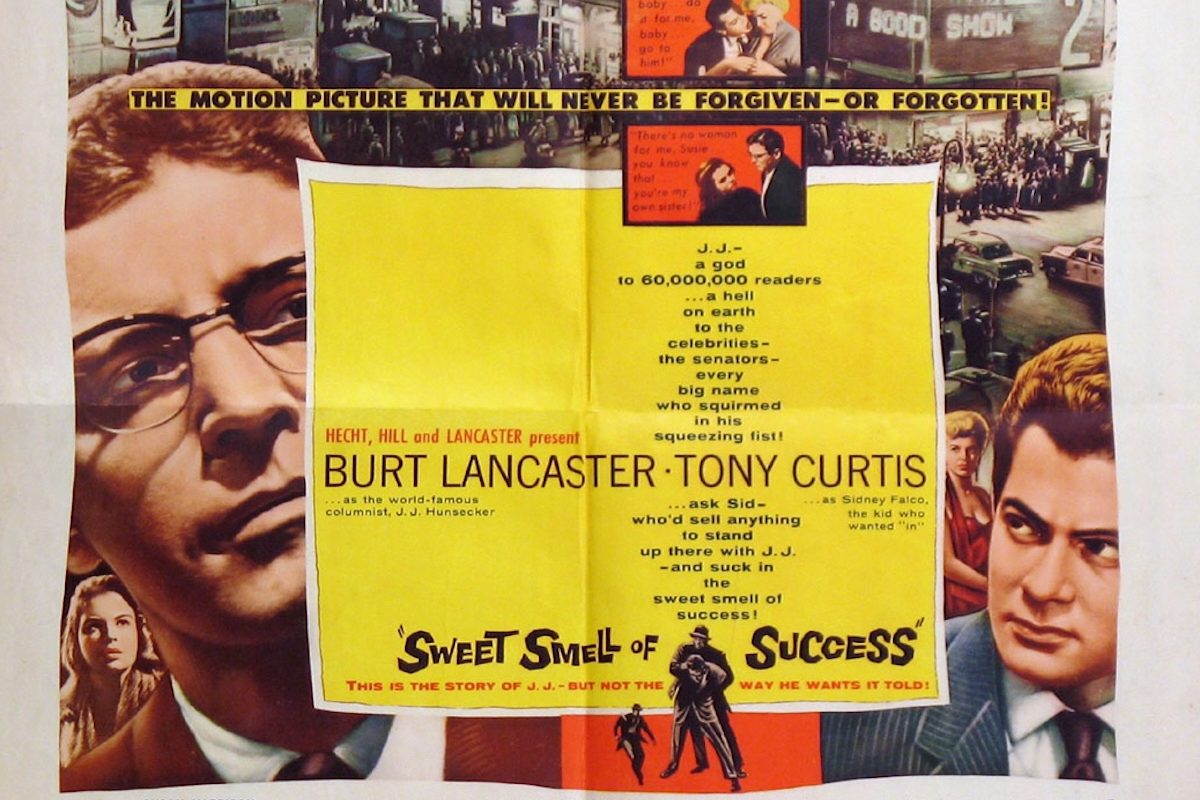
When it bombed at the box office in 1957, Alexander Mackendrick’s Sweet Smell of Success was perceived as a thinly veiled attack on powerful gossip columnist and red-baiting radio host Walter Winchell, who publicly reveled in the film’s failure. Now, nearly 70 years later, nobody knows who Walter Winchell was anymore – in fairness, I don’t think most people under 40 have any idea who Burt Lancaster and Tony Curtis were, either — yet the movie has endured as a classic, with character names and quotable lines that have entered the cultural lexicon. Sweet Smell of Success has surpassed its inspiration for the same reason Citizen Kane outlived William Randolph Hearst. These are movies about more than just a specific man of his time, but about human nature itself.
And boy golly, does this one show a grim side of the species. A bleak and unsparing depiction of obeisance before power in a morally bankrupt culture, Sweet Smell of Success started as a story screenwriter Ernest Lehman wrote for Cosmopolitan magazine called “Tell Me About It Tomorrow!” inspired by his early days working as an assistant to a press agent for The Hollywood Reporter. Said press agent then refused to speak to Lehman for a year and a half after the story was published, which is entirely understandable if you’ve seen the picture.
Tony Curtis stars as Sidney Falco, a small-time publicist and inveterate hustler so low on the showbiz totem pole that his office (where he also sleeps) doesn’t even have his name painted on the door, just a cardboard sign. Sidney schemes to get his clients mentioned by Burt Lancaster’s kingmaker columnist, the immortally named J.J. Hunsecker, who rules New York City nightlife like a feudal lord. Long before we meet the character, we see a logo of his ominous eyeglasses looming over the action on Broadway billboards and passing news trucks, overseeing everything like if Dr. T.J. Eckleberg was a terrifying asshole.
Lancaster’s crisp elocution was never put to more satisfyingly sinister ends, portraying the writer as a tightly-wound, sexless automaton. He’s a man seemingly impervious to human feeling, one of those people often found in the entertainment industry where you can’t understand how they ever got involved in show business because it’s impossible to imagine them taking any pleasure in music or art. It’s all simply land for him to conquer. Hunsecker’s dead-eyed stare famously came from Lancaster smearing Vaseline on his glasses so he couldn’t focus on anyone in front of him. It’s how he seems to be looking through everybody.
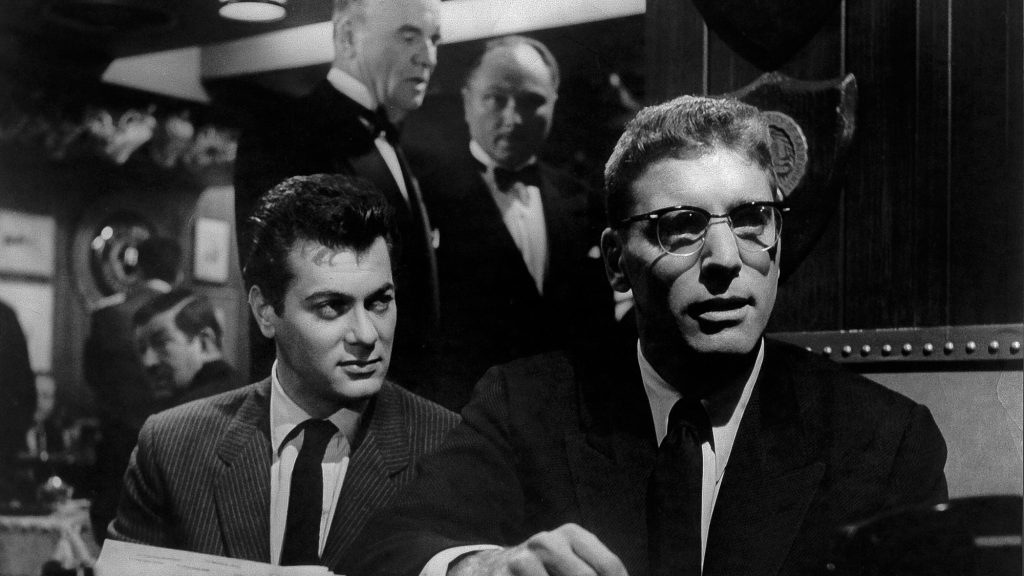
He certainly sees right through Sidney, and that’s why he’s unable to conceal his contempt for the younger man’s cloying desperation. Falco doesn’t mind, he just needs to get back into Hunsecker’s good graces. To do that, he’s tasked with sabotaging a relationship between an up-and-coming jazz musician (Martin Milner) and the columnist’s sweetly naïve sister (Susan Harrison), who doesn’t have a shred of her big brother’s ruthlessness. There’s no way Hunsecker is going to let his baby sis run off with some musician, even if he’s seemingly the only jazzman in 1950’s New York City who doesn’t do drugs.
These young lovebirds are admittedly pretty boring—so much so that the movie has trouble feigning interest in them for very long, and instead devotes most of the screen time to the toxic dance between Falco and Hunsecker. Shot in gorgeous, high-contrast chiaroscuro by the legendary James Wong Howe, Sweet Smell of Success creates a seductive, nocturnal New York City that seems to be both glowing and rotting from within. The harsh light across Lancaster’s eyeglasses paint the actor’s face with shadows, giving the character a Mephistophelean leer. Lehman’s script was heavily re-written by playwright Clifford Odets on set, sometimes the morning scenes were being filmed. It’s said he could often be heard in a prop truck, typing some of the era’s most indelible lines: “The cat’s in the bag, the bag is in the river,” “You’re a cookie full of arsenic,” and my personal favorite, “You’re dead, son. Get yourself buried.”
It’s long been my pet theory that painting Falco as such a sycophantic twerp was Odets’ way of purging his guilt for naming names as a friendly witness in front of the HUAC committee five years earlier. Curtis was hugely popular with young audiences – the Times Square shoots were frequently mobbed with gawking teenyboppers – and none of them were expecting a movie in which the up-and-coming heartthrob would turn out to be such a shit. You keep waiting for Sidney to suffer a serious pang of conscience and turn things around, to finally realize that there are some lows to which he won’t sink for the sake of his career. And he never does. It’s why audiences at the time didn’t just dislike the movie, they deeply resented it.
It’s also why it’s aged so well. Watching it again for the first time in a couple decades, I was struck by how relevant Sweet Smell of Success seems today, when we’re seeing people who know better grovel and prostrate themselves for proximity to power on a daily basis, submitting to humiliation rituals live on cable news the way Sidney dutifully jumps to light Hunsecker’s cigarettes. Turns out it’s a whole country full of Falcos; cookies full of arsenic.
“Sweet Smell of Success” is streaming on Kanopy, Hoopla, and Tubi.