Sean Burns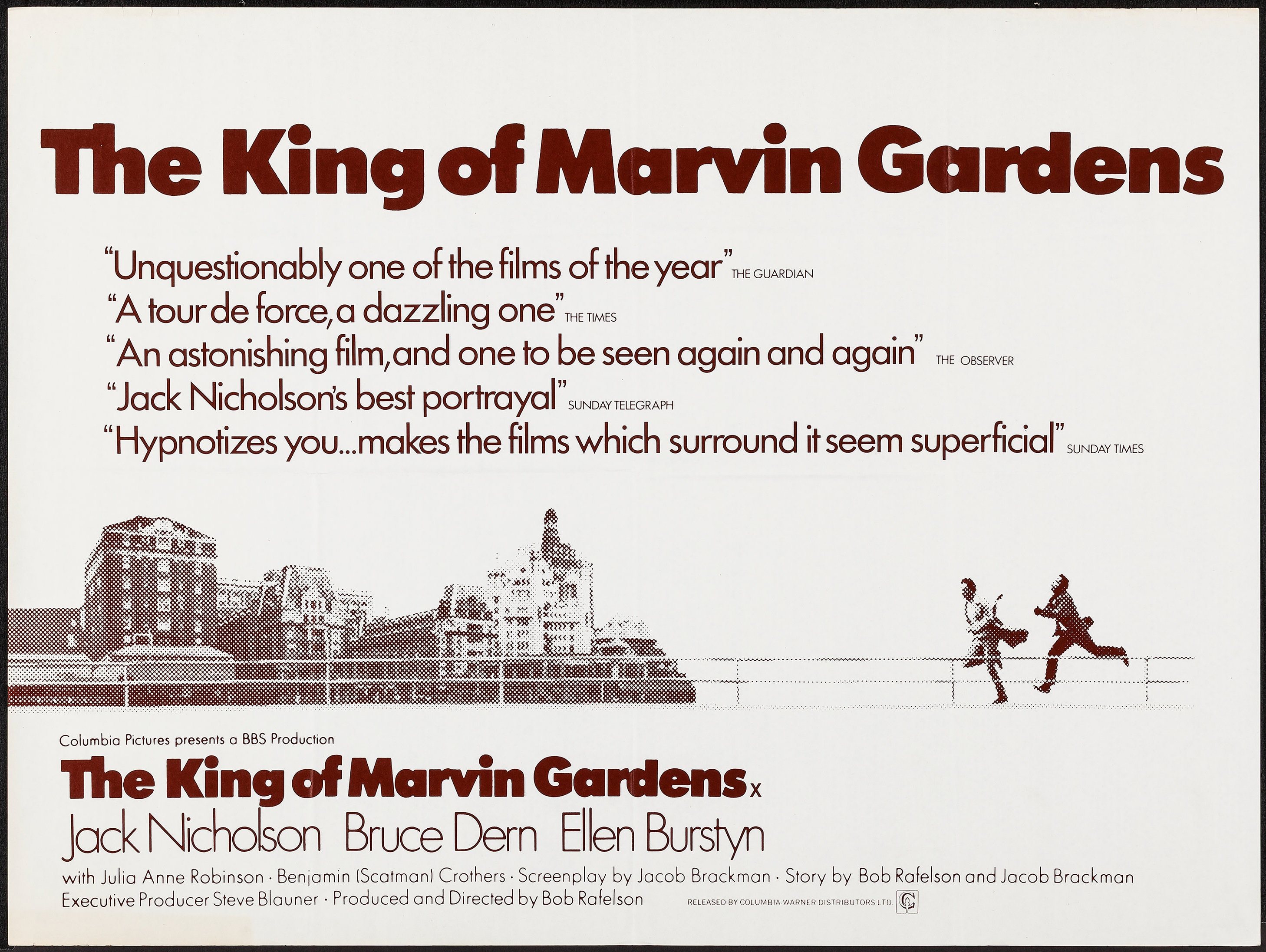
It begins in blackness. Without so much as a studio logo to let us know that the film is starting, Jack Nicholson slides sideways onto screen, his face filling the frame in tight close-up. Addressing the audience while also looking somewhere beyond us, he purrs, making a meal out of dramatic pauses: “I promised that I would tell you… why… I never eat fish.” We eventually put together that he’s a late-night FM radio host, monologuing into the microphone at three o’clock in the morning. His name is David Staebler and the program is called “Et Cetera.” The tale he tells is a harrowing one, about how David and his brother Jason watched their grandfather choke on a bony filet of sole and did nothing to help the mean old bastard as he died right in front of them.
Like most fish stories, it’s entirely fabricated. Minutes later we see that David lives with his grandfather in a Philadelphia townhouse, which is a perfectly disturbing and disorienting way to begin The King of Marvin Gardens. The eagerly anticipated 1972 reunion of Nicholson and his Five Easy Pieces director Bob Rafelson confounded audiences at the time, and despite the imprimatur of a Criterion Collection release, continues to cause more than a little head-scratching today. A moody and meandering meditation on brotherhood and broken dreams, it’s one of those great, misshapen movies full of bizarre tonal shifts and strange directorial choices that don’t seem to make much sense in the moment but linger in your mind for months afterward. Pauline Kael called it “an unqualified disaster of the type that only talented people have.” I think it might be something of a masterpiece.
Nicholson is counterintuitively cast as the more introverted of the two brothers, all bundled up in cheap suits and bad glasses, looking like he’s borrowed Gene Hackman’s costume from The Conversation two years in advance. The blustery one is played by Bruce Dern in a gregariously toothy turn. We first meet Jason when David’s bailing him out of jail, and the hustler will spend the rest of the movie trying to rope his kid brother into riding shotgun on a sketchy-sounding scheme to buy a Hawaiian island and turn it into a gambling resort. Nicholson’s David is not so much sold on the idea as he’s swept along by the chaos Jason kicks up around him wherever he goes, and intrigued by an entourage that includes a mysterious young woman (Julia Anne Robinson) and a manic, fading beauty queen played to the hilt by Ellen Burstyn.
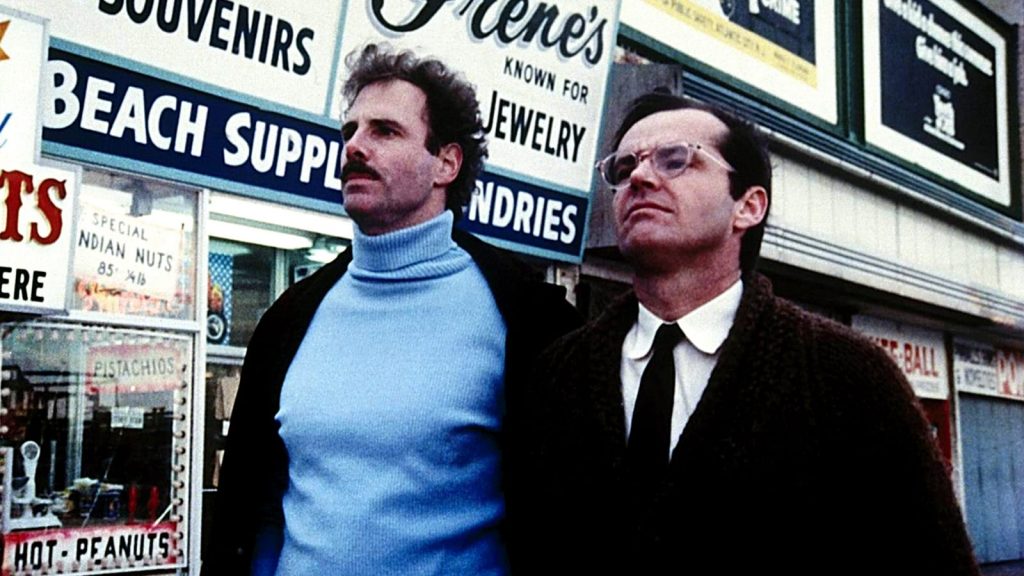
A monument to ruin, the film is set in a crumbling Atlantic City boardwalk area of vacant, outdated luxury destinations that will soon be bulldozed to make way for the casinos that ironically today are also empty. The elderly are everywhere – I don’t think there’s an extra in this movie under the age of 70 — as if haunting the halls of these postwar tourist traps. Everything we see in The King of Marvin Gardens is abandoned or in a state of disrepair, a fitting visual analogue for the characters’ inner lives. Arguably some of legendary cinematographer Lazlo Kovacs’ finest work, the seaside sunshine carries a cool, winter chill. He and Rafelson emphasize the smallness of these characters against their massive, barren surroundings, most memorably when the quartet stages a mock Miss America pageant inside an eerily empty ballroom. It’s like “Ozymandias” in New Jersey.
No, the metaphors in Jacob Brackman’s screenplay aren’t exactly subtle. Like when Burstyn burns her beauty accessories in a beach bonfire and buries her makeup in the sand as a “funeral for Maybelline.” She’s terrifically unhinged here as what Nicholson calls “a middle-aged Kewpie doll,” bitterly aware she can’t compete with her younger companion for men’s attention, so she acts out in all sorts of other, increasingly dangerous ways. This might be Nicholson’s most internalized performance, with all of David’s rage and anxieties turned inward until he ultimately implodes on the air.
The King of Marvin Gardens was the beginning of the end for BBS Productions, the company via which Rafelson, Bert Schneider and Stephen Blauner had parlayed their success with TV’s The Monkees into the launch pad for an entirely new era of adventurous Hollywood cinema, producing Easy Rider, Five Easy Pieces and The Last Picture Show. With its gallery of losers, emphasis on character and atmosphere over incident, and occasionally inscrutable symbolism (why again are David and Jason having that conversation on horseback?), The King of Marvin Gardens is the kind of movie people mean when they describe something as “a ‘70s movie.” As the years wear on, the gorgeously decaying setting seems even more appropriate for a sort of film that’s sorely missed.