Jason Bailey
It’s fortunate that Orson Welles’s The Lady from Shanghai – now streaming on Amazon Prime, and a perfect addition to your “Noir-vember” viewing slate – is a near-perfect movie, because it would be so easy for the juicy backstory to eclipse the end product. To wit: Welles owed $50,000 on the costumes for his elaborate, expensive (and, ultimately, financially disastrous) stage production of Around the World in 80 Days, so on opening day, he phoned Harry Cohn. Cohn was the head of Columbia Pictures, which held the exclusive contract on Rita Hayworth, the redheaded bombshell and Gilda star to whom Welles was married. So Welles offered the mogul a deal: he would write, direct, and star in a film for Columbia, in exchange for an immediate advance of, you guessed it, $50,000. Hayworth would co-star. Cohn asked, not unreasonably, what the film would be. Welles, in a semi-panic, glanced at a nearby bookshelf (or at the paperbacks rack of a newsstand – in some versions of the story, Welles was trying to collect the costumes from customs at the airport) and announced the first title he saw: If I Die Before I Wake, a book he had not heard of, much less read. The deal was made, and (after a title change) the result was The Lady from Shanghai.
That’s a great story, and Welles, ever the storyteller, expanded and retold it for years thereafter. What actually happened, biographer Simon Callow explains in his book Hello Americans, was a good deal less dramatic: Welles was indeed in dire financial straits, and had reached out to Cohn for work when a costume bill came due, though certainly not on opening night. And the project was not selected at random – R. Sherwood King’s 1938 novel had been on Welles’s radar for years, and he had in fact agreed to appear in it for up-and-coming filmmaker (and future B-movie impresario) William Castle, should Castle get the project off the ground. He didn’t, so Welles swiped the property for himself. And it was Cohn, not Welles, who had insisted on the team-up with Hayworth – as the couple, once the toast of Hollywood’s gossip pages, had at that point been separated for the better part of a year.
And yet. The Lady from Shanghai is nevertheless colored by what’s outside the frame, by the circumstances that led its participants to it, because of Welles and Hayworth’s history. It is, by definition, pulp – a film noir thriller, complete with a femme fatale, a sap, a rich husband, a murder, and a complicated plot that ties them all into various knots. Nothing is ever quite what it seems, as they say, in a story like this, and Welles seems (not unreasonably) to have taken that approach to its logical conclusion: if the plot is an illusion, a series of smoke and mirrors, then why get too invested in it?
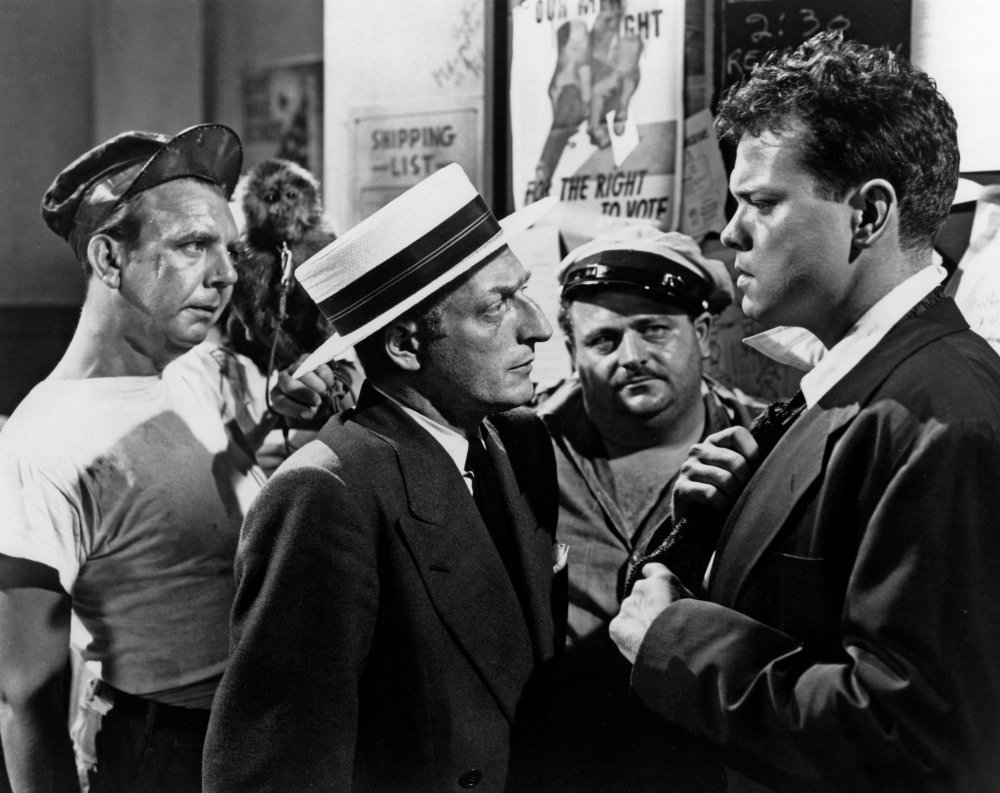
Instead, he takes a roundabout route to the types and tropes, subverts expectations (he infuriated Cohn by transforming famously redheaded Hayworth into an icy blonde), and indulges primarily in mood and style. From a contemporary perspective, the first half or so of The Lady from Shanghai feels less like Welles than Howard Hawks – with the kind of loose, hangout vibe he would create with the ensembles of Only Angels Have Wings and Rio Bravo (among many others). It doesn’t feel subservient to plot the way that even the best noirs often do. Which is not to say that plot isn’t happening; it’s that Welles is less interested in its machinations than in how his characters interact. He revels in the spiky sexual tension between his drifter sailor Michael O’Hara and Hayworth’s Elsa Bannister, who is unhappily married to Arthur Bannister, a wealthy criminal attorney (played by Welles’s frequent collaborator Everett Sloane) who is crippled not only from polio but his unrequited love for his wife with a wandering eye. . “Would you like to work for me?” she asks O’Hara, her voice dripping with possibilities. “I’d like it.” He enjoys the unspoken unease between Michael and Arthur Bannister And when Arthur Bannister, drunk aboard his luxury yacht , starts rambling about whether money can buy happiness, in front of his servants and subordinates, you can cut the strain with a knife.
What’s most striking, on a surface level, is the sweaty sexiness of the movie. The heat generated by not only the tropical climates they’re cruising through but the actors and the characters is palpable (“Do all rich women play games like this?” he asks), and Welles’s camera absolutely caresses Hayworth; she’s never been hotter on screen, not even in Gilda. We sense the effect her attractiveness has on him, both as a man and a filmmaker – when he (and the viewer) get their first eyeful of Hayworth in a swimsuit, his face is out of focus in the foreground. She’s made him all blurry. That blurriness turns to paranoia, which begins to invade the narrative; it soon feels like everyone wants a piece of Michael, for their own cross-purposes.
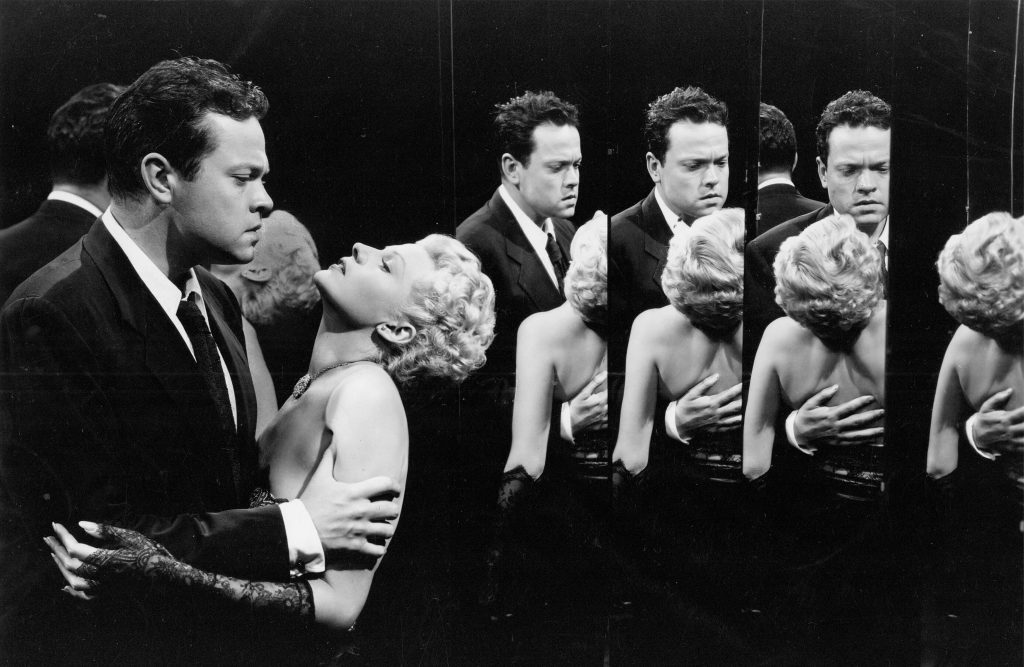
The virtuosity of the filmmaking is what most people talk about when they talk about The Lady from Shanghai, and for good reason. The camera movement is electrifying (the cinematography is credited to Charles Lawton Jr.), and the compositions sizzle; get a load of the uncomfortably tight close-ups when Hayworth takes the stand in the circus-like, out-of-control courtroom sequence. And then there is the justifiably beloved carnival climax, in which Michael finds himself wandering a funhouse, ranting and raving (only semi-coherently) in the voice-over, before finding himself facing both Elsa and her husband in a hall of mirrors that serves as a pointed visual metaphor for the events of the previous 80 minutes. The visual wizardry of the sequence – reflections, eyes, superimpositions, triptychs – still dazzles.
All of which makes Lady from Shanghai a damned fine potboiler, but the stars are what make it more. Welles is a charismatic and magnetic actor, and his work here (dodgy Irish accent aside) is no exception. But Hayworth’s performance is next- level. Elsa draws Michael in with her vulnerability, and though he tries to resist her with his world-weary cynicism, we know he’s a goner, and he knows it too. But that vulnerability is what sticks, even when Welles’s script insists it’s fraudulent, because the way Hayworth looks at Welles… well, you can’t fake that. And when he muses, in the final voice-over, that “Maybe I’ll live so long I’ll forget her” or “Maybe I’ll die trying,” there’s little doubt which way Michael – or Orson – is going to go. 
“The Lady from Shanghai” is now streaming on Amazon Prime.