Sean Burns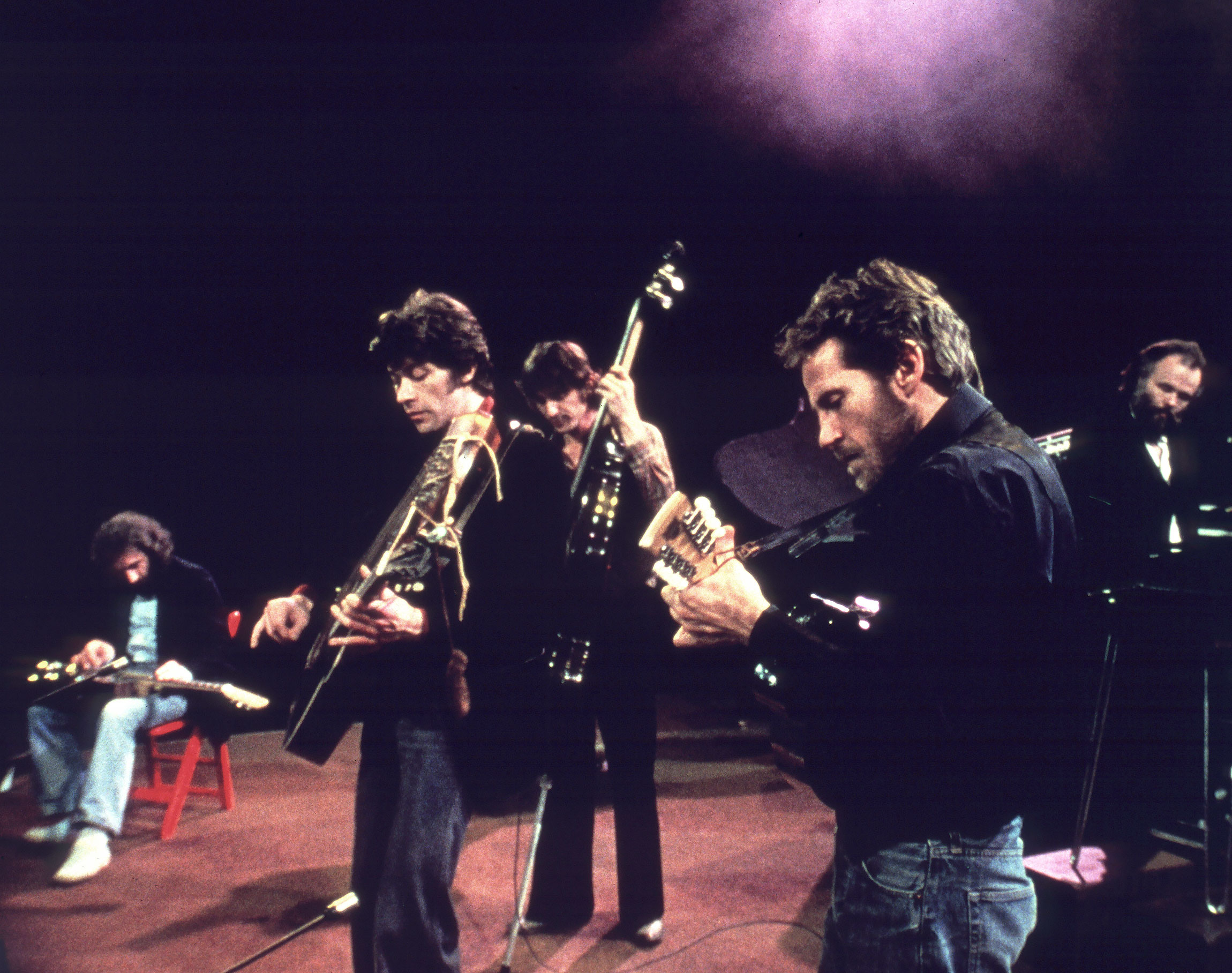
“It’s a goddamned impossible way of life,” says Robbie Robertson in The Last Waltz. He’s talking about touring, and he looks exhausted. Everybody in the movie looks exhausted, except when they’re onstage. Martin Scorsese’s seminal 1978 concert documentary is not just a record of some of the most thrilling rock n’ roll performances ever captured on film. In the behind the scenes banter between Robertson, Levon Helm, Rick Danko, Richard Manuel and Garth Hudson – aka The Band – it is also a slightly alarming portrait of prematurely aging people who appear in desperate need of a good night’s sleep. And perhaps a salad.
After Robertson decided that The Band was breaking up – a move he may or may or may not have cleared with his colleagues, depending on who you asked – the idea (at first) was to stage a farewell concert with a few friends. Maybe shoot a bit of it on 16mm film or black-and-white video for posterity’s sake. Of course, like most notions floated by 1970s entertainers at odd hours of the morning under the influence of certain substances, it quickly ballooned out of any reasonable proportion, to a point where at the Thanksgiving Day show promoter Bill Graham was serving a sit down turkey dinner to all five thousand people in the audience. (A reported 4k lbs. of bird were harmed in the making of this picture.) Curiously, none of this makes it into Scorsese’s documentary about the concert, in which the audience is barely glimpsed at all.
It’s a weird movie, The Last Waltz. This is something that’s often overlooked a lot when people herald the transcendent musical performances it features. Scorsese actually starts with the last encore at the end of the night – following a quick prologue of Danko playing pool that appears to be the filmmaker warming up for The Color of Money nine years ahead of schedule, and an instruction to projectionists that the film is to be played LOUD. The Band re-takes the stage for the last time (“You’re still here?” a weary Robertson half-kids the crowd) and launches into a hard-charging locomotive cover of Marvin Gaye’s “Baby Don’t You Do It” that ends as abruptly as it began. Then they’re done, the movie over before it even started.
Rock concert films were generally shoddy, 16mm affairs caught on the fly. Scorsese insisted on shooting The Last Waltz on 35mm film, with a murderer’s row of the industry’s best cameramen (László Kovács! Vilmos Zsigmond!) working under the supervision of Michael Chapman. He hired West Side Story production designer Boris Leven, who decked out the Winterland stage with set decorations and crystal chandeliers from the San Francisco Opera House’s production of La Traviata. Scorsese turned the set list into a 200-page shooting script with precise camera movements and lighting cues keyed to the song lyrics. Even post-production was state of the art, utilizing new traveling matte technology pioneered for Star Wars in order to conceal a large chunk of cocaine hanging from Neil Young’s nostril.
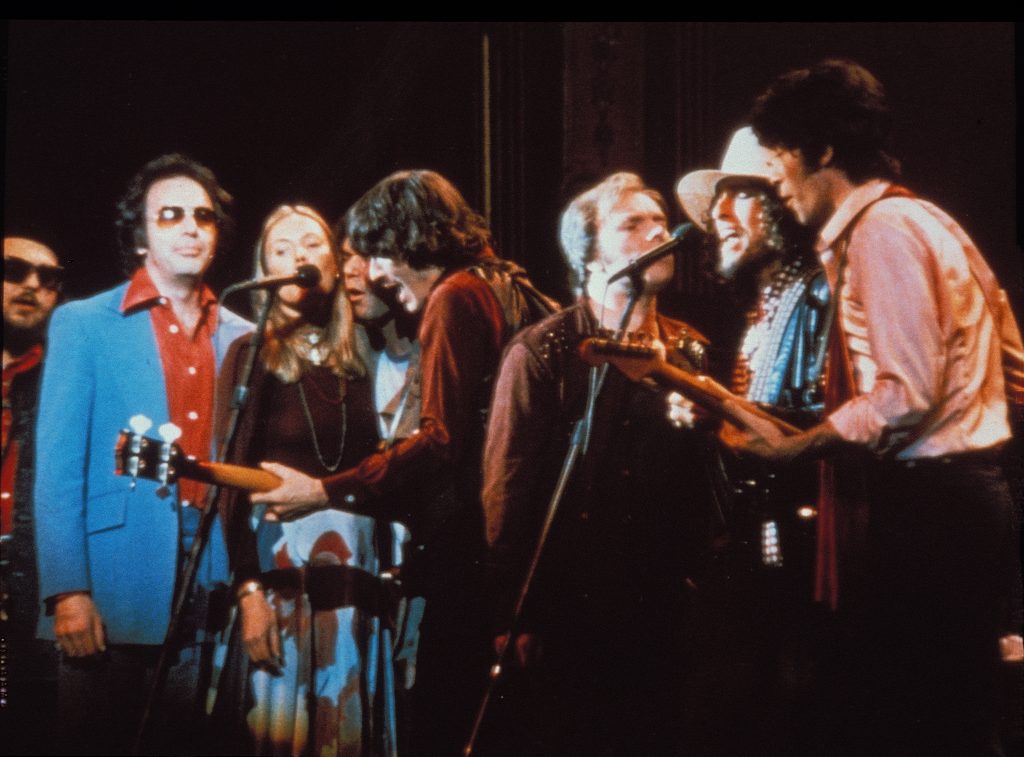
Everyone has their own favorite Last Waltz number, whether it be Van Morrison, resplendent in his purple spangled jumpsuit, kicking the air to “Caravan,” or Bob Dylan howling “Baby, Let Me Follow You Down” like a man possessed. (He has the movie’s best hat, and the competition is fierce.) The film is crammed with iconic guest stars like Muddy Waters, Eric Clapton, Joni Mitchell, Neils both Young and Diamond, Ronnie Hawkins, Emmylou Harris, Paul Butterfield, Dr. John, Ringo Starr and Ronnie Wood. My personal favorite performance wasn’t even shot at Winterland, but later on an MGM soundstage where, in an attempt to offset the overbearing whiteness of the concert lineup, the Staple Singers joined The Band to sing Robertson’s masterpiece “The Weight.”
A soulful and cryptically funny meditation on shared burdens, it’s one of those songs that feels as if it’s always been with us, like a hymn passed down through the ages. I remember being shocked to learn it was written as recently as 1968 – with Robertson taking inspiration from Luis Bunuel’s Viridiana and a bookstore owner named Fanny. The sequence features some of Scorsese’s most fluid, mellifluous camerawork, as if he were harmonizing with the singers. But then, Scorsese wanting to be part of The Band is one of the strangest sources of amusement in The Last Waltz. Hanging around all the backstage segments like somebody’s excitable little brother, Scorsese’s obsequious interview style was the inspiration for Rob Reiner’s Marty Di Bergi character in This Is Spinal Tap. Accentuated by his penchant for leaving bloopers and re-takes in his documentaries, there’s something terribly endearing about a director being so jazzed that he gets to hang out with rock stars. And if I could have one wish for everyone in this world, it’s that we all may someday find someone who looks at us the way Martin Scorsese photographs Robbie Robertson.
The big complaint with The Last Waltz, laid out rather scathingly in Levon Helm’s memoir This Wheel’s On Fire, is that the film is overrun with closeups of Robbie. His billowing scarves and preening stage presence are magnets for Scorsese’s camera, and for a group that prided themselves on sharing singing duties, he does almost all of the talking in the interview segments. (When the Criterion Collection Blu-ray came out last year, I quipped that it should have come with a “Mute Robbie” option. And now I feel awful about that because he died.) Robertson was only 33 years old when the film was shot – same age as another Scorsese protagonist who pulled into Nazareth – and his constant complaining that rock n’ roll is a young man’s game become retroactively amusing when you realize how many performers in the movie are still touring, or at least were until relatively recently.
When Robertson passed away in August at the age of 80, a musician pal of mine was told by a young person in his band that they always thought Robbie was pretentious. My friend replied, “You’re fuckin’ allowed to be if you played on Blonde on Blonde.” It’s true. Robertson could be a camera hog and a gloryhound, but hey – he wrote “The Weight.” The Last Waltz is not a particularly informative movie if you want to learn about the history of The Band. (There’s no mention at all of Big Pink, or any of those electric Dylan shows.) But that’s because Robertson and Scorsese are both natural born curators, which is how they became fast friends and ultimately roommates who ingested most of the cocaine in Southern California. They’re after something much grander than just the story of a band… even if it’s The Band. The Last Waltz is trying to tie in all the disparate traditions of country, gospel, blues and even Tin Pan Alley, attempting to illustrate how this music all flows together to form rock n’ roll. The miracle of the movie is that it succeeds. It’s like a music history class taught by instructors who are all a little zonked, and a filmmaker who adores them.
“The Last Waltz” is streaming on MGM+, Tubi, Pluto TV, and Fobu, and is available for digital rental or purchase.