Audrey Fox
The biopic has been a crucial part of cinema from its very beginning. The first film featuring a historical figure dates all the way back to 1895, with Thomas Edison’s The Execution of Mary Queen of Scots, while the first traditional biopic came out in 1900 – a Georges Méliès production about Joan of Arc. The Story of the Kelly Gang, an Australian action movie released in 1906 about the real-life outlaw Ned Kelly, is often considered to be the first feature-length film. And at only the third ever Academy Awards ceremony held in 1930, George Arliss was given the Best Actor Oscar for his performance as English Prime Minister Benjamin Disraeli in the biopic Disraeli. So when Charles Laughton took on the role of King Henry VIII in The Private Life of Henry VIII, he was not the first film actor to play a real-life character on screen – far from it. But his performance nonetheless influenced the trajectory of the biopic, demonstrating the full potential of actors to redefine historical figures in the public imagination.
The Private Life of Henry VIII, directed by Alexander Korda in 1933, is a fairly straightforward biography of the famous British king. It details the many marriages of Henry VIII, although interestingly enough, it skips over Catherine of Aragon – Henry’s first wife – entirely, and features only a few moments with Anne Boleyn just as she is about to be executed. This choice reflects Korda’s disinterest in delving into the political and religious aspects of Henry’s reign, or is simply an effort to focus on the period of his life best suited to Charles Laughton’s boorish, hot-tempered performance. His romantic life is a comedy of errors, as he is incredibly successful at marrying women but less so at remaining married – after the first two, his third wife dies of complications from childbirth, his fourth (cheekily played by Elsa Lanchester, Laughton’s real life wife) is quickly dismissed on the grounds of being homely, and his fifth is arrested and eventually executed for adultery. (It’s only his lucky sixth wife, Catherine Parr, who survives him.) Nevertheless, he soldiers on, throwing himself into the earthly pleasures of life – namely eating and seducing the many palace maidens who surround him.
In the hands of Charles Laughton, Henry VIII is larger than life, a physically imposing king audiences can well see holding an entire royal court in thrall. He is lusty and bad-tempered, but he also has a charm that can’t help but captivate both viewers and the characters that surround him. His performance is so powerful, so commanding, that it had a lingering effect on how modern audiences view the actual King Henry VIII. There’s nothing in the history books that he was particularly slovenly (in fact, many records suggest that he was unusually fastidious for the time), and yet the image of this immense royal figure tearing into turkey legs with his teeth and throwing the bones over his shoulder persists regardless of its historical accuracy. Biopics of this time could be expected to pay homage to historical figures, but to effectively rewrite them in the public imagination was unprecedented – something only Charles Laughton had managed to do thus far.
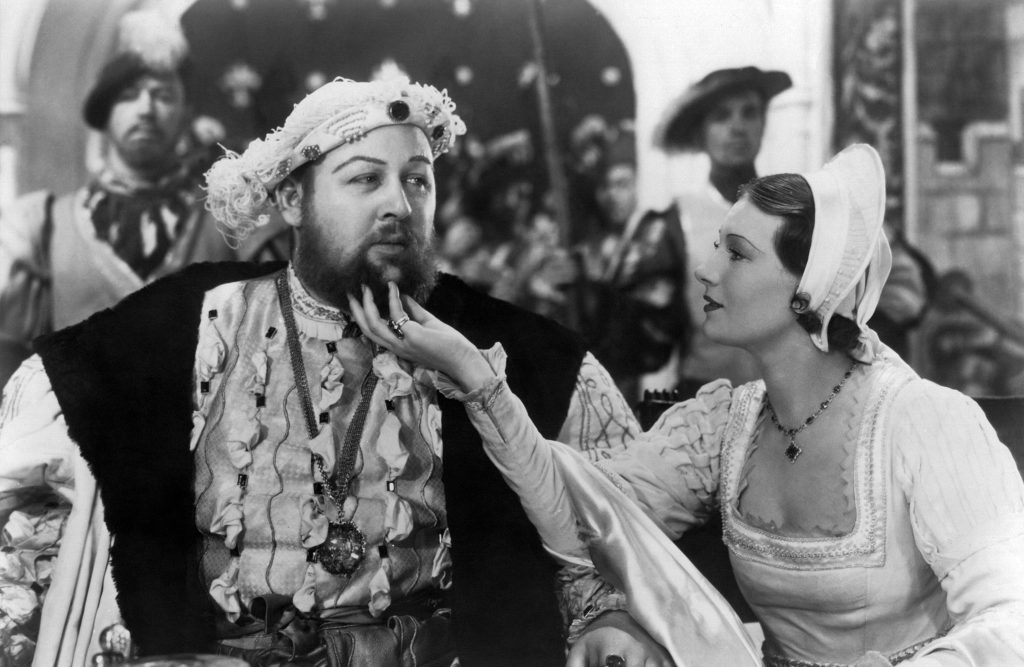
His performance in The Private Life of Henry VIII was lauded appropriately. Mordaunt Hall of the New York Times praised his interpretation of Henry VIII, writing, “He gives an admirable idea of Henry’s vanity and also of his impetuousness, his sense of humor, his courage and fear. This Henry is seldom able to conceal his actual thoughts. If he admires a woman, not only she knows, but everybody else. If he dislikes anything, as he does the appearance of Anne of Cleves, he almost groans.” Writing for TCM 75 years later, Sean Axmaker summarized the legacy of his performance: “Laughton’s rotund, hearty Henry, bouncing between thoughtful statesman and tyrannical man-child, became the definitive screen portrait of the childish tyrant king.”
Although the film as a whole suffers from a lack of focus and cohesion – indeed, it’s more of a set of vignettes about Henry’s later life than anything else – Laughton’s work in it is above reproach. At the sixth Academy Awards ceremony in 1934, he received the Oscar for Best Actor, cementing his performance in the history books. His portrayal of King Henry VIII signaled to audiences that they could expect more from performances in biopics than mere impersonations and dry, matter-of-fact recitations of a historical figure’s life. Actors could take liberties with the truth to better reflect the essence of their character. The king may have had perfectly refined manners in real life, but it fits far more naturally with his lecherous, id-driven persona to depict him as boorish and slovenly. By amplifying some of Henry VIII’s personality traits and following them through to their logical conclusion, Laughton creates a vision of the infamous British ruler that has a life of its own.
“The Private Life of Henry VIII” is streaming on Amazon Prime Video, the Criterion Channel, Max, Tubi, and more.