Megan Feeney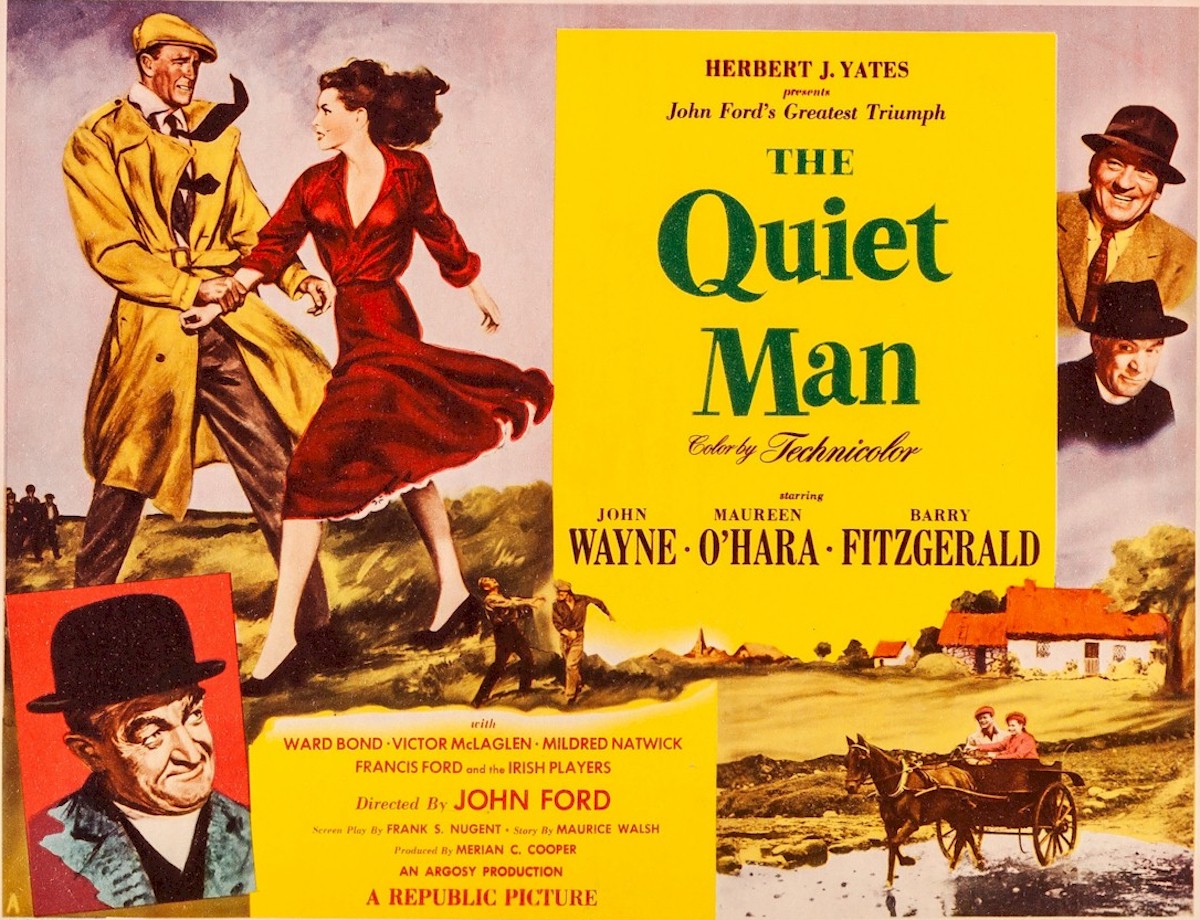
Per Saint Patrick’s Day tradition, John Ford’s 1952 film The Quiet Man will be trotted out this March 17th for nostalgic re-watching, lauded as a masterpiece by one of America’s greatest directors, an enduring tribute to his proud Irish roots, and “one of the greatest love stories ever told.” This year, on the occasion of the film’s 70th anniversary, The Quiet Man merch can still be found in Irish-themed gift catalogs, advertised between so many Claddagh rings and “May the Road Rise Up to Meet You” dishtowels. At the risk of alienating earlier generations of Irish-Americans, including my own relatives, I’m calling “blarney.”
Certainly, I’ll grant that The Quiet Man renders the Emerald Isle gorgeously in Technicolor, with all the expected iconography: glowingly verdant fields ringed by stone walls; lime-washed cottages roofed in thatch; quaint pubs filled with Guinness and folk songs; even a stone castle. A Hibernophile born to Irish parents, Ford insisted upon filming on-location in western Ireland, mostly in the idyllic village of Cong, County Mayo. He would accept no less for his passion project, which was finally green-lighted for production by Republic Pictures almost two decades after Ford bought the rights to Maurice Walsh’s 1933 short story of the same title—a story about an Irish-born, Pittsburgh-raised native son returning “home” to Ireland to buy a little farm, seeking peace and quiet but, instead, falling in love with a fiery “red-haired woman” and then into a protracted battle with her bullying brother over her dowry. From this source material, Frank S. Nugent elaborated a screenplay which begins with a friendly little jab at Ford, with whom he collaborated on ten other scripts: “BEHIND the TITLE and the CREDITS there will be a series of shots in and around Galway, which the director knows like the back of his hand – the same back of the hand which this writer would get if he risked suggesting the shots.”
And certainly, as Nugent’s jab suggests, The Quiet Man is pure Ford as auteur, bearing his authorial stamp despite being a romantic comedy rather than a Western. (Actually, it’s worth remembering that Ford won four Best Director Oscars, none of them for Westerns and the last of them for The Quiet Man). Most obviously, The Quiet Man is populated with Ford’s preferred players. Firstly, there are its top-billed stars: John Wayne (who starred in a dozen Ford films) as the protagonist, Sean Thornton; and the Irish-born Maureen O’Hara (who starred in four Ford films) as the Irish hothead he falls for, Mary Kate Danaher. (With her brilliant red hair and giant green eyes, no actress has been better served by Technicolor, nor by veteran Republic costume designer Adele Palmer.) And secondly, there are its Ford-loyalist character actors: Victor McLaughlin (as Mary Kate’s brother Will Danaher); Ward Bond (as the village priest, Father Lonergan, who also serves as the film’s narrator), and Barry Fitzgerald (as the village’s drunken matchmaker Michaeleen Flynn), each of them trafficking heavily in Irish stereotypes.
Furthermore, though not shot in Monument Valley, The Quiet Man is shot through with Ford’s signature visual style—with the help of another loyal collaborator, cinematographer Winton C. Hoch (who filmed three Ford Westerns, i.e., Godfathers [1948], She Wore a Yellow Ribbon [1949], and The Searchers [1956]). There are sweeping pans of rugged and timeless landscapes, still spaces on which to juxtapose the action of men moving through them. The most gorgeous of these in The Quiet Man is a thrilling horse race on Lettergesh Beach, with a thundering cavalry of men vying for the chance to snatch a woman’s bonnet rather than scalp a Native American. In Ford’s hands, western Ireland looks not unlike the American Frontier West, where Nature and Civilization clash; where the lone hero stands outside the community and its values, even while ultimately defending them; and where the Past is romanticized, even as its passing is rendered inevitable.
It is this sentimentalism about the past that provokes my (corned) beef with The Quiet Man, or perhaps, more fairly, my beef with nostalgic celebrations of it today. What version of the past is Ford—and the 21st century fan of The Quiet Man—pining after? To put it another way, as did Frances Mulraney here, Ford’s portrayal of early 20th century Ireland as some sort of prelapsarian “Heaven” (per its protagonists’ proclamation) has analogy to the “backward[ness]” of “Make America Great Again,” pining regressively for a mythical past in which [white] ‘men were men,’ and their authority was uncontested.
The Quiet Man’s sexism comes through loud and clear, unavoidable in even the briefest of synopses. The film opens with the arrival of a strapping Irish-born “Yank,” Sean Thornton (Wayne), who has “come home from America” to the fictional village of Innisfree, circa 1920s. There, he intends to reclaim the cottage of his early childhood, about which his mother waxed poetic throughout his youth in America (Here we get her voiceover about the “lovely little house. And the roses!” in Sean’s memory.) Shortly after spotting the cottage, Sean spies Mary Kate (O’Hara), herding sheep in an idyllic pasture. Just like the cottage, he determines that he will have her. Her status as object for consumption is, of course, reiterated by the male gaze of classical Hollywood cinema, not least of all in this first scene, in which Michaeleen Flynn compares Sean’s immediate lust for her to “a terrible thirst.” The film thereafter unfolds as Sean’s quest to quench that thirst: securing Mary Kate as his bride, away from her possessive brother, and then consummating their marriage, belatedly.
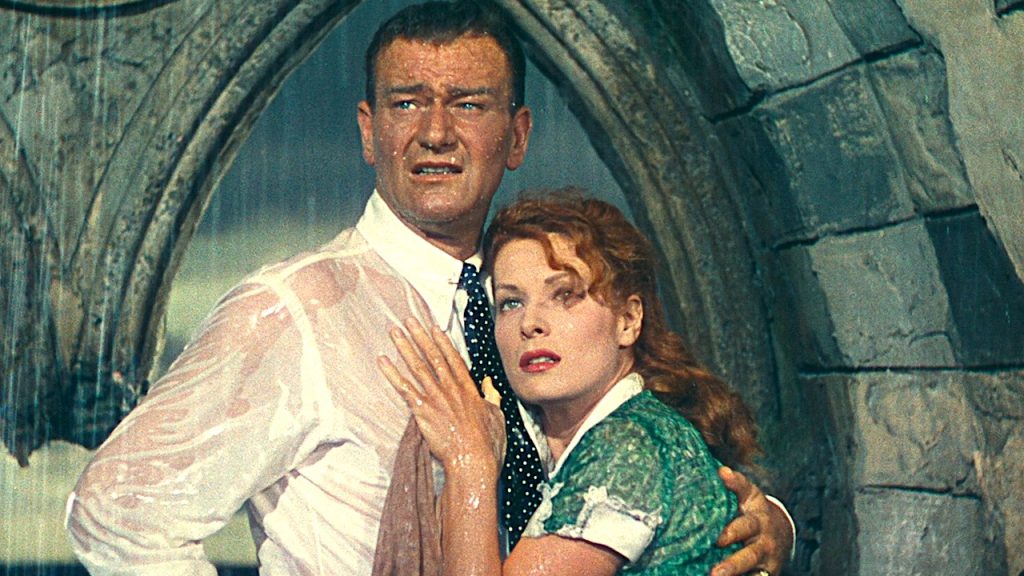
In other words, Mary Kate is an object for consumption and, relatedly, an object of exchange between men. Per Irish custom, Sean learns that he must win Mary Kate’s brother Will’s permission for her hand, and that she comes complete with a £350 dowry. On one level, The Quiet Man gently critiques this Irish patriarchal system as a relic of the past; as a modern American, Thornton thinks the matters of Will’s permission and the dowry are absurd. But on another level, the film redeems it; after all, it is Mary Kate who insists that Will pay her dowry, as a measure of her value. In fact, until Sean proves himself ‘man enough’ to fight for it, she withholds sex, denying Sean his rightful physical satisfaction and the procreation of heirs, causing him to be as “ill-tempered” as the black steed he rides.
Similarly, the film moves towards a critique of what we call “toxic masculinity” today, but ultimately reiterates the same, with gusto. The film’s title refers to Sean’s “quiet and peace-loving nature,” his pacifism born of a boxing match in which he accidentally killed his opponent. (Ford renders this accident in flashback, in a sequence so modern in its sensibilities that it belies the rest of the film as old-fashioned even in 1952.) Thornton refuses to fight Will, and won’t be chided into it by accusations of cowardice, by his wife or anyone else. That is, until the film’s end, when Thornton finally cracks, and confronts Will in a bare-fisted brawl, much to the delight of Mary Kate and the entire village, assembled to spectate and bet on the results. For much of its running time, The Quiet Man suggests the righteousness of Thornton’s “turn-the-other-cheek” philosophy, but this climactic fight sequence of a full ten minutes undoes all of that, with its gleeful energy, jiggy score, and slapstick comedy. Clearly, Ford’s heart is in the fighting—just as Nugent’s quote hints at above.
In fact, toxic masculinity seems to act as a sort of ‘kink’ for the lovers in this ‘greatest’ of ‘love stories.’ In a famous scene, Wayne yanks O’Hara into his new cottage, as rough as the gale force winds outside, causing her to swoon first, slap second. (Flynn later reprimands Mary Kate for her “fearful temper” with Sean: “Have the good manners not to hit the man until he’s your husband and entitled to hit you back.”) Mary Kate’s tempestuousness–dialed up to an eleven in O’Hara’s over-the-top performance–is an expression of a certain independent-mindedness, sure, but refracted entirely through the male fantasy of the “wildcat,” implying male sexual satisfaction far more than female self-actualization.
On their wedding night, peeved about her denied dowry, Mary Kate exiles Sean to a sleeping bag outside their bedroom. Enraged, Sean breaks down the locked door, and throws her violently on their new bed, breaking it. He stops just short of the marital rape the film suggests would be justified. Indeed, Mary Kate’s priest, Father Lonergan tells her as much when she seeks his counsel: “Woman! Ireland may be a poor country, God help us, but here a married man sleeps in a bed, and not in a bag!” Again, as Frances Mulraney argues in “Is The Quiet Man Misogynistic and Outdated?,” Ford’s romanticizing of an era in which the Catholic Church controlled women’s sexuality with shame and ostracization is troubling, to say the least.
Sean and Mary Kate’s lusty battle of wills ends with Sean’s Battle with Will, which is precipitated by Mary Kate’s attempt to leave him. Fed up, Sean drags Mary Kate off the train and then drags her five miles back to the village to confront her intransigent brother. And when I say “drag,” I mean drag. Sean violently pulls Mary Kate, stumbling to keep up and then falling, after which he drags her on the ground, all of which Ford treats as uproariously funny. A growing crowd follows and cheers, and Sean accepts a branch proffered by a village woman, who says, “Here’s a good stick to beat the lovely lady.” Haha.
All of this is to say that, like pouring green dye into the Chicago River and “Kiss Me I’m Irish” t-shirts, The Quiet Man is a St. Paddy’s Day tradition that begs critical re-examination through a 21st century lens. Erin Go Bragh! 
“The Quiet Man” is streaming on Hulu and Paramount+.