Kayleigh Donaldson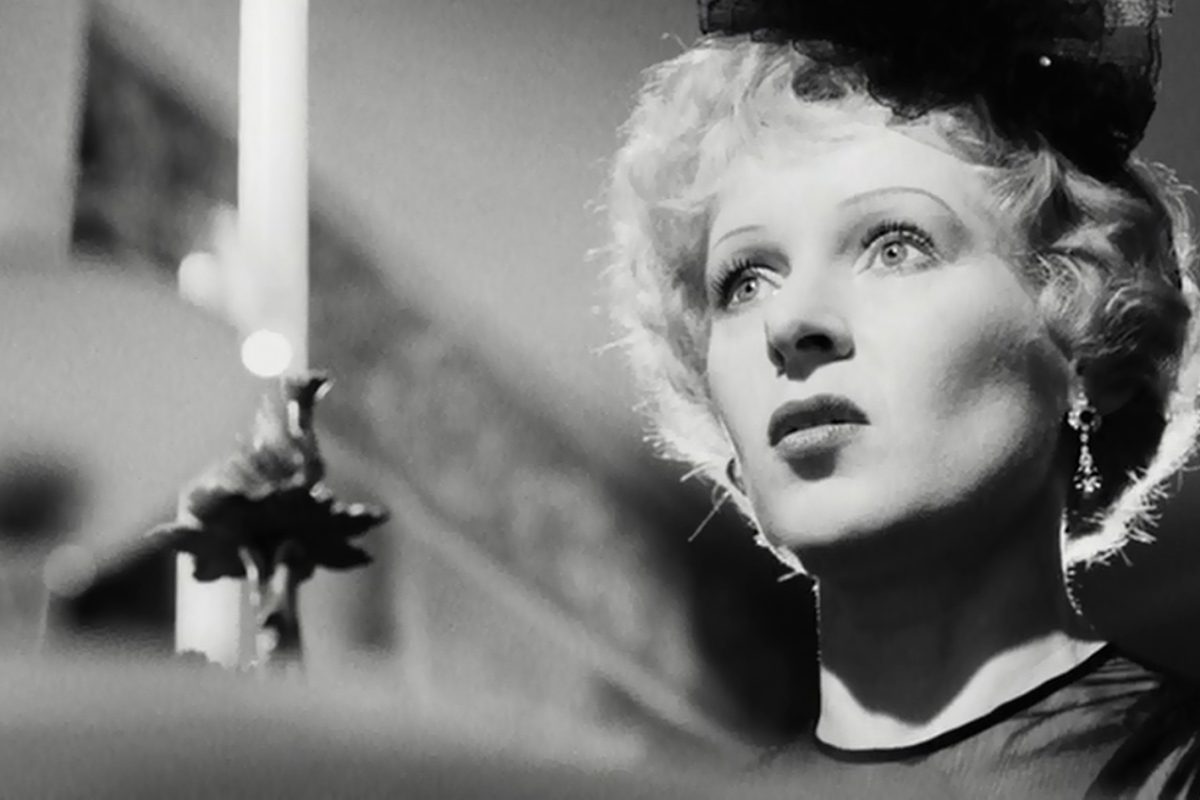
Over the course of only 13 years, Rainer Werner Fassbinder produced a prolific filmography that blended Hollywood melodrama and the avant-garde with a decidedly German perspective on society. His ferocious output offered a scalpel-sharp perspective on a postwar nation simultaneously trying to ignore and smudge away its shameful history. With his penultimate film, he decided to borrow from one of the greats of Hollywood’s golden age to reimagine a real-life figure’s culpability in Nazism, and by extension the embarrassment she elicited in the country that once adored her.
Die Sehnsucht der Veronika Voss, released in 1982 (mere weeks before Fassbinder’s death at the age of 37), follows the last days of its eponymous former diva, a one-time actress who became a regular star in Nazi-endorsed movies. Now, in 1955, she is unhireable and dependent on the morphine fed to her by her doctor. A sports reporter, Robert Krohn, becomes intrigued by Veronika and falls into a doomed affair with her, one that exposes him to the desperate trap of drugs, blackmail, and delusion that Veronika has sunk into.
The most obvious inspiration for Veronika Voss is Billy Wilder’s Sunset Boulevard, the ultimate story of Hollywood’s hubris and its discarding of the stars it helped to create. For his Norma Desmond, Fassbinder took inspiration from the life of Sybille Schmitz, an actress who starred in various propaganda films during World War II before being ostracised by the German film world and dying by suicide in 1955. Veronika, as played by Rosel Zech, is a trembling wreck, bereft of the charm that she must have once possessed to be a star of the silver screen. She has none of the arrogance of Desmond, although they share a desperate hunger for the fame of their prime. Both women are bound by a sense of decay: Norma with her opulent home that is stuck decades in the past, and Veronika with her disintegrating physical and mental state exacerbated by drugs and trauma.
Xaver Schwarzenberger’s cinematography evokes Hollywood noir (a genre with its roots in pre-war German expressionism) but with black-and-white contrasts so sharp that it verges on retina-burning. Often, it looks more like a ghost story than Golden Age Hollywood, only further emphasizing the desolate nature of Veronika’s story. She seems forever hidden in shadows, except for when she’s in the blindingly white clinic where she is administered all the morphine she wants. This austere aesthetic often swings into the uncanny.
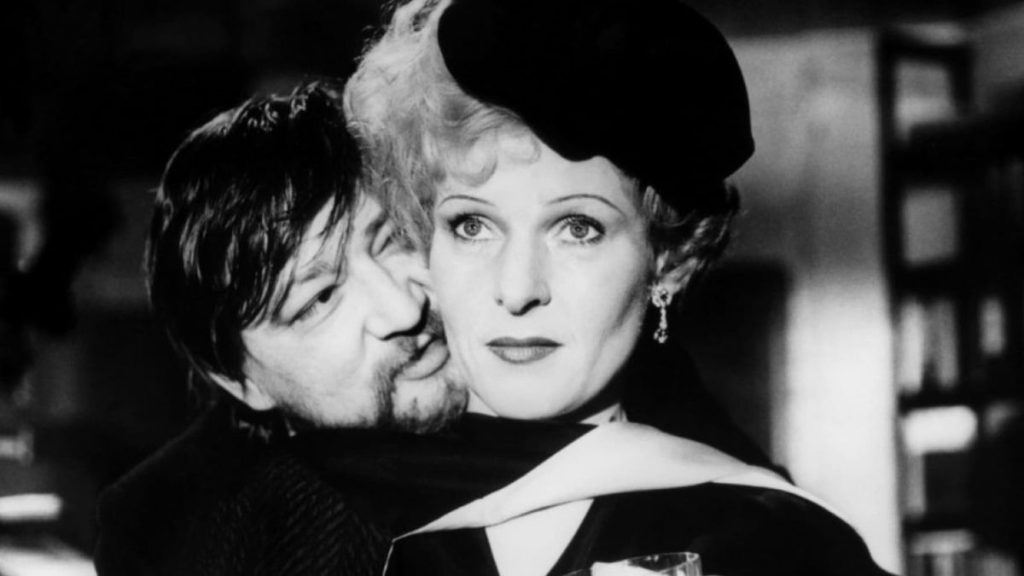
Wilder’s satire is acidic but still bleakly funny. Fassbinder’s is caustic without the release of tension that a good one-liner offers. The stakes are too high for a Germany in the era of denazification and more dominated by American culture than ever. Fassbinder shows the ‘50s as a time of revelry and wilful ignorance, one where intense evil can still thrive. Veronika is being held in a near-captive state by a devious neurologist who is keeping her hooked on drugs to bleed her of her wealth. To maintain this plan, the doctor is willing to murder anyone who gets in her way, a crime that they seemingly commit with total impunity.
There’s a sense of overwhelming hopelessness throughout Veronika Voss. While Veronika is not especially sympathetic given her status as a Nazi collaborator who probably slept with Joseph Goebbels, the rank exploitation of a broken woman is still tough to watch. In the aftermath of the war, opportunism has run rampant. The Americans stationed in the country certainly don’t seem interested in anything but exerting their own influence on the nation. The most prominent member of the Allied Forces shown here is a G.I. who deals drugs. Veronika, a drug addict and social pariah with no career prospects, becomes an easy scapegoat for a wider societal rot. By eliminating her, does Germany hope to make up for the past that she represents? If only it were so easy as a case of a few bad apples.
Veronika Voss serves as the second part of Fassbinder’s BRD Trilogy, three dramas about West German women connected by their desires to escape their pasts and overcome their prior circumstances (although it was the last one released, it is in the middle chronologically). In The Marriage of Maria Braun, a woman becomes a sex worker and mistress to survive after she believes her husband to have been killed in action. The Lola of the 1981 film of the same name, a loose remake of The Blue Angel starring Marlene Dietrich, is the object of obsession for an upstanding bureaucrat who spirals as he struggles to reconcile his idealised vision of her with the reality of her sex work.
All three women are self-made figures of ill repute who represent a nation in a financial boom but moral reckoning. All experience unbearable tragedy, but Veronika’s decline is especially bleak given that she cannot escape her culpability in a genocidal regime and all that she represents to a nation that wants to forget. She cannot evolve like Maria Braun or remain steadfast in her dignity like Lola. In the end, she must die, a sacrifice on the altar with no one to mourn her but the writer who nobody will believe. But no soul is cleansed by Veronika’s brutal death, locked in a room and forced to withdraw from morphine. The indignity carried over to future generations. Fassbinder died before he could see that future take form, but his stark eye for the truth has lost none of its potency in the ensuing decades.
“Veronika Voss” is streaming on the Criterion Channel.