Zach Vasquez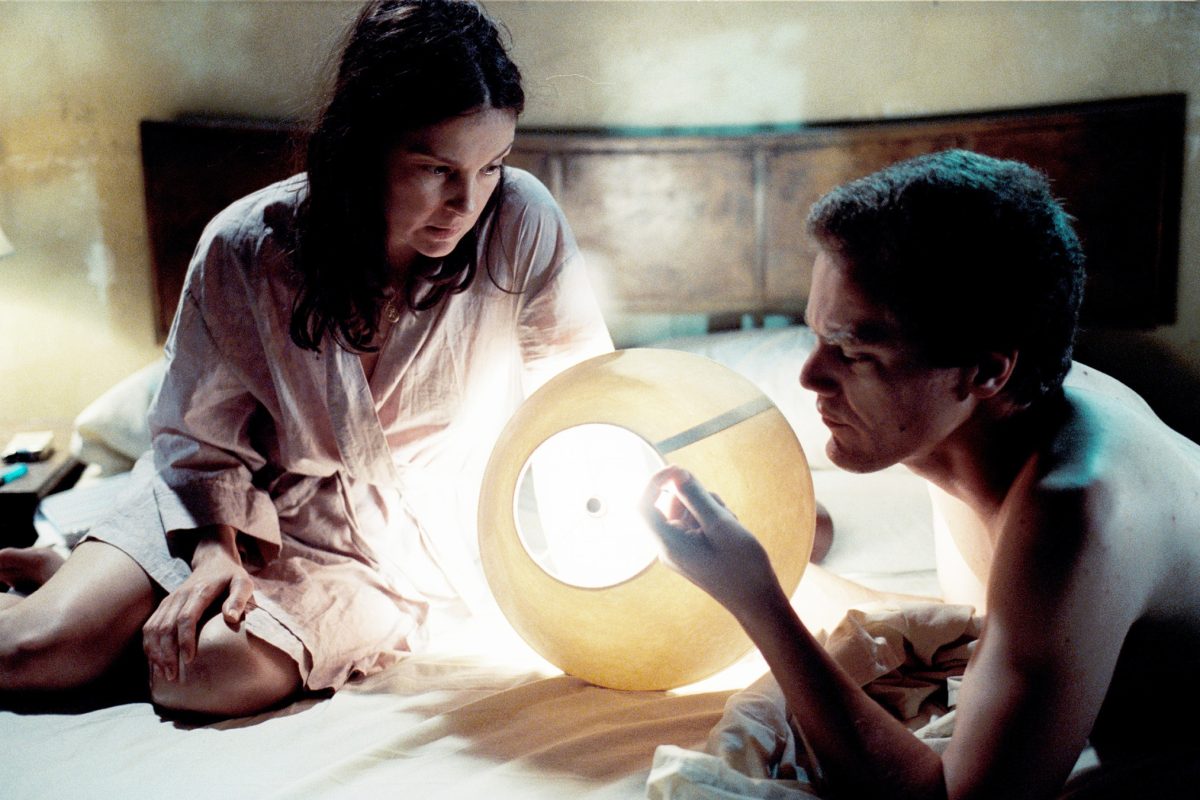
Upon its release in 2006, William Friedkin’s gnarly, claustrophobic adaptation of Tracy Lett’s stage drama Bug was viewed as a return to form for the prickly auteur, who’d spent the decades since his New Hollywood heyday floundering with audiences and critics (even as a number of his films from that period—including but not limited to Sorcerer, Cruising, To Live and Die in L.A., Rampage, The Hunted, hell even Jade—had been reclaimed as worthwhile efforts, if not outright masterpieces). Watched now, 20 years later, it plays like a work of prophecy.
Set almost entirely within a seedy motel somewhere in the badlands of Oklahoma, the film charts the symbiotic, ultimately apocalyptical relationship between Agnes (Ashely Judd), a lonely cocktail waitress reeling from the years-long disappearance of her young son and the return of her abusive ex-con ex, and mysterious drifter Peter (Michael Shannon), on the run from someone or something. Following their awkward meet-squalid—Agnes’s co-worker and sole friend brings Peter to her room, where he sits back as they rail lines and pound booze—Agnes makes the rash decision to let Peter move in with her. The two become lovers, finding solace from their self-imposed isolation. But within hours of their pairing, Peter—who we learn is a Gulf War vet currently gone AWOL from a VA hospital where he claims he was experimented on—starts seeing bugs in the bedsheets. It’s not long before Agnes, who prior to meeting Peter has been plagued by mysterious phone calls, starts seeing them too.
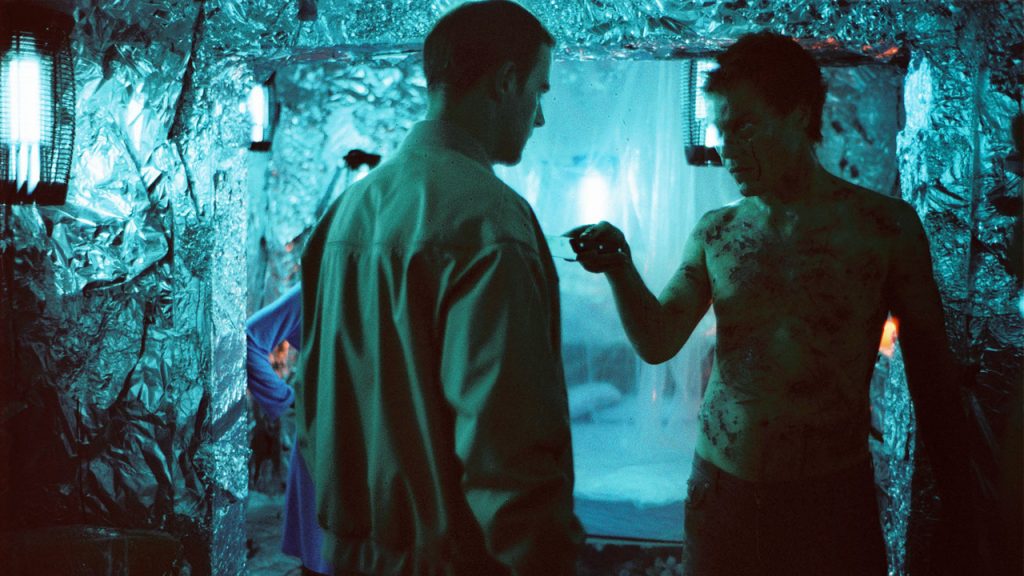
What follows is a full-throttle descent into madness, murder, and self-immolation. Theirs is a shared psychosis—folie à deux—fueled by their individual trauma and hard drug use (the film’s elliptical structure makes the viewer fill in some gaps regarding the latter plot point). By the berserk third act, both they and the motel where they’ve holed up have undergone monstrous transformations, and they find themselves trapped in a tinfoiled hell that is more frightening than anything in The Exorcist. And yet, there is still a very real connection between Agnes and Peter, one that can’t be accounted for via pat psychological terms, just as their paranoia can’t entirely be dismissed as imagined: Letts (adapting his own play for screen) and Friedkin layer in enough bizarre, unexplainable moments—such as when Peter’s doctor, who shows up near the end to take him back to the hospital, casually takes a hit off a crack pipe; or two short mid-and-post credit scenes that call into question the reality of the film’s climax—to keep things ambiguous.
Ultimately, Bug is less interested in diagnosing its characters—even as the closely studied symptoms of real illnesses, from schizophrenia to delusional parasitosis to Gulf War syndrome, lend a visceral sense of verisimilitude—than exploring how a dangerous relationship forms and how a couple changes within it. It’s easy to explain away Peter’s thoughts about microscopic spyware and electrical discharges as symptoms of combat-induced PTSD, just as it’s simple enough to point to Agnes’s maternal trauma and history of abuse to glean why she attaches herself so quickly and drastically to this stranger and his delusions. Harder to reckon with is the possibility that what makes both of them so susceptible to self-destruction is, first and foremost, loneliness, something all of us experience on a regular basis. As Agnes tells Peter during one of her last moments of lucid reflection: “I don’t know why I love you so much. I don’t even know you very well. I guess I’d rather talk with you about bugs than talk about nothing with nobody.”
This moment plays all the more startling now, in our current age of mass delusion, where these paranoid ideas have infected the minds of millions of lonely people via the internet and other forms of mass communication. Letts, who hails from Oklahoma, first wrote Bug in the wake of Timothy McVeigh’s bombing of the Oklahoma State Building, after he realized “there was this whole strata of society harboring these conspiratorial ideas…you realized…it was going to spread like a brushfire, that the internet was tinder for conspiracy theories.” Cut to 30 years after Letts first staged the play, and 20 since Friedkin adapted it, in a post-9/11, post-COVID, post-QANON, post-Epstein Files ravaged world, and nothing in Bug plays as heightened anymore.
(Again though, the conspiracy theories in Bug, like those in real life, are complicated by the confirmed examples Peter explicitly cites, including the MK Ultra and Tuskegee syphilis experiments.)
Which isn’t to say Bug has lost any of its shock value. Friedkin and his game cast—Ashley Judd shows a side of herself theretofore and since unseen (it’s truly a shame she was so mired in potboiler fare during her prime, as she might have proven an heir to Gena Rowlands) while Michael Shannon, who reprises his role from the original stage version, firmly establishes himself as the most intense leading man of his generation—go all in on the brutality of the material.
Despite Friedkin’s aversion to Bug’s advertisement and reception as a horror film, it certainly works as one, although it has more in common with the French New Extremity than the American body horror/torture porn examples of the Aughts. Friedkin is correct in describing it as a dark comedy, and watched in the year of our lord 2026, it plays very much like a forebearer to Eddington and Bugonia.(Letts and Friedkin’s follow up collaboration of five years later, Killer Joe, is an even darker comedy.)
At its sick, black heart though, Bug is a romance, which is why it’s so fitting that, at this very moment, there is a new, acclaimed production of Letts’s play on Broadway, starring his real-life wife Carrie Coon. Given the metamorphosis that Bug has undergone in the decades since it came first to stage and then to screen, it may well be THE romance of our era, the single most important entomological examination of love in the time of paranoia.
“Bug” is streaming on Tubi, PlutoTV, Plex and Starz, and is available for digital rental or purchase.
“Crooked Marquee’s Bad Romances” is an annual spotlight on anti-Valentine’s Day favorites. Follow this year’s recommendations here; you can also read our entries for 2025, 2024, and 2023.