Jason Bailey
There is a case to be made – and I’m certain plenty of people have made it – that this year’s New York Film Festival was some sort of affront to cinematic democracy and/or irresponsible risk to the public health, as it is one of the first major film festivals to altogether jettison the virtual components of recent, hybrid gatherings like Tribeca, Toronto, and Fantastic Fest (to say nothing of last year’s many virtual-only fests, including NYFF itself).
I’ll let others have those arguments. For this New Yorker, and attendee of every NYFF since 2011, the 59th New York Film Festival was as closest thing we’ve had to “normal” for quite some time. The fest may have been in-person only, but all events were masked, and proof of vaccination was required for all attendees, so it felt safe, and also like we were being safe.
And the movies, as usual, were marvelous, a carefully curated selection of the best of this year’s festival circuit, with a handful of world premieres to boot. The big one was Joel Coen’s The Tragedy of Macbeth, which initially seemed (at least to this viewer) a peculiar choice for the former Coen brother’s solo debut. But it now seems inspired. By using a durable (borderline foolproof) text, he was able discard script concerns and instead focus on style and performance, and both are masterful. He plays with light and sound, shooting in the boxed-in, square “Academy ratio” in luminous black and white, making breathtaking use of silhouette and darkness. Coen seems to have chosen black and white for its starkness – for what it does to his images of dripping blood, or birds circling overhead – and it allows him to paint his settings in darkness, as the uncluttered design sets scenes more with lighting than set dressing. (The cinematographer is Bruno Delbonnel.) So he ends up with something that is neither merely film nor theater, but a mutation of both, taking advantage of the wide berth of expressionism we allow work on the stage, as well as the tools (visual effects, shock edits, etc.) of the screen.
Acting Shakespeare in this 21st century is an act of translation; the language is ours but not, and thus a good Shakespearean actor must build that bridge, conveying the meaning of the more obscure vernacular via intention and physicality, and finding the emotional through-line that makes the work so timeless. Simultaneously, it’s an act of interpretation, of taking the well-known passages, turns of phrase that have become common currency, and making them fresh and meaningful in context. And this is where Denzel Washington and Frances McDormand really deliver; what a thrill it is to discover, this deep into their distinguished careers, that there is still more that they can do.
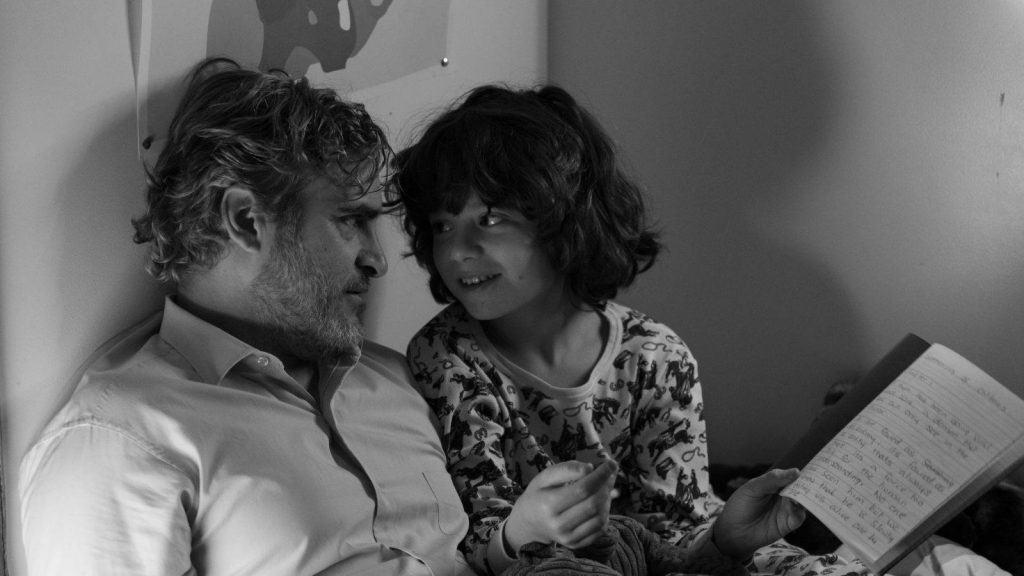
Mike Mills is the gifted writer and director of Beginners and 20th Century Women, and his latest, C’mon C’mon, again presents us with a portrait of a family far more complicated than the typical, nuclear variety. Johnny (Joaquin Phoenix) is an all but absentee uncle who swoops in to help his sister (Gaby Hoffman) deal with an emergency by taking care of his nine-year-old nephew, Jesse (Woody Norman). So it’s basically a 2020s riff on Kramer vs. Kramer, with the modern man unexpectedly pressed into child-rearing, and finding something of himself in the process. Like that film, C’mon C’mon occasionally lapses into too-cute/too-clever territory, but not often; Mills has a keen understanding of how kids’ brains work, the way they create strange little alternate personalities and realities, and an ear for how they communicate those strange connections.
And as with Kramer, it becomes a real showcase for the leading actor, playing a character whose period of responsibility ultimately requires him to figure himself out. This isn’t mere pageantry; Mills’s insightful script understands how being in charge of a kid means having to more acutely decipher emotions, and thus, to understand your own. C’mon C’mon has its problems, but it understands parenting and family from the inside out.
The barrage of assaultive, discordant sound and image that opens Todd Haynes’s The Velvet Underground is classic case of form following function, as the filmmaker manipulates footage and snatches of sound to create jarring juxtapositions and pastiches in much the same way his subjects made music. The Velvet Underground is a good subject for a film, because it was a very cinematic band, and one of the most valuable aspects of Haynes’ informative bio-documentary is how he contextualizes them within the avant garde scenes, in all kinds of media; music, film, poetry, literature, and visual art all fed in to their distinctive style and aesthetic.
It is somewhat disappointing that Haynes doesn’t take the opportunity to complete deconstruct (or, perhaps, destroy) the bio-doc, the way he did with the musical biopic in I’m Not There, a film that increasingly seems like an outright miracle. But he finds places to play with form and structure, cleverly curating and manipulating the archival footage, crisply marrying those images with the music. And the presentation is energetic, turned into the sped-up, fried-and-wired feeling of their best records. Haynes is not reinventing the wheel here, which is too bad, because he has the tools to do so. But this is an informative and entertaining history, and that’s valuable too.
Paul Verhoeven’s Benedetta is a truly strange brew, coupling probing, thoughtful questions of faith and religion with the kind of sexual ribaldry and scatological humor you’d expect from a picture that’s already being shorthanded as “the lesbian nun movie” (or, to borrow the throwback terminology, “nun-spoloitation”). Verhoeven loves to have it both ways – he takes what’s happening between his protagonists seriously, but he also can’t resist having a giggle at the prurient elements.
Yet the picture poses more serious questions of faith than we might expect from a heaving-bosom Sapphic melodrama – of divine visions, faith, and doubt, and how those might (or might not) intertwine with pleasures of the flesh. Are the title character’s visions genuine? Or merely manifestations of her newfound desire? Or both? Could a spiritual awakening also be a sexual awakening? That material is provocative, and Verhoeven clearly sees himself as a provocateur; he’s playing with dynamite, toying with the most loaded of symbols and ideas, casting them as both divine and dirty. I found it fulfilling and challenging, but (obviously) your mileage may vary.
When I first saw the running time for Celine Sciamma’s Petite Maman I thought it must have been a typo – surely the new film from the director of Portrait of a Lady on Fire couldn’t be just 70 minutes long? (Why, that’s an episode of Game of Thrones!) But the listing is correct, and the film is just as long as it should be – slender and short, yes, but by no means slight. It’s a keenly observed, perfectly realized short story about loss, parenthood, childhood, and change.
It’s poignant from frame one, as we see little Nelly (Josephine Sanz) saying goodbye to all the old ladies in a hospital, and soon realize she and her mother (Nina Meurisse) are there because her grandmother just died. They then have the unenviable job of going to grandmother’s house, to sift through all of her things – and all of her mother’s memories. More than that I will not say, except to note that Nelly makes a friend, and the scenes of their interactions are uniquely charming; Sciamma has a wonderful ear for how kids of this age relate and communicate, and once the film’s device becomes clear, she lands all the little jokes while finding, in scene after scene, all the right, precise, delicate notes.