Craig J. Clark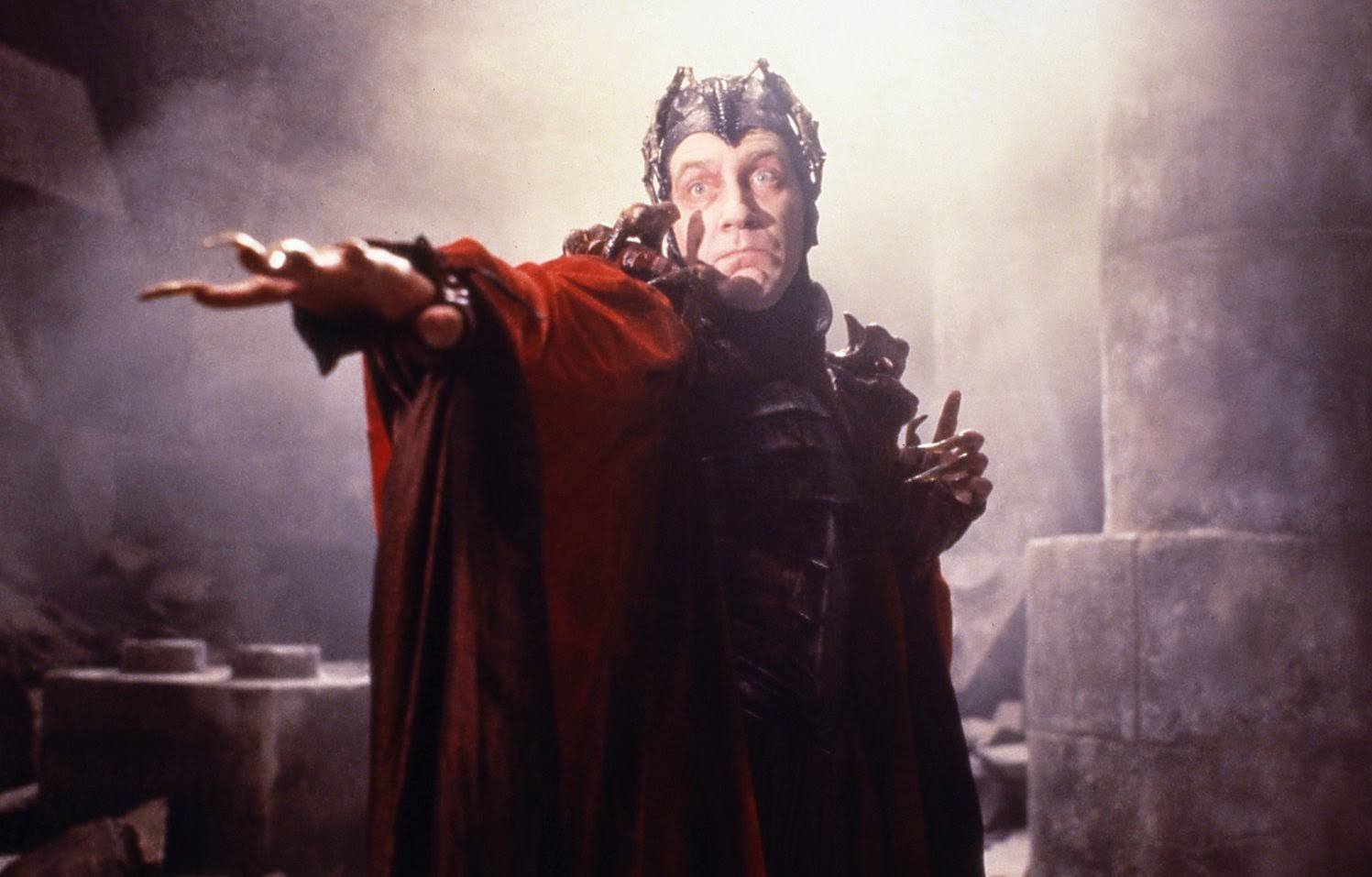
“No one created me! I am evil! Evil existed long before good. I made myself. I cannot be unmade. I am all-powerful!”
David Warner has long been the living embodiment of evil to me, thanks in large part to his flamboyant turn as the Evil Genius in Terry Gilliam’s Time Bandits, a film I watched countless times on cable when I was roughly the same age as Kevin, its central character. While most of the film’s other name actors show up for a scene or two at most, Warner’s schemer sticks around, keeping tabs on Kevin and the band of time-traveling thieves he’s fallen in with, methodically guiding them to the Fortress of Ultimate Darkness and what the technology-inclined usurper expects to be his triumph over the forces of good, represented by Ralph Richardson’s absent-minded Supreme Being.
As an impressionable young viewer, it wasn’t lost on me that God and the Devil were both played by Brits, only now I can’t help noting it was Sir Ralph (and had been since 1947), while his co-star remains un-knighted 40 years on. Considering Warner was educated at the Royal Academy of Dramatic Art and a member of the Royal Shakespeare Company, he should be a shoo-in, but whatever the reason for this heinous oversight, there’s still time to correct it – even if it’s not before his 80th birthday on July 29.
Over the course of his six-decade career, Warner has racked up hundreds of stage and screen credits, and has been called upon to play all manner of authority figures. Kings, military officers, counts, priests, lords, doctors (lots of doctors), senators, professors (so many professors), barons, admirals, chancellors, dukes, police inspectors, princes, judges, magistrates, rabbis – you name it, he’s played it. That kind of typecasting was in place right from the start, even, since his first major screen role was Blifil, the disdainful, aristocratic antagonist of the title character in 1963’s Tom Jones.
Three years later, when Warner was given the chance to play the romantic lead, there was something inherently off-kilter about the choice – and that’s not even taking into account the fact that the primate-obsessed protagonist of Morgan: A Suitable Case for Treatment is as unconventional as they come. This nonconformist attitude carried over to 1968’s Work Is a Four-Letter Word, a proto-Brazilian satire in which Warner rebels against the automated society he’s expected to acquiesce to, sowing chaos (and growing psychedelic mushrooms) wherever he can. That same year saw him branch out by working with John Frankenheimer (The Fixer) and Sidney Lumet (Chekhov’s The Sea Gull) in addition to playing one of the young lovers in the RSC’s screen adaptation of A Midsummer Night’s Dream.
As the Sixties waned and the Seventies dawned, Warner went from the lead in Volker Schlöndorff’s Michael Kohlhaas – The Rebel to a supporting role in Sam Peckinpah’s The Ballad of Cable Hogue, his first Western. This led to the slow-witted Henry Niles in Straw Dogs, in which he went uncredited. (Warner’s third and final collaboration with Bloody Sam came six years later in Cross of Iron, in which he played a Nazi for the first – but not the last – time.) The year 1977 found Warner top-billed in The Blue Hotel, a television film made as part of “The American Short Story” series for public television, and Alan Bridges’s Age of Innocence, but otherwise he spent the decade taking supporting roles for directors like Joseph Losey (A Doll’s House, as the paternalistic Torvald), Richard Donner (The Omen, in which he gets the film’s most spectacularly creative death), Alain Resnais (Providence, a fruitful reunion with Morgan scribe David Mercer), and Ivan Passer (Silver Bears, in which he played a con man).
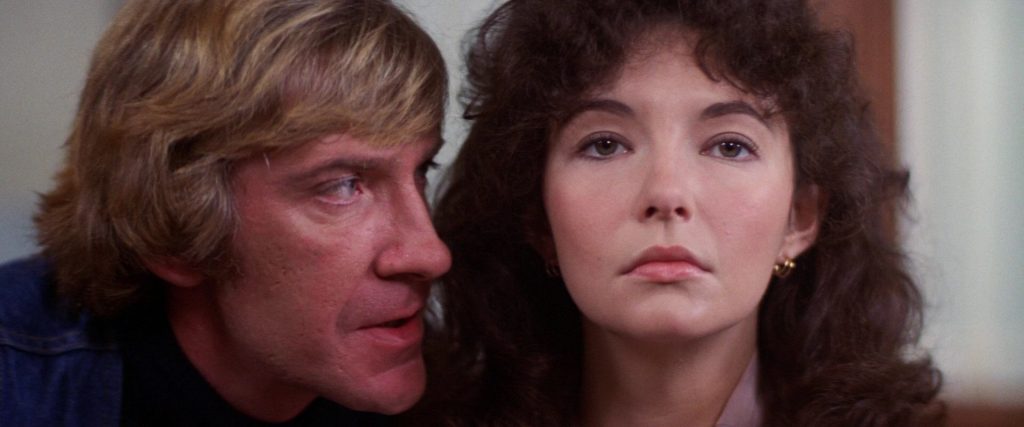
Warner also showed up in a pair of disaster films while they were in vogue – 1979’s S.O.S. Titanic and The Concorde… Airport ’79. His most terrifying turn, however, was in Nicholas Meyer’s Time After Time as an urbane and sophisticated Jack the Ripper, who uses H.G. Wells’s time machine to escape to modern-day San Francisco, where he fits right in. “Ninety years ago I was a freak,” he tells Wells, who has followed him through time. “Today I’m an amateur.”
Time After Time marked a turning point in Warner’s career. Having established his ability to command attention and send chills up the spine without raising his voice, he went on to play complex and memorable villains in Michael Ritchie’s The Island, Tron, Waxwork, Cast a Deadly Spell, John Carpenter’s Body Bags, and James Cameron’s Titanic. He even got to play both sides in the low-budget fantasy Quest of the Delta Knights, which was thoroughly skewered on Mystery Science Theater 3000.
That gets at the heart of what makes Warner such a unique screen presence: He brings a sense of gravitas to situations that might otherwise come off as ludicrous in the hands of a performer less adept at injecting a wry sense of humor into them. When Wes Craven needed someone to come in midway through Scream 2 to give Sidney Prescott a pep talk, Warner was his man. It was the same when Tim Burton needed an actor to lend dignity to his remake of Planet of the Apes. Warner even appeared in two consecutive Star Trek films as two completely different characters, most notably the Shakespeare-quoting Klingon chancellor out to make peace with the Federation who’s assassinated for his troubles.
It hasn’t been all menace and murder, though, since Warner supplemented these with comedic roles in Time Bandits, The Man with Two Brains, and My Best Friend’s a Vampire, as well as sympathetic turns in the George C. Scott version of A Christmas Carol (as Bob Cratchit), the 1984 TV movie Frankenstein (as the Creature), Neil Jordan’s The Company of Wolves, and Cannon’s musical fantasy Hansel and Gretel. He’s also quite effective in an obscure Canadian thriller called Hostile Takeover as a soft-spoken office drone who takes his co-workers hostage without giving much thought to what happens after that.
Just as little-seen and worth seeking out is Warner’s last starring role to date: 2013’s Before I Sleep, a delicate drama about an aging poet and one-time Pulitzer winner prone to disorienting hallucinations, with an estranged daughter and a lifetime of regrets to mull over to boot. He shows no signs of slowing down, though, if his IMDb page is any indication. Warner even flexed his musical muscles in 2018’s Mary Poppins Returns as Admiral Boom, which is a far cry from his villain from 1988’s Waxwork who wants to bring about the end of the world. When asked why, his matter-of-fact reply is “Somebody has to.” And if somebody has to, it might as well be David Warner. Just make it Sir David already.