Jonah Koslofsky
Pixar’s Inside Out opens with a question: “Do you ever look at someone and wonder, ‘What is going on inside their head?’” Within the same medium, released the same year, Charlie Kaufman’s Anomalisa provided an opposite answer. And yet, according to Kaufman, we shouldn’t contrast the pair: as the filmmaker said in an interview, “There is a great gulf, [a] chasm, between these movies.”
Perhaps Kaufman’s animosity makes sense: Inside Out and Anomolisa competed for the Best Animated Feature Academy Award at the 2015 Oscars, and it’s worth wondering if Anomalisa even qualifies as “animation.” The film evolved from a stage play into a puppet-based stop-motion feature thanks to a crowdfunding campaign. Anomolisa was produced completely independently for pennies, especially compared to the $175 million it cost director Pete Docter to deliver Inside Out.
Of course, Inside Out took home the golden statue. Yet despite the David-and-Goliath dynamics behind the scenes, both Anomalisa and Inside Out plunge headfirst into their subjects’ subconscious, demonstrating the endless bounds of subjectivity on an expressionist canvas only possible outside of live-action cinema.
Inside Out looks, well, inward. We see representations of the many emotions of Riley, a middle schooler at the end of childhood, on the first steps of whatever comes next. Her family has just moved to San Francisco, and we experience Riley’s flux from the point-of-view of her emotions: Joy (Amy Pohler), Sadness (Phylis Smith), Anger (Lewis Black), Fear (Bill Hader) and Disgust (Mindy Kaling).
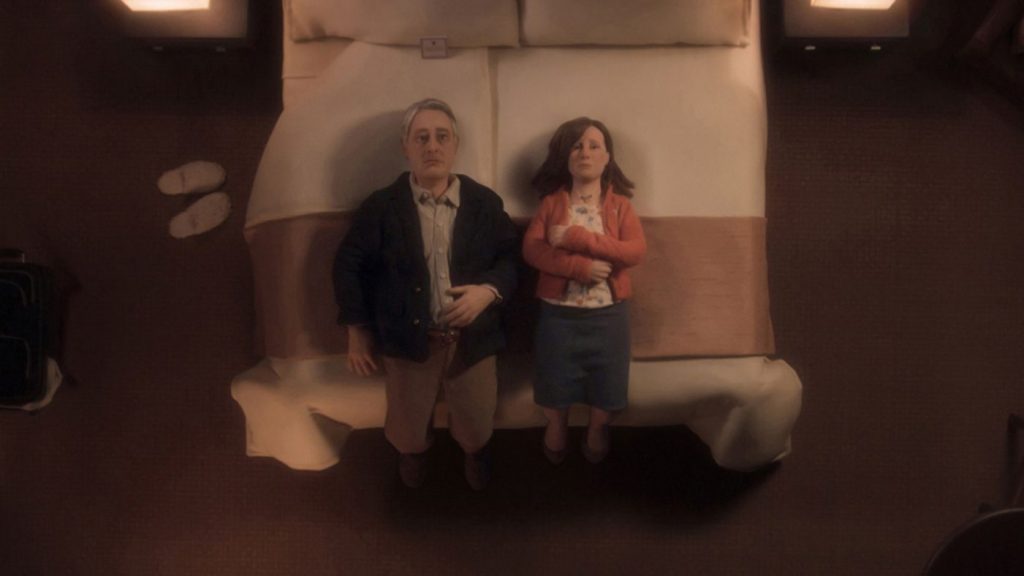
Anomalisa doesn’t boast an entire NBC sitcom of voice talent– in fact, its cast has only three actors. Michael (David Thewlis) arrives in Cincinnati to give a speech on customer service, but everyone he meets – from his cabbie to the guy at the front desk of his hotel, even his wife, son and ex-girlfriend – has the same voice (Tom Noonan). Only the vocal cords of Lisa (Jennifer Jason-Leigh), a woman he meets late that night, break through the noise. Until they don’t.
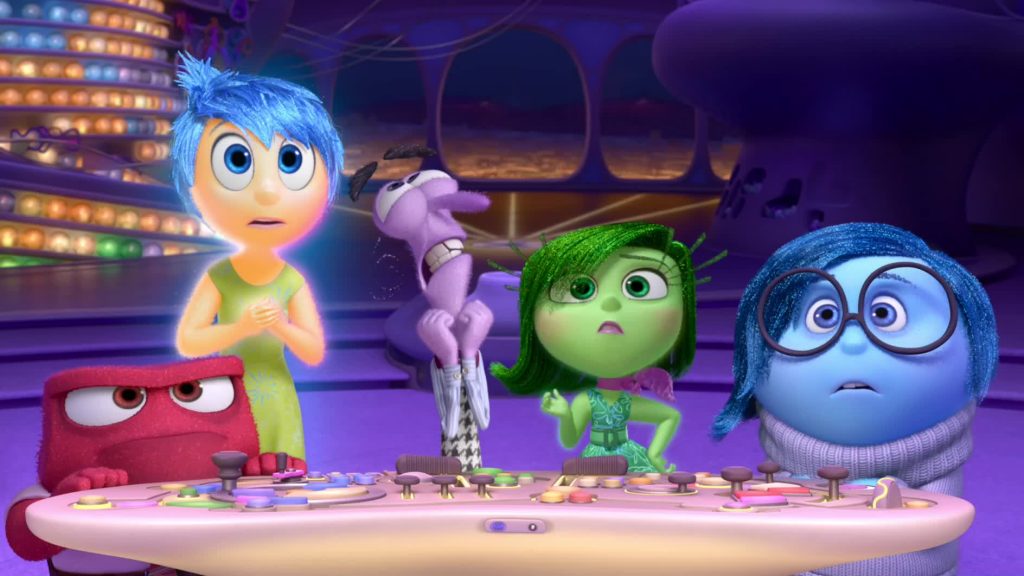
If Inside Out takes a peek at the voices in our heads, Anomolisa asks what happens when those voices become all we can hear. Ironically, Riley and Michael share a similar isolation, an inability to connect with others. Riley can’t tell her parents her feelings of sadness and anxiety around her move away from Minnesota, the same feelings that have her crying in class on the first day of sixth grade, in a mortifying sequence.
The source of Michael’s predicament is a bit more difficult to trace, as Kaufman and co-director Duke Johnson don’t show us anything outside of Michael’s work trip. Instead of literally going into his head, Michael’s psychology is grafted onto those around him. Everyone has the same voice, because they’re all the same to him. He bristles from small talk and dodges a call from his spouse and son. From the minute we meet him, it’s clear Michael is sick of their collective, droning voice. No one is real to Michael, and no one is worth talking to.
Kaufman originally credited the play to “Francis Fregoli,” and Michael stays at a hotel named “The Fregoli.” It’s a reference to The Fregoli Delusion, a real mental illness in which an individual believes all people around them are a single person. I’m not sure Kaufman would literally diagnose Michael with this condition, because doing so would minimize Michael’s agency in his own self-destruction. Michael and Lisa sleep together, in the film’s most tender sequence, a shockingly frank and awkward depiction of sex on-screen (made somewhat unsettling considering we’re watching puppets).
But in the morning, Lisa starts to sound different. As Michael asserts his vision for their relationship, her voice cracks. In the span of a single conversation, she loses her “anomalous” status, becoming another Tom Noonan. With Michael’s desire to sleep with Lisa fulfilled, he loses his ability to conceptualize her – Lisa morphs into another person he can’t hear. He will alienate her, and remain alienated from everyone else.
In a sense, what Michael can’t hear is what Inside Out so gracefully shows: every individual carries a complex and valuable mechanism of self inside their heads. You are meant to see yourself in Riley, to recognize your own distance from childhood, the way melancholy now colors happy memories.
But Inside Out generally refrains from showing many other heads besides Riley’s. Thirty-seven minutes in, there’s a dinner table scene in which we glimpse the emotions of Riley’s parents, and the final sequence cuts to the “headquarters” of a number of strangers (and even some animals). Of course, had Pixar truly incorporated more than one subconscious into the narrative, Inside Out could’ve easily descended into cacophony. Then again, isn’t cacophony representative of seriously interacting with other people who’re just as complex as you?
In the third act, we learn that if Riley’s Joy and Sadness can’t reconcile each other, Riley will lose her ability to feel anything. Crisis is eventually averted, and the movie concludes with Riley a well-adjusted tween. But there’s an individualist undercurrent here: Riley solves herself. She is the solution to her turmoil. If I had to guess, I’d say this is the source of Kaufman’s dislike of the film: across the filmmaker’s oeuvre, he’s been adamant that we need to connect with other people if we’re to have any hope of fulfillment and satisfaction.
With Anomolisa, Kaufman illustrates what happens when we don’t. It concludes on a note no studio would ever pitch, let alone spend the GDP of a small nation to produce: nothing changes for Michael. We find him back home, more alone than ever, even as he’s surrounded by “loved” ones. Michael’s selfishness has made it so he cannot break out of his own prison alone, and those same walls stop him from reaching anyone who could help.
It seems unfair to ignore the ranging target audiences of these pictures: Inside Out is meant for children, Anomolisa’s most certainly not. Hopelessness has been baked into Michael, but not an eleven-year-old. But by placing these films in conversation with each other, the limits of Inside Out’s focus and individualism become clear. Just a few years later, Bo Burnham’s Eighth Grade dealt with an equally-aged ennui, but clearly pointed to other people as the solution.
The danger of Inside Out boils down to blurring the line between introspection and self-absorption. Viewers who identify with Riley should see a cautionary tale in Michael: obviously he’s deeply complex, but reconciling oneself is only half the battle. On the other hand, the danger of Anomolisa is failing to see yourself in Michael: he’s living an extreme of something we all exhibit. Regardless of whose subconscious you’re entering, eventually, we all need to get out of our heads, and reach each other.