Josh Bell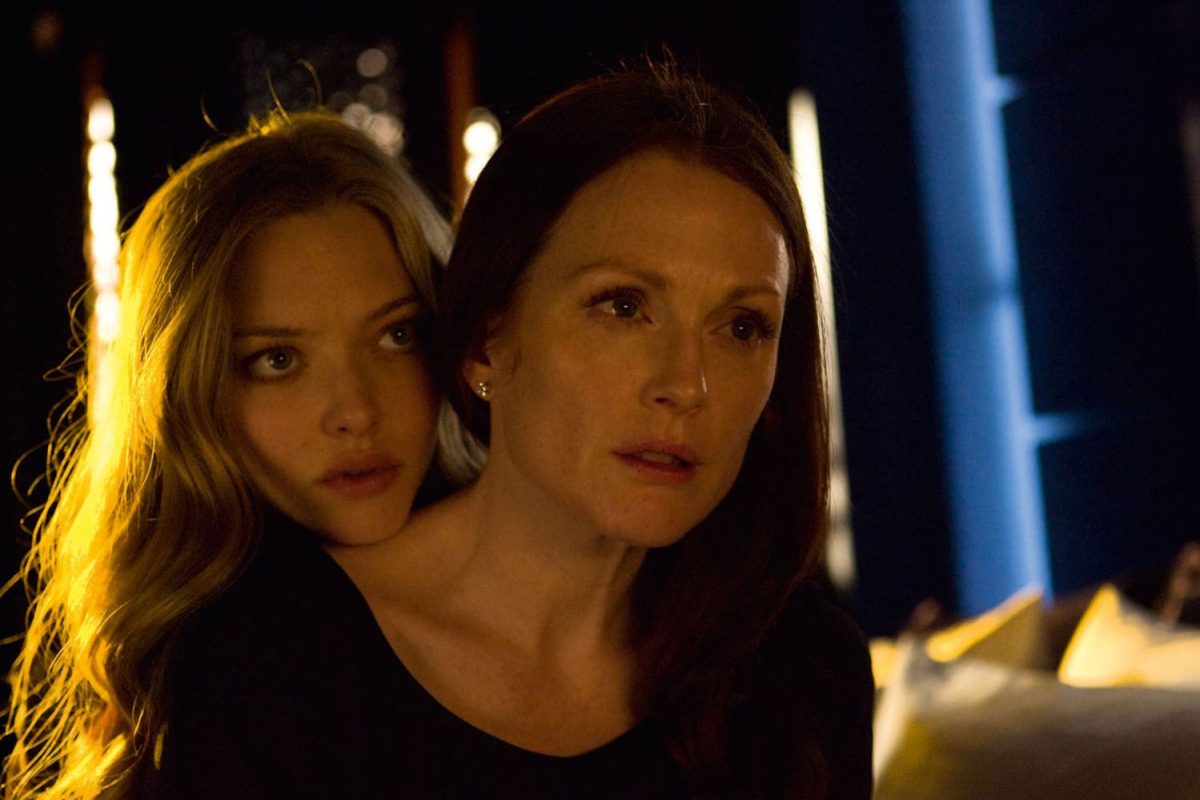
The two newest movies in the Criterion Channel’s recently launched Directed by Atom Egoyan collection may initially seem like late-career afterthoughts for the Canadian filmmaker who’s best known for his 1994 international breakthrough Exotica and his 1997 Oscar-nominated drama The Sweet Hereafter. But while 2005’s Where the Truth Lies and 2009’s Chloe may not have the same artistic ambition or deeper resonance as Egoyan’s most acclaimed work, they’re deviously entertaining pieces of high-toned exploitation, mixing Egoyan’s early, more serious explorations of complex sexual dynamics with an accomplished filmmaker’s knowing embrace of camp.
Even in his more naturalistic films, Egoyan has always taken an arch, mannered approach to dialogue and performance, bringing a sense of alienation to even the most intimate character relationships. Like fellow Canadian sicko David Cronenberg, he seems to take perverse pleasure in mixing the erotic with the off-putting, and both Where the Truth Lies and Chloe seduce the viewer with explicit sex scenes that carry an undercurrent of manipulation and transgression. The characters are as perverted as the filmmaker, but they’re more reluctant to express that—at least at first.
Both begin with voiceover narration from their central seductresses, describing their different but perhaps complementary professions. After a brief look back at one of the final performances from legendary 1950s showbiz duo Lanny Morris (Kevin Bacon) and Vince Collins (Colin Firth), Where the Truth Lies shifts ahead to 1972, with young journalist Karen O’Connor (Alison Lohman) recounting her efforts to coax the now-reclusive entertainers into participating in a book she’s writing. Amanda Seyfried’s Chloe also explains her strategies for coaxing men into giving her what she wants, although in her case that’s her fee as a high-class escort. Both characters put on acts in order to achieve their goals, maneuvering wealthy, powerful men into their desired outcomes.
Both of them also become dangerously obsessed with their older targets, blurring the lines between the professional and the personal. These films could be categorized as erotic thrillers, although Egoyan seems less interested in building suspense than in finding twisted ways for the characters to hurt each other. Karen strikes a deal with Vince for unlimited interview access, in exchange for a hefty payment from her publisher. The relationship between Chloe and married gynecologist Catherine Stewart (Julianne Moore) also begins as a business transaction, but there’s an erotic charge to all of these negotiations from the start.
“I don’t usually meet with women,” Chloe tells Catherine during their first formal sit-down, after a chance encounter in a restaurant bathroom. Catherine is initially defensive, assuring Chloe that she’s not there for herself, but rather for her college professor husband David (Liam Neeson), whom she suspects of cheating on her. Catherine hires Chloe to tempt David and see how he responds, but she’s clearly the one responding to Chloe, even at this early stage. The covert mission is just a conduit for channeling the attraction between Chloe and Catherine, and Karen’s book functions largely the same way, especially once the movie reveals that she’s been intertwined with Lanny and Vince since childhood, appearing on their annual benefit telethon as a polio survivor.
That telethon is the clearest indication that Lanny and Vince are variations on Dean Martin and Jerry Lewis, but Where the Truth Lies isn’t a Hollywood exposé any more than Chloe is about campus politics. The characters’ careers provide a framework for their erotic explorations: Lanny and Vince use their fame to bed as many women as they like, while also remaining emotionally distant from any relationship except their own partnership. Years later, Karen uses her position as a journalist to gain access to the men she’s been fixated on since she was a preteen, and that adoration transforms into sexual desire.
As a doctor, Catherine clinically describes the process of an orgasm to a patient who’s never had one, and later she uses her medical skills as a pretext for touching Chloe, in cinema’s most sensual bandaging of a scraped knee. Chloe’s status as a prostitute offers an excuse for openly discussing sexual practices, and she takes advantage of that expectation to give Catherine aggressively detailed recaps of her sessions with David.
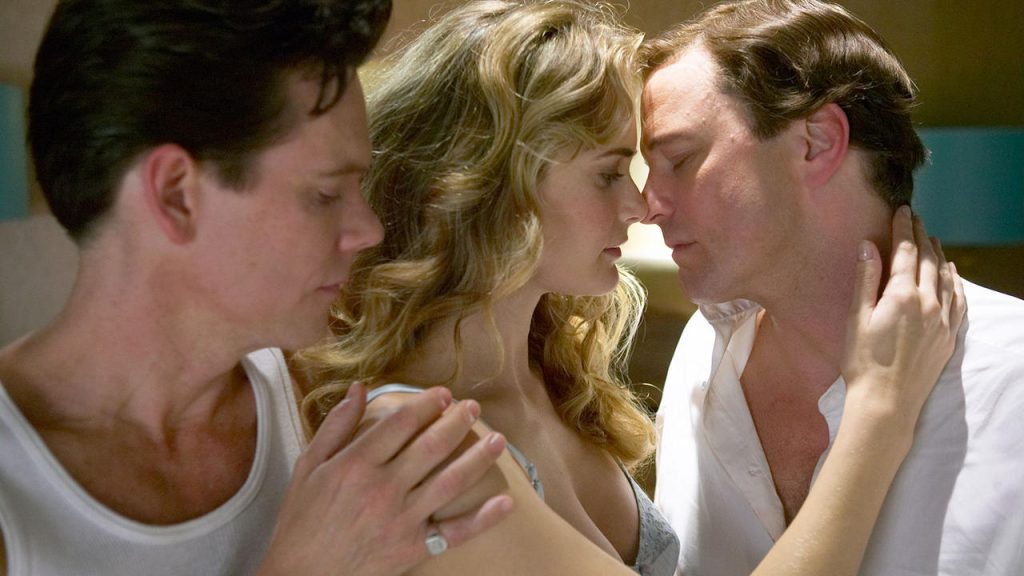
Egoyan presents those recaps as gauzy, impressionistic flashbacks, and he does the same in Where the Truth Lies when Karen gains access to chapters from Lanny’s unpublished memoir. There’s an almost Sirkian lushness to the 1950s scenes in Where the Truth Lies, in contrast to their sordid events, as Lanny and Vince become entangled in the accidental (or is it?) death of a waitress at their fancy hotel. Cinematographer Paul Sarossy and composer Mychael Danna, both longtime Egoyan collaborators, give these films a sophisticated gloss and elegant grace that makes their lurid subject matter feel even naughtier.
The actors, too, know exactly what they’re doing, balancing serious emotions with sly melodrama. Lohman delivers breathy hard-boiled narration almost like a parody of a neo-noir femme fatale, but she also shows the vulnerability of this emerging writer who has to put on a front of experience and expertise in order to further her interests. While Firth is sometimes too sulky, Bacon continues the delightful nastiness of his role in another underappreciated erotic thriller, John McNaughton’s Wild Things, making Lanny both volatile and alluring.
Seyfried’s wide-eyed innocence as Chloe makes it easy for both Catherine and the viewer to be drawn in, and Moore finds the pathos in this middle-aged wife and mother who feels like her youthful vibrancy and attractiveness has faded. There’s a level of lecherous anticipation to their inevitable coupling, and Egoyan follows through on his playful teases to the audience. It’s clear that this is a lesbian movie directed by a man (albeit from a screenplay by a woman, Secretary’s Erin Cressida Wilson), but Egoyan is not unaware of the male gaze he’s representing. It’s no coincidence that David, the main male figure in this unhinged love triangle, is increasingly cut out of the proceedings.
In Where the Truth Lies, the deconstruction of the male gaze is even more explicit. After convincing Karen to take some mysterious, unnamed pills, Vince reveals that he’s brought along another young woman, and he encourages them to pleasure each other while he sits back and watches. It’s literally lesbian sex engineered for a man’s benefit, even if the women appear to be having a good time.
Viewers can enjoy the scene in the same way that Vince does, and Egoyan doesn’t judge them for it. But there’s more going on in these films than mere titillation. They’re the cinematic equivalent of literary smut, and Egoyan makes no apologies for his highbrow prurience.
“Chloe” and “Where the Truth Lies” are streaming on the Criterion Channel.