Chloe Walker
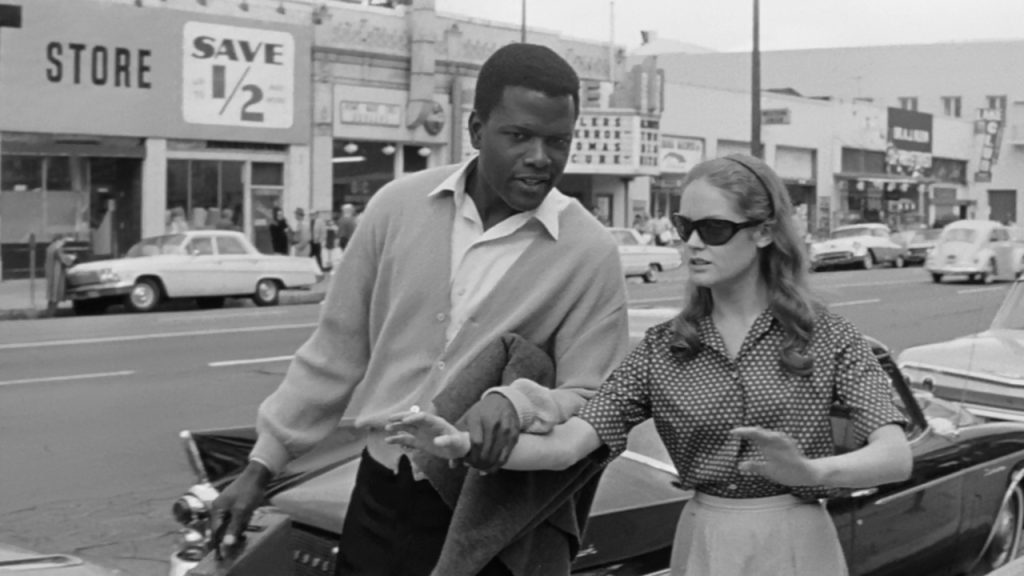
Sidney Poitier was fifteen years into his groundbreaking movie career, and long a titan. Elizabeth Hartman’s biggest credit had been the lead in the ill-fated play Everybody Out, The Castle is Sinking, which floundered before it reached Broadway. Nevertheless, MGM scouts were in the audience one night, and it led to her casting opposite Poitier in 1965’s A Patch of Blue.
Hartman plays Selina, a young blind woman who lives in a one room apartment with an abusive, racist mother (Shelley Winters) and an alcoholic grandfather (Wallace Ford). Selina’s small, sad existence is made infinitely larger and more joyful when kind Black newspaperman Gordon (Poitier) becomes her friend, and helps her learn how to navigate her sightless world. It would have been so easy for the movie to lean into the sentimentality of its premise, but A Patch of Blue ducks the tweeness traps at every juncture – and much of that is down to Hartman.
There are few recollections from former co-stars that don’t refer to Hartman’s shyness. There was often a delicate tremor to her speaking voice, and at rest, her eyes held a dreamy reserve that left the impression of a rich inner life. Yet as an actor, she wore her emotions even more legibly than most, with an aptitude for grounding big moments with quieter texture.
Her Selina is an impressive balancing act, particularly for someone so early in their career. She’s sweet, but never cutesy; devoid of guile, and yet canny enough to have protected herself through an existence where all the cards have been stacked against her.
Whether she’s gushing over her first experience of pineapple juice, cursing her cruel mother when she realises just how cruel she’s been, or glowing with love for Poitier’s Gordon, there’s not a moment when she’s unconvincing. That’s especially important when Selina’s relationship with Gordon is of such a sui generis nature – partly romantic, partly platonic, partly filial, whilst also something totally undefinable. She and Poitier are a wonderful team, with the sort of unusual but undeniable chemistry that makes you sit closer to the screen even sixty years later.
Hartman’s performance was deservedly nominated for an Academy Award, but she’d never get a movie role near that magnitude again. However, in the brief flicker of her filmography, she still managed to work with Sidney Lumet, John Frankenheimer, Francis Ford Coppola, Don Bluth and Don Siegel – not bad for someone who made nine features total. Alas, despite their directorial pedigree, her first three films after her Oscar nomination stopped her momentum dead.
In Lumet’s unwieldy The Group, she’s a 1930s Vassar graduate who contends with the post-college realities of systemic sexism. Though her bafflement at finding herself a feminist Democrat married to a misogynistic Republican is an affecting encapsulation of the movie’s wider themes, as one of eight leads, she gets lost within the large ensemble. She was wildly miscast as the vampy love interest in Coppola’s sexist sex comedy You’re A Big Boy Now. And in Frankenheimer’s dreary The Fixer, her character disappears too early to leave an impression.
She took a break from the big screen after that. A downhearted Times interview from1969 titled “After ‘A Patch of Blue, Gray Skies’” noted that she had no acting jobs on the horizon. But she wasn’t done yet.
Two years later, in The Beguiled, she was the plain, virginal Edwina, the sole teacher at a Mississippi Confederate School for Girls. Like the rest of the school’s female inhabitants, she’s wooed by Clint Eastwood’s injured Union soldier, John McBurney, who convinces Edwina he loves her. When she catches him in bed with a student, her heart breaks and her blood boils all at once. It’s her resultant fury, so vividly played, that hurls the unhinged production into its feverish third act.
Although she had less to do in 1973’s Walking Tall as the lovingly concerned wife of Joe Don Baker’s vigilante sheriff, her innate authenticity, and her lovely rapport with Baker, gives the ultraviolent production its vital emotional grounding.
And there was a poignant circularity to her last movie role, voicing plucky mouse Mrs. Brisby in Don Bluth’s 1982 animation, The Secret of NIMH. Like Selina in A Patch of Blue, she is charged with diving into a scary new world that she doesn’t understand. Like Selina, she presents as fragile but proves formidable. While it was only a vocal performance, that same combination of fragility and fortitude with which she started her career helped to make Mrs. Brisby a beloved character, and The Secret of NIMH a classic.
Hartman struggled with depression for much of her life, and tragically died by suicide in 1987, aged just 43. In various outlets, most notably a devastating LA Times article, her premature death was blamed at least in part on her Hollywood disappointments. After watching her luminous debut turn in A Patch of Blue, it’s hard to view the remainder of her career outside the shadow of tragedy.
Yet when her performances were so heartfelt and full, even when she had little to work with, it’d be wrong to label it entirely squandered. She deserved so much better than what she got, but she gave all she had.
“A Patch of Blue” is streaming on Kanopy and is available for digital rental or purchase.