Chelsea Spear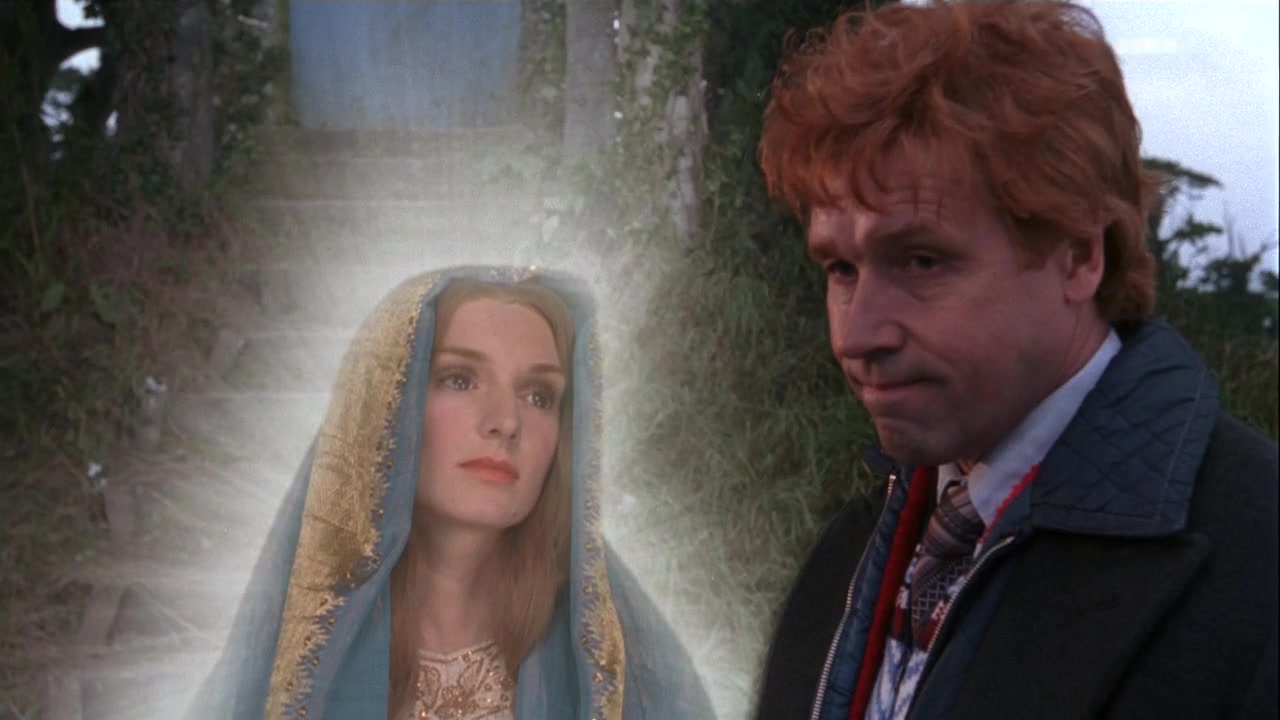
It was the role she was born to play.
By the mid 1990s, Sinead O’Connor had developed an ardent following through her gorgeous, clarion-throated vocals and ethereal, allegorical art-folk songs. She used her considerable platform to advocate for the rights of marginalized people in her native Ireland and elsewhere, but some of her harshest critics would also say she abused it by protesting the Catholic church on a notorious episode of Saturday Night Live.
Like O’Connor, director Neil Jordan grew up in Ireland during the middle of the 20th century. He parted ways with Catholicism at an early age and grew into a plainspoken atheist—a contrast with O’Connor, who spent much of her life on a spiritual journey. While the pair’s upbringings and religious beliefs were in marked contrast with one another, they forged a loyal friendship and a collaboration that extended across two films. In 1997, Jordan cast O’Connor in one of her most significant onscreen roles, that of the Blessed Virgin Mary in his adaptation of the 1992 novel The Butcher Boy.
The Butcher Boy follows Francie Brady (Eamonn Owen), a precocious 12-year-old boy coming of age in a turbulent working-class home. His mother (Aisling O’Sullivan) suffers from an unnamed mental illness and is frequently abused by his alcoholic father (Stephen Rea). The enmity Francie feels towards the Bradys’ rich neighbors, who describe them as “a family of pigs,” leads him to act out in increasingly violent and antisocial ways, and he develops a break from reality after his mother completes suicide and after his molestation at the hands of a local priest.
O’Connor and Jordan’s friendship extends back to the director’s work on the 1988 remake of We’re No Angels. “I called her up. I said, look, this guy Sean Penn wants to be with you,” he told RTE Radio’s News at One in the days after O’Connor’s death. “And it didn’t happen.” Jordan befriended the singer when he returned to Dublin, and would later tap her to record her version of the Irish folk song “He Moved Through the Fair” for the closing scene in Michael Collins.
When Jordan and casting directors Maureen Hughes and Susie Figgis began work on The Butcher Boy, their first choice for the role of the Blessed Virgin Mary—who comes to Francie in a series of visions—was Sinead O’Connor. At the time, she was still actively recording and performing music, but her reputation had taken a hit after she ripped up a picture of the pope on Saturday Night Live. The website Industry Central described this casting as “an in-joke,” but Jordan defended his choice: “She’s obviously a very spiritual person, and she understood exactly where that character was coming from. I think Sinead’s a very good actress. She’s very beautiful, and she looks like the statues I remember as a kid.”

O’Connor’s portrayal of the Blessed Virgin Mary has a similar gravitational pull on the narrative to that of Harry Lime in The Third Man, and Jordan teases her appearance in ways that would make Carol Reed proud. We first hear her on the soundtrack when Francie’s mother returns from the hospital; as Annie Brady frantically bakes cakes and buns, she listens to a folk-rock recording of the song “The Butcher Boy” on repeat. The comforting recording takes on an air of menace as we take in Annie’s bulging eyes and stiff, fast movements, as well as the stacks and stacks of butterfly buns and zeppole. When Francie is enrolled in a reform school after his mother’s death, a line drawing of the BVM is placed prominently in the church rectory, and the sharp planes of her face and the sobering look in her eye more closely resemble Sinead O’Connor than any previous illustration of the religious icon.
When Mary finally appears to Francie in a vision, those expecting O’Connor’s forthright stage presence and fresh-scrubbed appearance might not recognize her. Spackled in more makeup than she wore throughout her career and kitted out in a waist-length titian red wig under Brandenburg blue robes, O’Connor bears an uncanny resemblance to kitschy bathtub Mary sculptures.
Similarly, O’Connor’s line readings sound calmer and more deliberate than her gutsy singing style. She addresses Francie in a steady voice only slightly louder than a whisper, and her even tone gives her performance a sense of subtlety. (It also makes the BVM’s lapses into profanity that much funnier.) Her steadfast performance, and her ability to connect with Eammon Owens when they probably weren’t in the same room, reflects well on O’Connor’s gift for empathy.
Empathy was one of the animating forces in Sinead O’Connor’s career. Throughout her time in the public eye, she not only spoke of the causes that were important to her, but she would frequently donate time and resources to those who didn’t have access to the resources she did. Watching The Butcher Boy, with its depiction of substance abuse and mental illness, viewers might see parallels between Francie’s upbringing and the tumultuous family life O’Connor was able to escape. Her portrayal of the BVM is rooted in a similar sensitivity.
Like so many of her admirers, Neil Jordan was devastated at the loss of Sinead O’Connor. Describing her death to RTE Radio’s News at One as “just tragic, but not inevitable at all,” he added “I would have liked to have seen what work she could do when she got through all of the troubles and she came out the other side. I’m sure she could have done extraordinary things when she got through this turbulent period in her life.” Jordan’s collaboration with O’Connor is a lasting testament to their friendship and to the values in which she was most invested.
“The Butcher Boy” is available for digital rental or purchase.