Audrey Fox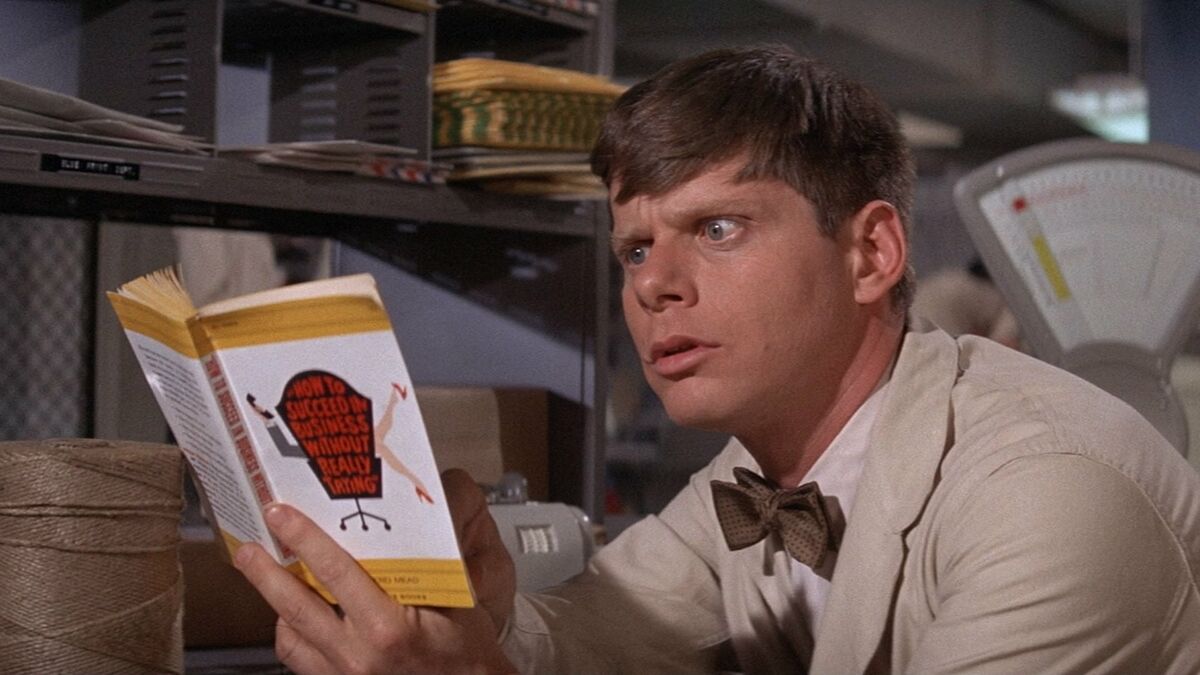
If the COVID pandemic taught the world anything, it’s that a whole lot of office jobs are made up of mindless busy work that doesn’t really need to be done. It’s sort of like an episode of the improv comedy show Whose Line Is It Anyway?: everything is made up and the points don’t matter. Films have criticized the capitalist grind since the early days of cinema – in 1927, dozens of exhausted workers shuffle in eerie unison into their factory in Fritz Lang’s Metropolis, and in Modern Times nearly a decade later, we watch Charlie Chaplin literally get trapped in the cogs of production. But when it comes to the satirical interpretation of the American corporate rat race, the sly musical How to Succeed in Business Without Really Trying is pretty much the gold standard. With its hyper-stylized depiction of a Manhattan office in the 1960s, its closest modern analog, on the surface, is Mad Men. But its impact on the workplace satire has a much broader legacy, and finds an unlikely contemporary mirror in a film like Mike Judge’s Office Space, which flips the 1967 musical’s hyperfocus on ambition and success into one of mere survival.
J. Pierpont Finch (Robert Morse, who also co-starred in Mad Men) begins his career as a window washer, polishing the glass walls of an American skyscraper that houses what amounts to an empty shell of a company. It’s called the World Wide Wicket Company, but no one seems to know what exactly a wicket is, and most of its employees have worked there well past the point where it feels appropriate to ask. What we learn about the great American corporation in How to Succeed in Business WIthout Really Trying is that climbing the ladder is entirely dependent on nepotism, luck, or, in the case of Finch, a carefully orchestrated web of schmoozing – knowledge, skill, and actual work are all functionally useless. Finch doesn’t do much of anything at the office. How could he? No one knows what the company even does. They float from coffee break to coffee break, eyeing secretaries and hoping not to get noticed by the high-level executives. For Finch, success is measured by the accumulation of a series of promotions that have very little meaning, and hardly impact what we generously consider his day-to-day “job.”
But if How to Succeed in Business Without Really Trying pokes fun at the unbridled pursuit of wealth and power of the mid-century white collar executive, Office Space is defined by a complete lack of ambition. Peter (Ron Livingston) is just trying to survive his menial office job. Forget taking his place among the top brass at software company Initech – he’s just happy to be left alone in his cubicle and not asked to come in on the weekends by his drawling, passive-aggressive boss. Although there’s more of a flurry of activity in How to Succeed in Business Without Really Trying, Office Space nonetheless exposes the emptiness and lack of purpose representative of the American corporate experience. Their days are filled with mundane printer issues and endless TPS reports rather than actual work (as Peter remarks at one point in the film, he only spends about 15 minutes a day with his nose to the grindstone). There’s even the character of Milton, who was fired several years earlier but was somehow kept on the payroll due to an accounting oversight: even the bosses in Office Space don’t really know what their employees are doing.
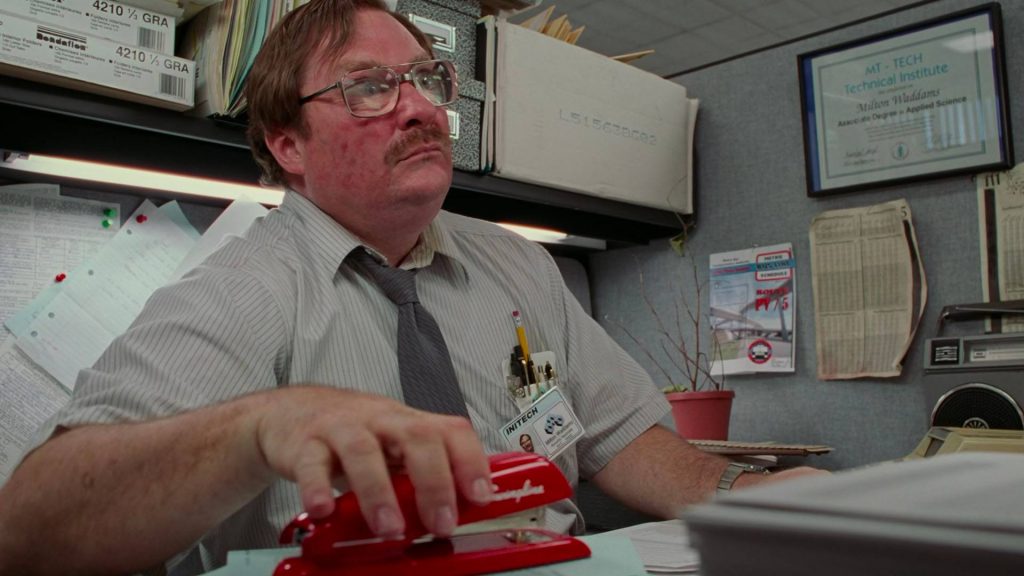
There’s a paradoxical approach to having a thriving career at Initech. As we see through Peter’s experience with hypnosis, the less he pretends to care about his job, the more he is admired for being a straight shooter, and is quickly flagged for a leadership role. Meanwhile, his friends Michael Bolton (David Herman) and Samir (Ajay Naidu) are considerably more committed to their work, but are perpetually overlooked by their supervisors. Success or failure as an employee appears to be decided on a whim or, even worse, is more perplexing, is entirely counterintuitive.
How to Succeed in Business Without Really Trying posits a world where any work takes a backseat to the subtle manipulation of one’s supervisors. It’s a comical exaggeration of corporate America, but it still follows a fairly traditional office hierarchy that relies heavily on a sense of interpersonal dynamics that we can recognize. Office Space takes this a step further into an entirely anarchic direction: Not only is the American workplace hollow and aimless, it functions in a way that makes it impossible to develop and predict a strategy for success. Finch finds his in a self-help book, while Peter essentially moonwalks into praise at work – but both are making it up as they go along, creating hilariously chaotic interpretations of industries that have long presented themselves as being intimidatingly professional.