Zach Vasquez
On a recent episode of Quentin Tarantino and Roger Avery’s new podcast, Video Archives, the pair talk about their shared love of the 1997 monster movie The Relic. While not necessarily forgotten, the movie has flown under the radar until recently—following their podcast discussion, Tarantino programmed a couple screenings of it at his Los Angeles repertory theater The New Beverly, where it proved a big hit with the crowd. The Relic is a film worthy of rediscovery not just by the horror crowd, but those who miss the type of sturdy, handsome and smarter-than-you’d-expect-populist entertainment that we used to take for granted.
Or, to put it more simply, a Peter Hyams movie.
While it’s hard to call Hyams under-appreciated, given that he enjoyed a prolific forty-plus year career in the Hollywood mainstream, he’s never been given his proper due as an artist. A genre-hopping journey-man with a penchant for high concept stories grounded in a blue collar sensibility, he would seem to be the platonic ideal of a gun-for-hire director, save for the fact that for the majority of films he’s directed, he’s also served as producer, writer (or at least co-writer), and, most surprisingly of all, director of photography.
(Hyams has been officially listed as director of photography on every one of his films since 1984’s 2010: The Year We Make Contact, although according to the man himself, he’s actually been shooting his own movies since the beginning and it was only union rules that kept him from getting the credit.)
Hyams is the living embodiment of the auteur in both its original meaning—as developed by the Cashiers du Cinema crowd to describe directors who found ways to express their personality through style and recurring themes, even when working within the studio system—as well as the later, more generalized understanding, which uses the term to describe a director who maintains strict control over their vision.
The son of a Broadway producer and publicist, respectively, and grandson of a Russian-Jewish impresario, Hyams was born with show business in his blood. Gravitating to journalism, he produced documentaries for television news and even served as an on-air anchor, until his artistic temperament got the better of him and he decided to make the jump to movies. He initially stuck around in television, directing a few TV movies, including the well received 1972 private eye mystery Goodnight, My Love. Off the strength of that film’s reception, as well as the eventual commercial success of his script for the romantic drama T.R. Baskin (directed by Herbert Ross in 1971), Hyams was able to move fully into studio filmmaking.
His debut feature proved one of his best and most influential, even though it didn’t make much of a splash at the time. Busting (1974) sees a pair of Los Angeles vice cops (Elliot Gould and Robert Blake) tear up their city in their quest to bring down a powerful and protected gangster. It’s a movie that is very much of its time, both culturally (let’s just say it wouldn’t pass any sensitivity tests today) and spiritually (coming as it does with the expected ‘70s bummer ending)– and also ahead of its time, helping set the template for the buddy-cop action-comedies that would explode in popularity throughout the following decades.
Hyams followed up Busting with two pictures—Out Time (1974) and Peeper (1975)—that flopped before scoring a huge rebound with Capricorn One (1978), the movie for which he’s arguably best remembered. It concerns a trio of astronauts (James Brolin, Sam Waterson, and OJ Simpson) forced by NASA into faking a Mars landing for PR and political reasons, and then targeted for execution in order to cover it up. A rare example of the post-Watergate conspiracy thriller with a happy ending, Capricorn One proved a major crowd pleaser and hit (although Hyams credits much of its success to the fact that Warner Brother’s other major release set for that summer, Superman, had to be delayed, forcing the studio to redirect all of their advertising budget to his movie.)
The next five years made for another period of commercial—if not necessarily artistic—disappointments for Hyams, with his Harrison Ford-starring romantic war drama Hanover Street (1979), his High Noon-in-space remake with Sean Connery, Outland (1981), and his Michael Douglas vigilante thriller The Star Chamber (1983) all receiving disappointing receptions (although Outland stands as perhaps his best work). Still, his reputation as a steady hand and his proven ability to mount a good looking science fiction picture with broad appeal led to MGM hiring him to direct 2010, the much anticipated—and much-dreaded—follow up to the greatest science fiction picture of all-time: 2001: A Space Odyssey.
Adapting Arthur C. Clarke’s novel of two years earlier with the personal blessing of the author as well as Stanley Kubrick—who, per Hyams, couldn’t have been less interested in the project and instead spent the majority of their conversations grilling him with questions about Outland’s production and effects—2010 is about as good as anyone could reasonably expect a 2001 sequel to be. It has nothing on the technical grandeur, artistic scope, thematic weight or numinous power of the original, and its plot (particularly its ending) make for a disappointingly pat continuation of Clarke and Kubrick’s story. However, judged on its own merits, it still makes for a damn good movie. Few directors are as adept as Hyams at setting stories in large but enclosed spaces and using them to their full potential, be it a spaceship, an underground extraterrestrial mining colony, a moving train, a hockey stadium, or a metropolitan museum.
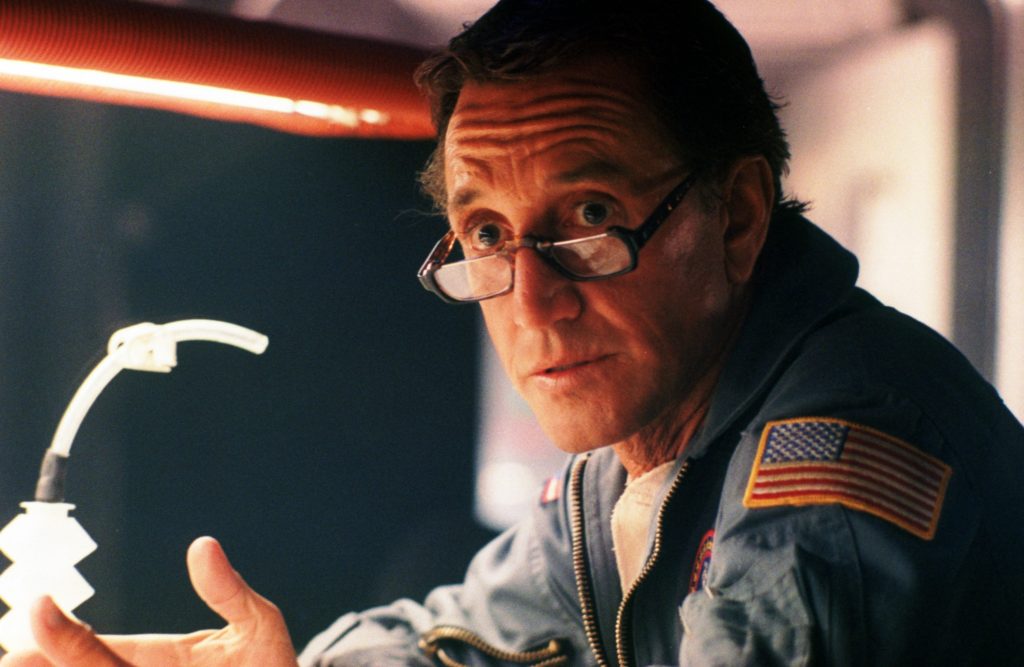
Although 2010 attempts to replicate 2001’s hallucinatory feel a couple of times, for the most part, it stays much more grounded (not counting its copious use of zero gravity effects). Hyams’ movies have always had an endearingly unpretentious, meat-and-potatoes quality. This is best encapsulated by a scene late in 2010 when two of the American astronauts (Roy Schneider and John Lithgow) mentally prepare themselves for a dangerous mission by talking about their favorite ballpark hotdogs, a scene that would be completely out of place in Kubrick’s original, but would fit in just about any Hyams film, whether it be a grand space odyssey, a gritty police procedural, or an over-the-top kung fu flick.
After 2010, the highest-profile project Hyams would ever helm, he’d direct 12 more features over the next 30 years, a list that includes some notable successes (Running Scared, Time Cop, End of Days), a couple big flops (The Presidio, A Sound of Thunder) and a whole bunch of relentlessly fun films that may not have lit the world on fire at the time, but either found their audience in the time since or are primed to in the future (Stayed Tuned, Sudden Death, The Relic). What’s most remarkable about Hyams body of work is its breadth of scope, vacillating between punchy action, hard boiled crime, high concept sci-fi and fantasy, and old fashioned horror.
But for as eclectic as his films are genre-wise, obvious patterns emerge throughout. We find Hyams returning to certain stories and topics: Capricorn One, Outland and 2010–the latter two both set in and around Jupiter’s moon Io—all revolve around astronauts caught up in webs of corruption and conspiracy (much the same can be said of Time Cop, minus the astronaut bit). Taken together, there’s an argument to be made that Hyams is one of the major directors of science fiction of the last 40 years. At the same time, his penchant for gleefully profane comedy, masculine bonding and high-octane, gritty action set pieces make him as key a figure to the buddy cop movie as Shane Black or Walter Hill, with two of the three films he made in that genre—Busting and Running Scared—standing out among the best (The Presidio, not so much).
If Hyams doesn’t get enough credit as a director of science fiction, he is similarly underrated as an action director, rarely held up amongst the bigger names in the category, despite how many incredible set-pieces he’s staged throughout his movies – most notably the foot chase and shootout through a Los Angeles market place in Busting, a car chase over an above ground subway track in Running Scared, a showdown atop a moving train in The Narrow Margin, and the final fiery battle with the monster in Chicago’s Feild Museum Natural History in The Relic, and just about every scene in Sudden Death, aka the best of the Die Hard rip-offs. (I also find it endearing that Hyams has continued to work with Jean-Claude van Damme over the years, even serving as director of photography on 2009’s Universal Soldier: Regeneration, which was directed by his son, John Hyams).
It’s not just genre obsession that runs through his work. As unpretentious as his movies are, they still contain a strong political worldview, a healthy sense of distrust for power borne out of ‘60s and ‘70s cynicism (particularly post-Watergate). But unlike a lot of movies from the same period with a general anti-authority ethos, Hyams injects an unabashedly leftist POV. Outland is a naked condemnation of capitalist labor exploitation, making it a far more politically coherent movie than the one it’s reimagining. The Star Chamber primes its audience for Death Wish-style bloodlust by showing how the justice system is tipped in favor of criminals rather than victims, only to pull the rug out with an ingenious twist that turns everything they’ve just seen and felt on its head (it’s just too bad the actual ending is such a big nothing). There are sharper indictments of the military and consumerism than The Presidio and Stay Tuned, respectively, but both of those films still make a solid attempt. Meanwhile, Timecop goes out of its way to distinguish its slimy politician villain from other rote examples by explicitly making him a pro-life, anti-immigration Reaganite Republican. It’s funny to think about, but if Timecop, of all movies, came out today, a lot of the same types who did or would have made up its target demographic when it was originally released would bitch about how it’s too woke.
It’s easy to understand why the political aspect of Hyams’ work has been overlooked. It’s the same reason why he was never treated like the auteur that he is. His movies are smart, but they’re not pretentious. They’re impeccably made, but they’re not ornate or showy. The scripts are, for the most part, clever and well-told, but even when they’re dealing with socio-political themes, they’re never preachy or didactic.
(Hyams himself has taken this in stride, saying of himself, “I’ve never gotten an Oscar. I’ve never been nominated. I have never been given, nor do I deserve, a Lifetime Achievement Award. However…I am the only director to have two leading men tried for the first degree murder of their wives – Bobby Blake and O.J. Simpson…”)
The artless, weightless, shapeless content that makes up our current populist A-list fare, as well as the boring, unimaginative stuff that counts as modern-day B-pictures, really puts Hyams’ mastery of his craft in sharp relief. Of course, that was always evident if you were paying attention. But today, after years and years of being fed slop, a well-made ballpark hot dog tastes like a five star, four-course meal.