Kayleigh Donaldson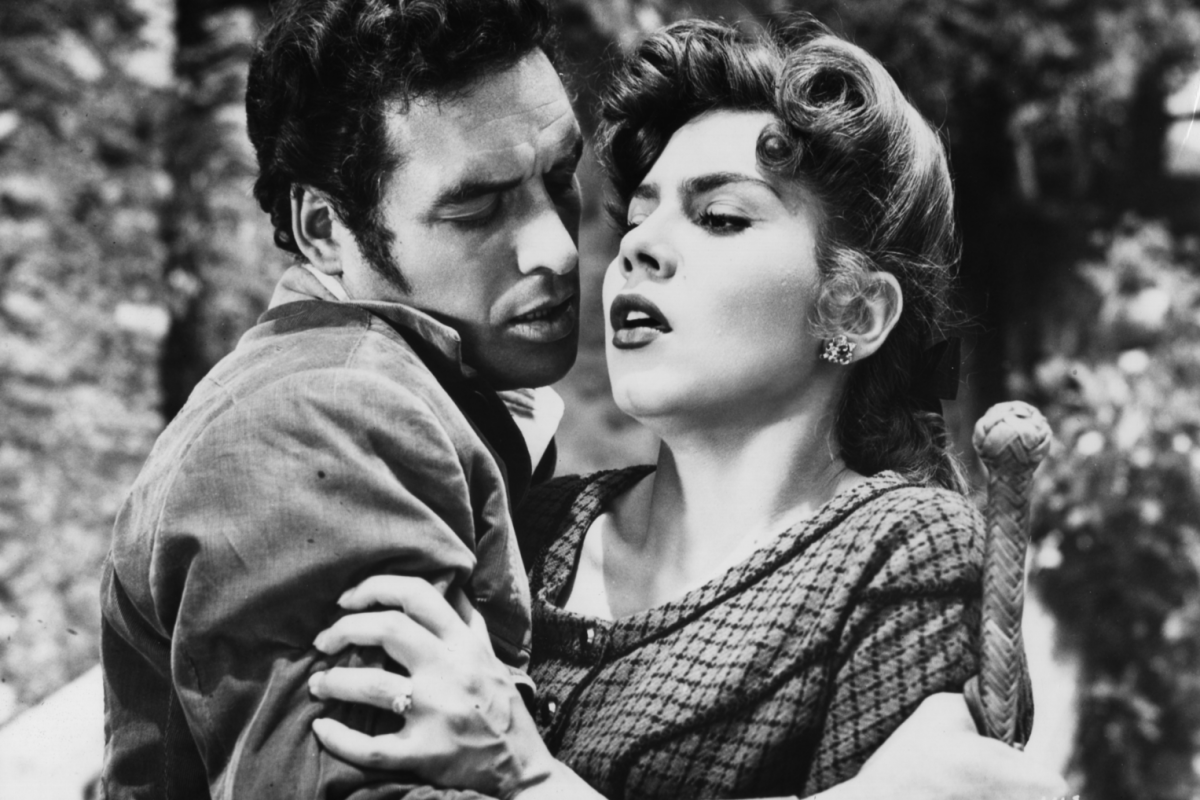
Emerald Fennell’s Wuthering Heights, the latest in a long line of adaptations of Emily Brontë’s only novel, was destined to be a discourse-producing machine from the moment it was greenlit. Fennell’s decision to go for broke with aesthetic anachronisms and no-holds-barred horniness has already earned her the ire of the internet, long before anyone got the chance to watch it. She can take comfort in knowing she’s not alone on that front. The tempestuous gothic romance has kept English literature professors busy for decades, and the various re-imaginings of it have seldom been welcomed without question. It’s a tough novel to adapt, and most don’t even tackle the entire thing, so why not embrace the reinvention? One of cinema’s most important filmmakers decided to take on Brontë in his own way, and it gave audiences one of the most feverish takes on Wuthering Heights ever committed to celluloid.
Directed by Luis Buñuel, 1954’s Abismos de pasión (Abysses of Passion) doesn’t take place in any kind of wuthering location but the barren plains of Mexico. Heathcliff is now Alejandro, Cathy is Catalina, and everything is, of course, in Spanish. Buñuel wasn’t the first filmmaker to transfer the class war of the Yorkshire countryside to another country – Indian cinema got there a few years prior – but his version is unique in its blending of the novel’s sensibilities with the director’s heralded blend of surrealism, politics, and melodrama. Really, it makes him an ideal fit for Brontë and her primal exploration of lust and resentment across the generations.
The set-up is familiar, kicking off midway through the novel (a common move for Wuthering Heights adaptations). The brooding Alejandro (Jorge Mistral) returns to the home of his youth, where he was raised alongside the beautiful Catalina (Irasema Dilián.) They adore one another, but she has married Eduardo (Ernesto Alonso), a brutish, rich creep who kills butterflies and treats Catalina’s brother like a slave. Now pregnant with Eduardo’s child, Catalina yearns for Alejandro, but he is too stubborn and resentful for his own good and ends up seducing Eduardo’s sister.
“Like all surrealists, I was deeply moved by this novel,” wrote Buñuel. He was drawn to “its climate of passion, for l’amour fou that destroys everything.” His decision to cut out the childhood scenes is understandable – there’s a reason so few versions take on the entire text – but we could have used more backstory for Alejandro and Catalina. That lack of origin for these characters is compensated through sheer emotion, at least; Abismos de pasión certainly has a lot of passion. It feels like it could slot comfortably into Mexico’s history of heightened telenovelas and swoon-heavy romances where bosoms are heaving at a record pace. Outside of the control of the Hays Code, which left William Wyler’s Wuthering Heights feeling a tad inert, Buñuel gets to revel in some real messy heat with the doomed lovers.

Buñuel makes it all feel thoroughly Mexican, all without reinventing the core narrative. He also made it extremely Catholic, a contrast from the prim Anglican “keep calm and carry on” ethos of Brontë’s time. Catalina not only craves the man who is her brother in all but blood; she desires him more than her husband, and, as she tells Alejandro, “more than the salvation of my soul.” It’s a moment of damnation for our spurred lovers, a contrast to the more “noble” savagery of Eduardo, a man who is a proper gentleman in the eyes of society and whose own sadistic streak is spared the possibility of hell. He methodically pins butterflies to boards – a classic piece of Gothic romance imagery – and seems smugly satisfied with his lot in life, a sharp contrast to his poor wife, who is trying to fight her fate.
Most of the film avoids Buñuel’s legendary surrealism, but the ending is some of his finest work in the style. Alejandro hallucinates an image of Catalina in a wedding dress, arms stretched out towards him, eager for embrace. It then cuts to a graphic match of Eduardo with a shotgun. It’s both Buñuel and Brontë, that sharp contrast between passion and violence that makes the book an enduring tale of both.
Abismos de pasión was a compromised work. The director had to work with a pre-chosen cast he wasn’t fond of, and the producers limited his budget and restrained his vision. But even under those circumstances, this remains one of the most emotionally resonant versions of Wuthering Heights committed to cinema. It’s a chest-thumping, all-emotion, high-heated portrait of the agony and ecstasy of class, love, and revenge. As with all adaptations of the book, you can see what’s missing and yearn for its inclusion, yet Buñuel’s take acutely captures the liminal state its doomed lovers are forced to navigate before they tumble headfirst into their tragic conclusions.