Zach Vasquez
Despite its troubled production history and ultimate commercial failure, the 1978 crime drama Straight Time would turn out to be one of the most important films of its time. Primarily known as Dustin Hoffman’s failed first attempt at directing—he oversaw only one disastrous day of location shooting at California’s Folsom State Prison before stepping aside and handing the reins over to Ulu Grossbard—the film would, in fact, prove pivotal for other members of the production, including a young, uncredited screenwriter by the name of Michael Mann.
For his planned directorial debut, Hoffman chose a gritty crime story from a then-unknown writer named Edward Bunker. Today remembered as America’s preeminent ex-con of letters, Bunker is one of the most fascinating fringe figures across both literature and film. Brought up in an alcoholic and abusive household during the Great Depression, Bunker’s run-ins with the law began when he was still a child, earning him various stints in reform camps for stealing and vagrancy. He soon graduated to the big time, embarking on a life of crime both petty and serious, mostly involving drug dealing and theft (including armed robbery and even bank robbery), which earned him many years behind bars.
Even while he was deep in the game, Bunker showed a proclivity for literature, and in 1975, while still serving part of a five-year sentence, he published his first novel, No Beast So Fierce, about a career criminal named Max Denbo (Hoffman in the film) who finishes up a lengthy prison stretch and tries going straight, only to fall back into his old ways when his corrupt parole officer (M. Emmet Walsh) unfairly tries to bounce him.
Retitled Straight Time, Hoffman’s adaptation sought to retain the lived-in quality of Bunker’s text by bringing him onboard as a screenwriter, as well as consultant and bit part actor. Unexpectedly, Bunker showed that he had some real chops in the latter role, more than holding his own with the likes of Hoffman and Harry Dean Stanton*, and he would parlay this into a successful side career as a character actor.
Enter a young Michael Mann, who was already making a name for himself as a director of television and commercial advertising by the time he was brought onboard to do a pass on Straight Time’s script (officially credited to Bunker, Alvin Sargent, and Jeffery Boam). It’s here he would meet Bunker, who would go on to be one of his key collaborators moving forward. Like the characters in his films, Mann is famed for his attention to specifics, thus making Bunker’s first hand knowledge of the criminal milieu indispensable.
Watching Straight Time today, it becomes immediately evident how formative the film was to Mann. Hoffman’s stoic and uber-professional burglar is the progenitor for those played by James Caan in Thief, Robert De Niro in Heat, and (to a slightly lesser extent, given its true-life basis) Johnny Depp in Public Enemies, while the beautifully detailed heist scenes make the blueprint, no pun intended, for the technical marvels in those later works. Straight Time also traffics in many of the key themes—particularly the lingering threat of recidivism and the seductive draw of revenge—and story beats—such as the hero’s doomed romance with Theresa Russell’s empathetic working stiff and a third act betrayal from Gary Busey’s trusted partner—as those other films.
Straight Time’s influence on Mann was as immediate as it was long lasting. The very next year, he would go on to helm his debut feature (faring much better than Hoffman in process) with one of the greatest made-for-television movies of all time. The Jericho Mile tells the story of Folsom lifer (Larry Murphy) who may just be the fastest runner in America. When prison officials discover this, they attempt to get him into the Olympics. Meanwhile, the murder of his best friend and fellow inmate at the hands of the Aryan Brotherhood sets him on a collision course with the gang that threatens to kick off a full scale, prison-wide race war. Part rousing sports drama, part emotionally-devastating tearjerker, and part hardboiled crime thriller, The Jericho Mile is as sterling a debut as any director can lay claim to and undoubtedly Mann’s most underseen and underrated picture.
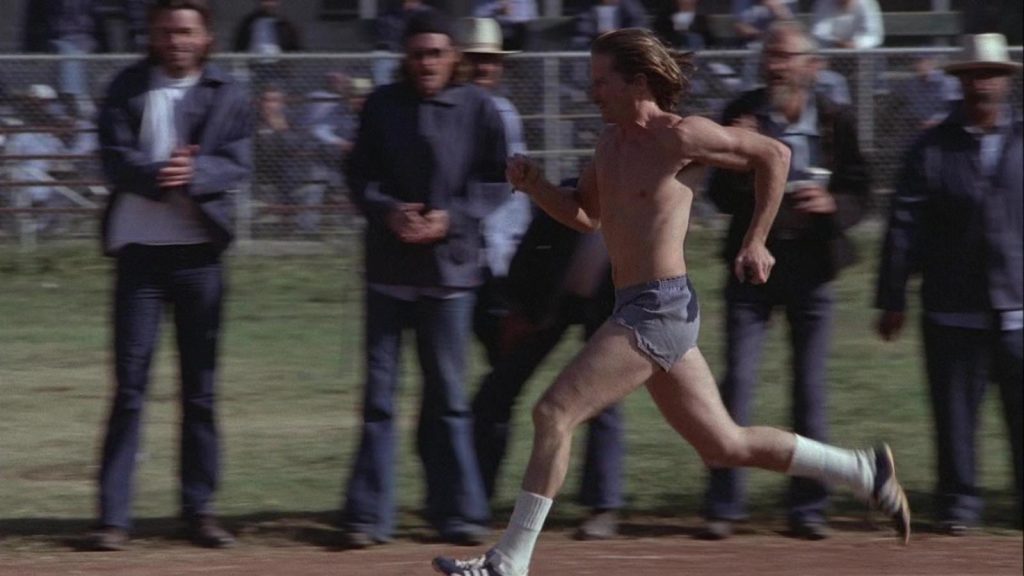
Like Straight Time before it, The Jericho Mile was shot on location, but whereas the former only had a few scenes set in Folsom, the latter takes place almost exclusively within its walls. This proved technically difficult for a number of reasons, not least of which was because, as is in the film’s story, tensions between the three main inmate gangs—the Black Guerrillas, the Aryan Brotherhood, and the Mexican Mafia—were running high. Prison officials told the filmmakers that should this boil over into a race riot, production would have to be permanently halted.
Mann’s solution was to ensure the cooperation of influential inmates, who in turn would keep the rest of gen pop in line. This was partially achieved with the help of Bunker (as well as fellow ex-con turned celebrated scribe, playwright and screenwriter Miguel Piñero, who also acted in the film) serving as a liaison between both worlds. The Jericho Mile’s production ended up going surprisingly smoothly, and the finished film premiered to good ratings and high acclaim.
By this time, Bunker had gotten off the hamster wheel of crime and incarceration for good. He found steady work writing and acting, combining both talents for Cannon Film’s Runaway Train (1985). For the existentialist action masterpiece—which nabbed leads John Voight and Eric Roberts Academy Awards nominations—Bunker was one of three writers (alongside Djordje Milicevic and Paul Zindel) brought aboard to hammer out the original story idea from Akira Kurosawa (who originally planned to direct). He also had a small, but important role as an inmate during the prison-set first act. It was these scenes where a serendipitous reunion occurred between Bunker and an ex-con he knew from one of his stints in California’s San Quentin.
Like Bunker, Danny Trejo was raised in a household of abuse and addiction, leading him down the path of drugs, theft, violence, and the penitentiary. During one of his jags, he took part in a prison riot and hit a guard with a rock, nearly killing him. This earned Trejo solitary confinement, where, fearing he’d be given the death penalty should the guard succumb to his injuries, he attempted to bargain with the Almighty, praying, “God, if you’re there, everything will turn out the way it’s supposed to. If you’re not, I’m fucked.”
Through either an act of divine intervention or just plain luck, the charges against Trejo were dropped, and when he came out of the hole he made good on his word, getting clean and renouncing his life of crime. When he was released from prison for the final time in 1969, he dedicated himself to helping others by becoming a substance abuse counselor. Having taken up boxing during his time in prison, Trejo’s impressive physique garnered lots of attention, especially from casting agents in his home base of Los Angeles, and it wasn’t long before he had a decent side gig going as a background extra. Through this, he was able to reach out to other actors with substance abuse issues and get them into treatment.
It was while helping one of these actors that Trejo found himself on the set of Runaway Train, where he and Bunker recognized each other. Bunker was able to get Trejo hired on as Eric Roberts’s boxing coach (his character in the film is a boxer serving time for statutory rape), as well as an actor. Eventually, Bunker introduced Trejo to Mann, who as it happened knew Trejo’s uncle from Jericho Mile, where he’d been one of those Folsom ‘shot callers’ that facilitated cooperation between the crew and the cons.

Mann got Danny Trejo a part in the 1990 television miniseries Drug Wars: The Camarena Story (for which he served as executive producer and writer), before casting him in his biggest role up to that point in the L.A. bank robber opus Heat. As trusty getaway driver and reluctant turncoat Trejo—the character’s name was an homage to his uncle—the real Trejo showed that he was more than just a memorable mug and could hang with the pros (it helped that he had the greatest actor of all time in Robert De Niro as a scene partner, and that De Niro took the time to school him). From there, Trejo would go on to become one of the most prolific and recognizable actors of his generation, as well as a successful restaurateur and brand unto himself. A long way from solitary, indeed.
During this period, Bunker likewise continued to have success in the film industry, landing roles in the likes of The Running Man, Miracle Mile, and Tango & Cash. In 1992, young upstart director Quentin Tarantino cast Bunker as bank robber Mr. Blue in his debut Reservoir Dogs. Tarantino was familiar with Bunker’s work as both an actor and a writer, and has gone on record about Straight Time’s outsized influence on Dogs, calling it “one of the greatest crime movies ever made.” Although Bunker’s character has the smallest screen time of any of the core group in Dogs, the movie proved so iconic that it instantly became his most recognizable role, so much so that he titled his 1999 autobiography Mr Blue: Memoirs of a Renegade.
(During this period, Bunker continued working with Mann and would serve as a consultant on Heat, as well the inspiration for the character of Nate, the loyal underworld fence and fixer played by his old Runaway Train scene partner Jon Voight. Once you realize Voight is playing Bunker, the resemblance becomes uncanny.)
Twenty-two years after his debut novel was brought to screen, his follow up, the wholly prison-set Animal Factory (1977) was made into a critically acclaimed film of the same name by Dogs co-star Steve Buscemi and starring Edward a furlong and Willem Dafoe. As with Straight Time, Bunker co-wrote the screenplay (with John Steppling) and took an onscreen role. Naturally, Danny Trejo also appeared in the film. (In 2016, Dafoe would go on to star in another Bunker adaptation via Paul Schrader’s unremittingly nasty and bizarre—and also hugely underrated—Dog Eat Dog. Unfortunately, Bunker had passed away from complications from surgery eleven years earlier and so didn’t get to see it.)
Mann, of course, would go on to become one of the most successful filmmakers of the next 40 years. Although he’s branched out from crime stories on a number of occasions, he constantly returns to the genre, and specifically, to stories about or heavily featuring convicts attempting to go straight. In 2011, he reunited with Hoffman for HBO’s ill-fated horse racing show Luck, producing and directing the bravura pilot.
Take one guess what Hoffman’s character’s deal is in that show.
*One of the truest things Roger Ebert ever said was that “no movie featuring either Harry Dean Stanton or M. Emmet Walsh in a supporting role can be altogether bad,” so it should come as no surprise that he held Straight Time, which features great performances from both (especially Walsh) in high regard.