Marshall Shaffer
“This is insanity,” exclaims Idris Elba’s American president in A House of Dynamite, Kathryn Bigelow’s political thriller that premiered at the 2025 Venice Film Festival. “No,” replies Tracy Letts’ top military brass, “this is reality.” But across the festival’s selections this year, the two were hard to tell apart.
The 2025 edition of the festival was its second with Gaza at the forefront. While jury president Alexander Payne drew widespread criticism for his claim to being “unprepared” to answer a question about the ongoing humanitarian crisis, few others could claim such surprise. It played out everywhere, from a march on the festival grounds in support of Palestine that drew over 10,000 attendees to Kaouther Ben Hania’s competition title The Voice of Hind Rajab, which uses re-enactments to visualize the other side of a real emergency call from a Gazan child.
Though it didn’t always intrude as forcefully as Ben Hania holding up a phone with real-life footage in front of her actors performing the same moment, reality was inescapable at the festival. While Gus Van Sant’s Dead Man’s Wire and Yorgos Lanthimos’ Bugonia were shot well before the murder of a healthcare CEO last year, both channeled a dominant strain of populist rage echoing throughout America and the world. The fictions playing out on screen seemed to reflect a growing malaise off it, one that further pushes people toward extreme ends to upend systems they feel trap them on the bottom rung of a hierarchy.
Bugonia, my clear standout of the festival, captures this climate most acutely – if still obliquely, because Yorgos Lanthimos gonna Yorgos Lanthimos. His remake of the 2003 Korean film Save the Green Planet! practically feels ripped from the headlines as Jesse Plemons’ Teddy kidnaps a pharmaceutical CEO, Emma Stone’s Michelle. What makes him a little different from your average redpilled MAHA bro is that, thanks to his online filter bubbles, he’s convinced that his captive is an alien intent on destroying the earth through her perverse products.
Will Tracy’s script gives Teddy plenty of space to vamp on his tinfoil hat-style rants, but he mostly steers clear of overtly showing his didactic journey of radicalization. Instead, he gets to re-enact it on a human-to-human level with his cousin on the autism spectrum, Don (Adrian Delbis). He’s far from an ideological warrior, and the morality of continuing to inflict pain upon their prisoner causes great strain on Don. Watching his agonized deliberations as he weighs satisfying his crazed family against following social norms of decency gives the proceedings a beating, bleeding heart. Reality for him is not a construct; it’s a choice.

A comparable dynamic plays out in Anders Thomas Jensen’s Danish dark comedy The Last Viking, even down to the familial element. Anker (Nikolaj Lie Kaas) entrusts his eccentric brother Manfred (Mads Mikkelsen) with hiding some stolen money while he serves an extended prison sentence. While his sibling sits in the pen, Manfred receives a diagnosis of dissociative identity disorder. Anker returns to find not Manfred but John – styled after John Lennon, of course.
With some nefarious foes willing to put his family in harm’s way to reclaim their burgled money, the pressure is on immediately following Anker’s release. But John didn’t hide the money – Manfred did, and John knows not what his alter ego once did. Anker chafes at the notion of buying into his brother’s new self, even as deadnaming him causes a violent physical reaction.
It’s ultimately money and self-interest, not the kindness of his heart, that guides Anker on a journey of acceptance. If he cannot make his brother live in the reality where he could get a finger taken off with some rusty pliers, he has no choice but to indulge that vision of the world. This does involve creating an entire Beatles cover band, rounding up a Fab Four of fellow psychiatric patients with varying degrees of musical experience, to ensure his self-actualization. (John, of course, has none.)
Jensen’s film is a demented but delightful experience, marrying an earnest family drama with a captivating heist thriller. It’s a cheerful yet chaotic tribute to loving the reality you’re with if you can’t be in the one you want. This is meant as a compliment, I promise: The Last Viking feels like a prime candidate for an English-language remake at a time of such collective delusion.
If the present felt like uncertain terrain in Venice’s selection, the past was an outright battlefield. Some titles saw a more traditional battle playing out in geopolitics: rewriting history’s wrongs to justify the status quo. Láslzó Nemes’ post-WWII drama Orphan sees young Andor put his entire family at risk to maintain a mythological narrative about his father’s martyrdom in the Holocaust rather than accept a knottier truth about his parentage. Meanwhile, Noah Baumbach’s Jay Kelly finds George Clooney’s titular movie star replaying scenes from his life in an attempt to justify the choices that led him to a life of lonely luxury.
But the movies that met the moment were those that embraced the futility of trying to undo the ravages of time. In ways both literal and imaginative, Mark Jenkin’s metaphysical fairy tale Rose of Nevada and Ross McElwee’s autobiographical documentary Remake reckon with the fallacies that they can undo their current miseries by returning to the past. They’re each formally probing in their own way as they trod familiar territory of communities grappling with besieging forces that feel impossible to contain.
Jenkin does hit some rough seas in his plotting as the titular maritime vessel travels through time in a magical realist fashion. The “Rose of Nevada” once provided for a small fishing village in the southern British county of Cornwall whose precipitous decline maps neatly to the ship’s mysterious disappearance. When it turns up out of the blue thirty years later, the morose Nick (George MacKay) hops on board for another voyage despite misgivings about the safety of such a choice.
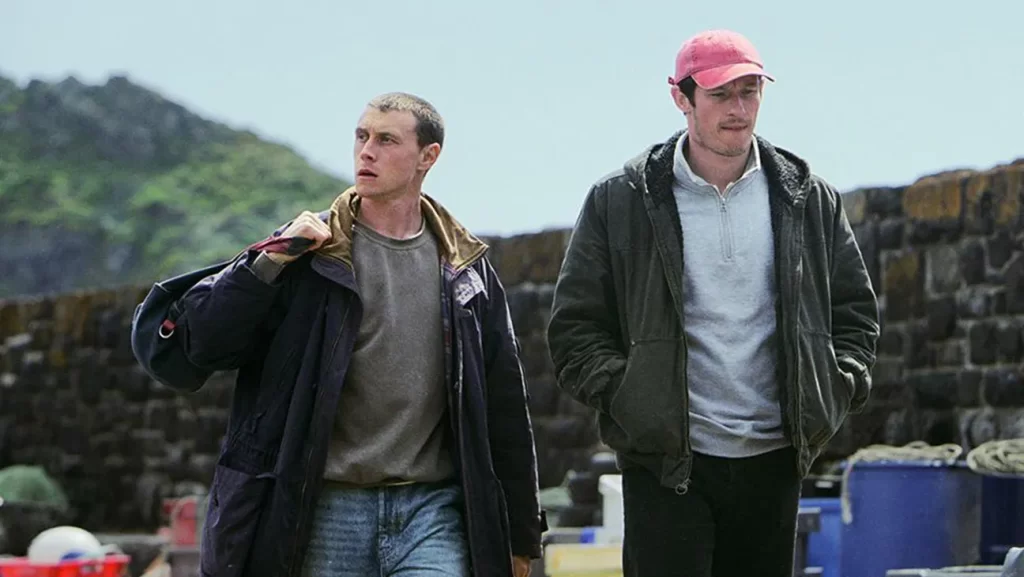
The “Rose of Nevada” represents a hope that the community can return to its glory days through the same means that once secured its prosperity. Little does Nick know that his ideological longing for a bygone era will become literalized through the cursed ship, taking him back in time to before his birth and their town’s troubles. The nuts and bolts of the voyage are a bit creaky, but the thematic thrust is always palpable and poignant. The past is not a sustainable route for navigating into the future.
The provocations of Remake, on the other hand, initially surface in a more unassuming manner. McElwee’s previous work has incorporated scenes and developments from his real life, but this is hardly a family album. He’s knitted something like a cinematic quilt across his decades in documentary. In the wake of his son’s tragic passing, the filmmaker attempts to unweave the delicate tapestry he’s threaded from the cloth of lived reality and documented footage.
McElwee’s folksy, plainspoken narration belies the complexity of his edit, which he shaped with Joe Bini, a collaborator of Andrea Arnold and Lynne Ramsay’s. That sense of imperceptibly shifting modes of consciousness pervades Remake as it becomes the very embodiment of memory. For McElwee, this act of sifting through his archive serves as a connective tissue between the past and the present.
Yet even when looking at objectively documented scenes of moments shared with Adrian, his late son, McElwee discovers these memories are not fixed. The footage responds to his glance and changes his own experience of them. He’s trapped between his desire to see Adrian in these glimpses of the child he loved and his sinking sensation that continuing to revisit the archive will replace that flesh-and-blood human with a fictional character.Remake is like watching the documentary profession’s equivalent of a doctor performing open-heart surgery on himself. With gut-wrenching vulnerability, McElwee made the most compelling case in Venice for re-committing to living in the real world. Pay no attention to the fact that he has to paradoxically use the tool that most tempts us to seek refuge elsewhere to argue so persuasively.