Josh Bell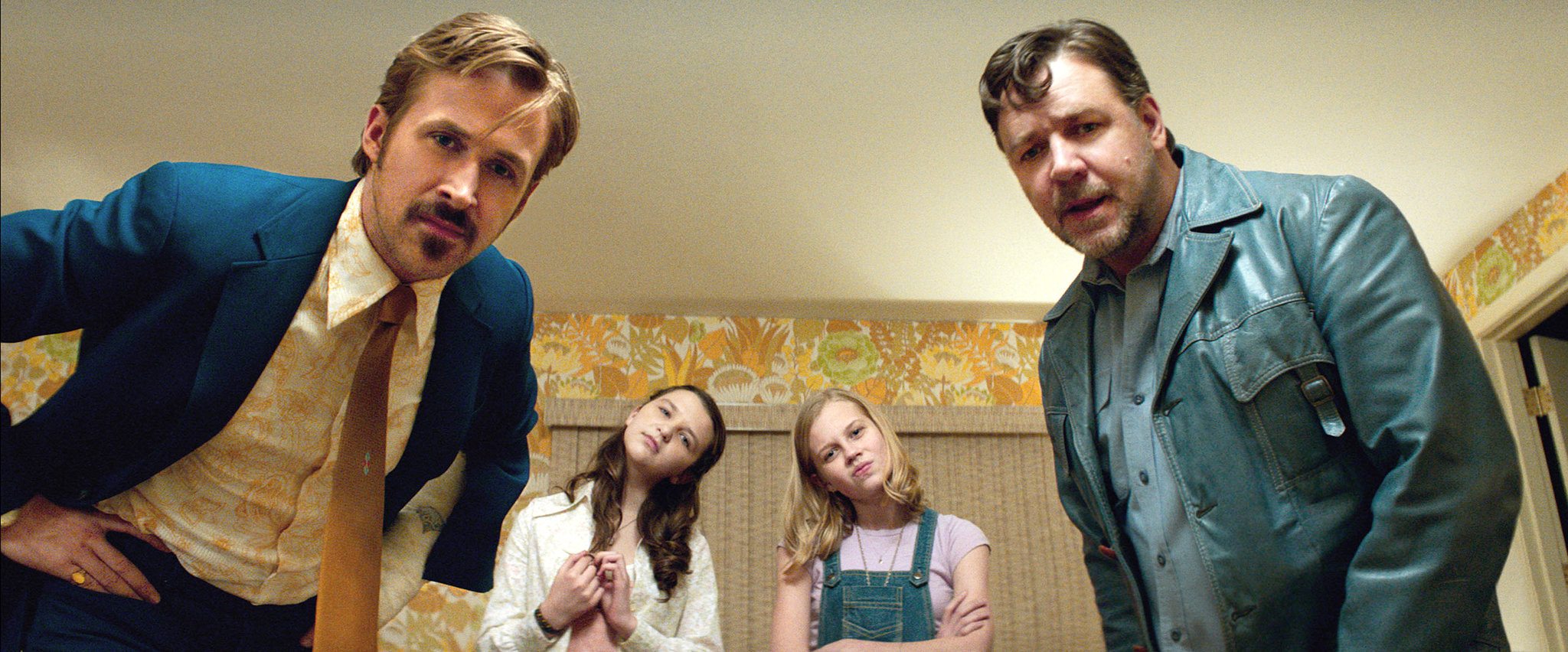
There’s a movie in Netflix’s top 10 right now starring Ryan Gosling as a wisecracking action hero, who takes on a monolithic government adversary and is motivated by his protectiveness for a young girl. I’m referring, of course, to Shane Black’s 2016 action-comedy The Nice Guys, featuring Russell Crowe alongside Gosling as a pair of private detectives in 1977 Los Angeles. For at least a little while this week, The Nice Guys has been nestled in the top 10 next to Netflix’s new massive-budget Gosling-starring thriller The Gray Man, a witless, exhausting take on the kind of thing that Black churned out to great success in the late ’80s and early ’90s.
Since then, Black has become more of a niche filmmaker, bouncing between uneven franchise projects like 2013’s Iron Man 3 and 2018’s The Predator and original works like The Nice Guys and 2005’s Kiss Kiss Bang Bang. The latter two are funny, exciting crowd-pleasers that ought to have been huge hits, but instead have become cult favorites that are mainly beloved by cinephiles. It’s possible that The Nice Guys’ Netflix debut will change that, as it has for many mid-tier action movies that didn’t make much of a dent on their initial release. Even if only a small portion of The Gray Man’s Netflix audience discovers The Nice Guys, that’s still a bonus for a movie that deserves to be seen as widely as possible.
“I get it. You’re glib,” Billy Bob Thornton’s CIA official tells Gosling’s convict when first recruiting him as a government operative in The Gray Man, and directors Anthony and Joe Russo seem to take that as a challenge, to make the character code-named Six into a quip-spouting machine, even as he’s in the midst of car chases and explosions and firefights. You could accuse Gosling’s The Nice Guys character Holland March of being glib, too, but his glibness is an obvious cover for deep sadness, and Gosling finds a perfect balance between the humor and the pathos, which are intertwined elements of March’s personality.
He’s an alcoholic and a scammer, milking his sometimes addled clients for all the money he can, while only half-heartedly investigating their cases. In that way, he’s the opposite of the dedicated, righteous Jackson Healy (Crowe), who trades in intimidation and physical violence, but uses his brute strength in service of standing up for underdogs. Healy has ambitions of becoming a private investigator, although his idealized sense of a private eye’s life looks nothing like March’s sad, lonely existence.
They cross paths thanks to Amelia (Margaret Qualley), an activist and adult film actress who hires Healy to stop March from looking for her. Quite a lot of people are looking for Amelia, who is the key figure in a knotty conspiracy that eventually encompasses the Justice Department and the “big three” American automakers, in addition to the porn industry. Black is working in the mode of detective stories stretching back to The Big Sleep and The Maltese Falcon, with plots whose near-incomprehensibility is part of their charm. March and Healy are closer to the protagonists of later comedic pastiches like Robert Altman’s The Long Goodbye and the Coen brothers’ The Big Lebowski, bumbling losers whose outsider status makes them perfect for uncovering corruption and murder among the rich and powerful.
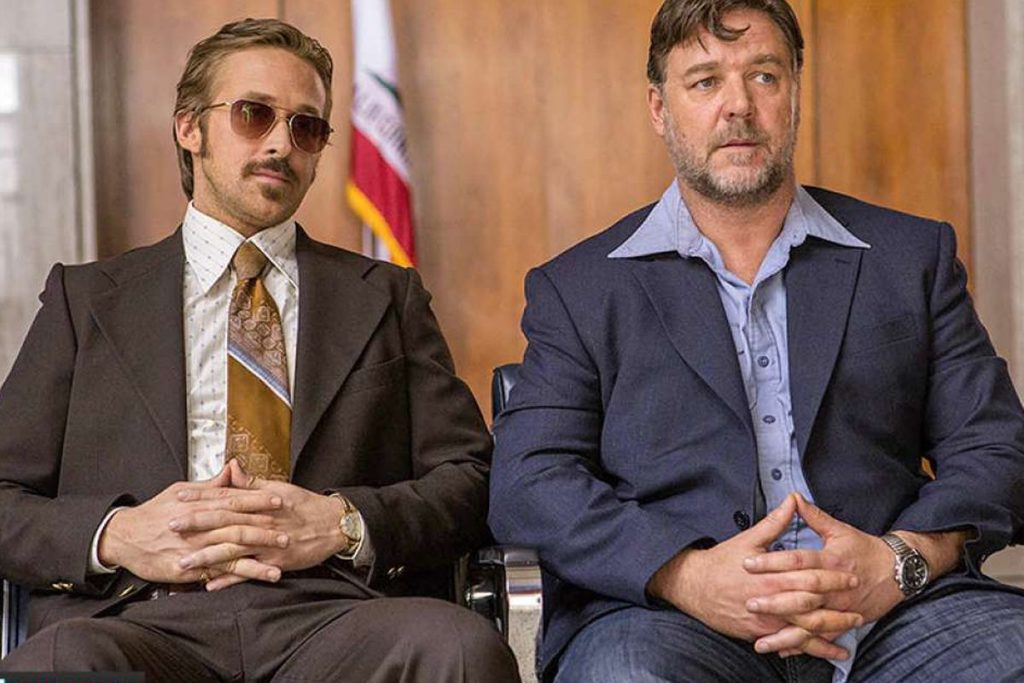
March and Healy aren’t exactly incompetent, although their stubborn persistence is mainly what makes them such a threat. That, and the skills of March’s 13-year-old daughter Holly (Angourie Rice), one of those kids who’s had to mature early while taking responsibility for an immature, irresponsible parent. March has barely been holding himself together since the death of his wife, and working with Healy on the Amelia investigation gives him a sense of purpose, even if he has to be reluctantly dragged into it.
In The Gray Man, Six has a mawkish, hastily established connection with his former handler’s niece (Julia Butters), whose peril provides easy motivation for vengeance. At times, March seems unduly casual about involving Holly in potential danger, but their bond is far more convincing in its complexity, strengthened by the charismatic, layered performances from Gosling and Rice. Holly is precocious without ever becoming cloying, believably scared when she’s in over her head but also sneakily resourceful, just like her dad.
The Nice Guys doesn’t have the budget of The Gray Man, but Black still stages action in a far more compelling and coherent manner than the Russos do. It takes a while before March and Healy find themselves in a full-scale shootout, but when they do, Black makes it thrilling and suspenseful, while also throwing in humor and moving the plot forward. There’s nothing gratuitous about The Nice Guys, whether it’s Gosling’s brilliant physical comedy in a bathroom stall or the explosions and fistfights of the action climax.
Everything that The Gray Man strains to accomplish, The Nice Guys delivers with ease, with added social commentary and winning supporting performances by everyone from Keith David to Kim Basinger. It’s not unprecedented for Netflix to take up the rights for a property initially released elsewhere, so there’s still time to redirect the resources for announced sequels and spin-offs for The Gray Man to The Nice Guys instead. 
“The Nice Guys” is now streaming on Netflix.