Josh Bell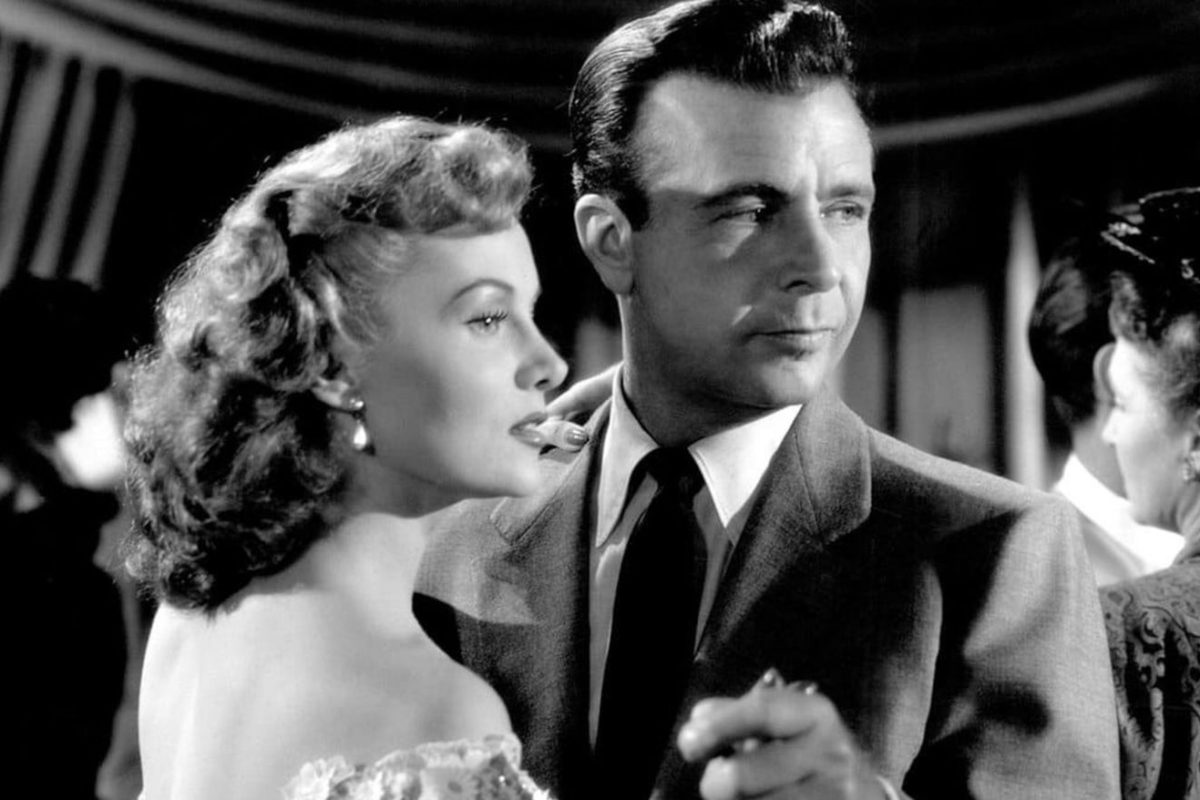
Over the course of a film career that lasted about 20 years, Rhonda Fleming never quite made it to the A-list, and rarely received top billing. But she was one of the leading stars of film noir, with supporting roles in classics like Out of the Past and The Spiral Staircase, along with lesser-known thrillers that offered more of a showcase for her talents. Two of Fleming’s best noirs were released 75 and 70 years ago this month, respectively, and both of them find her playing conflicted women who complicate the traditional image of the femme fatale.
In both 1951’s Cry Danger and 1956’s Slightly Scarlet, Fleming plays fundamentally decent women who give their love to troubled men and end up paying a price for it. While the enticing introductions to Fleming’s characters may imply that they’re opportunistic social climbers, their motivations are purer than that, and they consistently choose love over money, even if it leads to their doom. With her vibrant red hair, breathy vocal delivery, and often form-hugging outfits, Fleming could easily come off as a sultry seductress, but the films allow her to subvert audience expectations while sticking to a recognizable noir template.
“I want to introduce you to a pretty girl,” says ex-con Rocky Mulloy (Dick Powell) to his newfound accomplice Delong (Richard Erdman) in Cry Danger, as they make their way to the trailer park where Rocky’s former flame Nancy Morgan (Fleming) now resides. Nancy lives up to that billing, but she’s not the one melting hearts when Rocky and Delong arrive. “You better grab me quick before my knees give way,” she says upon seeing Rocky for the first time in five years, and it’s Rocky who draws Nancy away from the straight-and-narrow path she’s been on, not the other way around.
Slightly Scarlet also begins with Fleming’s character reuniting with an ex-con. Fleming’s June Lyons arrives to pick up her sister Dorothy (Arlene Dahl) from the women’s prison where she’s spent the last 18 months on a charge of grand larceny. Like Nancy, June has kept herself squeaky clean while her loved one has been behind bars, but Dorothy’s return begins a series of events that will draw her into a dangerous underworld. “You must be quite a secretary,” Dorothy says suggestively when she sees the upscale home that June’s job with businessman and mayoral candidate Frank Jansen (Kent Taylor) has afforded her.
Like Nancy, though, June is never dishonest with her feelings, and she isn’t working an angle. For both of them, their love for the wrong man is genuine. In Nancy’s case, she was once Rocky’s girl but is now married to his best friend and partner in crime, who’s still in prison while Rocky has been released on a technicality. Rocky is determined to clear both his own name and his partner’s, which necessitates renewing his connection to slimy crime boss Louie Castro (William Conrad), while a police detective (Regis Toomey) watches his every move, eager to send him back to prison.
Nancy is adamant that Rocky should drop the whole thing, especially because her husband is up for parole in six months anyway. Powell, another noir staple, is great at playing a principled tough guy, and Rocky doggedly pursues the truth even though all it does is put him and the people he cares about in harm’s way. He didn’t pull the job he was sent away for, but he wants to get paid anyway, since he did the time as if he had done the crime. Nancy is right when she tells him to let it go, but anyone who’s seen a film noir knows that this star-crossed couple isn’t going to get a happy ending.

At least Rocky has his principles, however misguided. That’s more than can be said for June’s love interest in Slightly Scarlet, a mob fixer who uses June’s connections to Jansen to get what he wants and doesn’t seem particularly concerned about hurting her. Former cop Ben Grace (John Payne) starts following June as a way to dig up dirt on Jansen for powerful kingpin Solly Caspar (Ted de Corsia), but she’s too upstanding for him to find anything. “A dame is a dame — there’s bound to be something you can nail her on,” Caspar insists, articulating one of the central themes of film noir.
Ben knows better, though, and instead he turns on Caspar, feeding June incriminating information that forces Caspar to flee town. Ben hasn’t gone straight, despite what June may think as she starts falling for him. He’s just positioned himself to take over Caspar’s operation, undermining Jansen’s efforts as a supposed social reformer. It would be easy to view June as naïve, but Fleming gives her a level of appealing self-assurance. She believes that Ben is a good person because she loves him, and she’s a good person herself.
Although Nancy and June are romantics at heart, Cry Danger and Slightly Scarlet are still blatantly horny movies, with noir’s familiar sublimated desires. Cry Danger’s Rocky is devoted to Nancy, but that doesn’t stop nearly every woman he encounters from throwing herself at him, including the spouses and accomplices of the people trying to set him up. Nancy’s trailer-park neighbor Darlene (Jean Porter) oozes sexuality every moment she’s onscreen, and she’s so alluring that Delong keeps hooking up with her even though she steals his money every time they’re together.
Pickpocketing is a handy metaphor for sexual activity, and Slightly Scarlet’s Dorothy is an even more insatiable kleptomaniac than Darlene. She’s ravenous for both jewels and men, and she sets her sights on Ben despite (or because of) his obvious interest in her sister. “We’re two of a kind — both bad,” she tells Ben, but he doesn’t want someone who’ll match his badness. Dahl plays Dorothy with a building mania that sets her up for a hard fall, punished for her unhinged appetites.
The fates of Fleming’s characters are less harsh, but still tragic, and she plays the anguish just as effectively as the flirting and scheming. Shot in crisp black and white, director Robert Parrish’s Cry Danger is more hard-boiled, ending on a bitter throwaway line from Rocky. Director Allan Dwan takes a different visual approach to Slightly Scarlet, which is filmed in lush Technicolor with the heightened style of a melodrama, giving June a final moment of catharsis. Regardless of how her characters go out, Fleming holds onto their emotional integrity. She finds the grace in a cynical genre.