Sara Batkie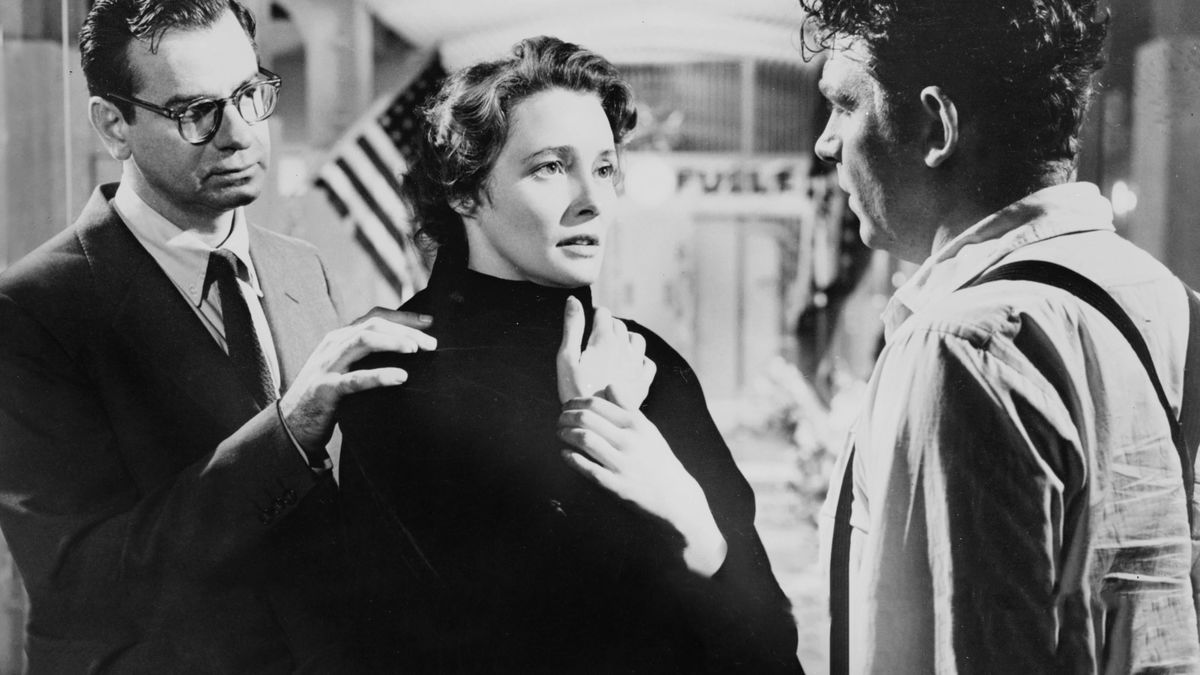
If you can stomach thinking back to the 2016 election cycle, you might recall that several pieces of pop culture floated to the surface of our collective consciousness. One of those was Elia Kazan’s 1957 film A Face in the Crowd; its depiction of a crude entertainer who fashions himself as a man of the people to a hungry television audience was pointed to as particularly prescient of Donald Trump’s rise to the presidency. Andy Griffith’s admirably malignant work as Larry “Lonesome” Rhodes sucks up much of the screen’s oxygen by design. But it’s Patricia Neal, who would’ve turned 100 on January 20th this year, who serves as Crowd’s moral fulcrum and gives its most crucial performance.
Neal’s own life shares some fascinating parallels with that of her character, radio reporter Marcia Jeffries. Like her, Neal was born in rural America – Arkansas for Jeffries, coal-town Kentucky for Neal. And like her, Neal went to a tony college – Northwestern for her, Sarah Lawrence for Jeffries. Both have the sort of intrepidness that comes from being raised in the sort of areas often dismissed and condescended to by coastal elites; according to April Wolfe’s Criterion essay, New York Times critic Bosley Crowther once called Neal “gauche.” She was thirty when Kazan cast her off his stage production of Cat on a Hot Tin Roof – too old for an ingenue – and had already been through the Hollywood studio wringer before. But Kazan rightly sensed that her indelible mixture of headstrong charm and doe-like delicacy would be a good fit for Jeffries’s unsteady ambitions.
She’s the one who comes up with the name “Lonesome” and first conceives of his potential. They meet in the drunk tank of a county jail, which Martha enters with a breezy naivete. She’s there to record her program “A Face in the Crowd” but most of the inmates aren’t interested in talking to her. Rhodes can carry a mean tune, though, and she’s taken enough by his cornpone bravado to ask to do a piece on him, the wheels in her head turning as quickly as the ones on her taping device. “What’s in it for me?” he wants to know. It’s a mutually parasitic pattern that will continue to repeat itself.
Rhodes has a knack for speaking to the people who consider themselves unheard, and it’s not long before his antics take him to a bigger platform. He whisks Jeffries along with him to Memphis where the more he chafes against the demands of television bigwigs the more the audience adores him. She remains equally befuddled and beguiled by his outrageous behavior, particularly his dalliances with various women. As savvy as Rhodes is with exploiting the folksy image that others have of him, Jeffries proves equally willing to use her feminine wiles to get what she wants from him.

As Rhodes moves from shilling dubious vitamin pills to a higher sphere of sinister America First political influence, Jeffries finds herself increasingly cut off from his boy’s club. But she seems more at home in the writer’s room run by Mel Miller (Walter Matthau, looking as fresh-faced as he ever got) where her husky-voiced, almost accidental confidence fits more naturally with their cigarette cynicism. Rhodes’s romantic sway over her proves hard to shake, though, leading to the film’s most painful scene, where a jilted Jeffries demands fifty percent of his business stake after he elopes with a high school beauty queen. “I’m gonna get something I deserve,” she spits at him, but it’s the flashes of vulnerability in Neal’s eyes that linger in the memory. Once she disappears from Rhodes’s life, there’s no check on his baser instincts and whatever thin veneer of accountability was left dissolves into open vitriol for the people who built him up.
Perhaps because of this ingrained pessimism, courtesy of Budd Schulberg’s piquant script, A Face in the Crowd was not a hit with audiences and it received no awards recognition. Neal did six years later, winning the Best Actress Oscar for her role in Hud. By then much of her time was spent in England, where she lived with her husband, author Roald Dahl, and their children. It was a union marked by tragedy and perseverance – their son Theo suffered from brain damage related to a car accident and eldest daughter Olivia died at age seven from measles encephalitis. Neal herself had three cerebral aneurysms in 1965 and was briefly in a coma. She recovered but her screen appearances were sporadic, and she never had a role quite as substantial as Marcia Jeffries again.
If there’s a hero in A Face in the Crowd it’s Jeffries, who eventually orchestrates Rhodes’s downfall as single-handedly as she did his rise. It’s this aspect that might require the greatest leap of faith from modern audiences, who’ve yet to see Trump’s stranglehold on his followers loosen no matter how abhorrent and insulting his rhetoric gets. But in that moment at least, Neal makes us believe it’s possible. After all, sometimes the best person to slay a monster is the one who created him.
“A Face in the Crowd” is streaming on Hoopla and available for digital rental or purchase.