Bill Bria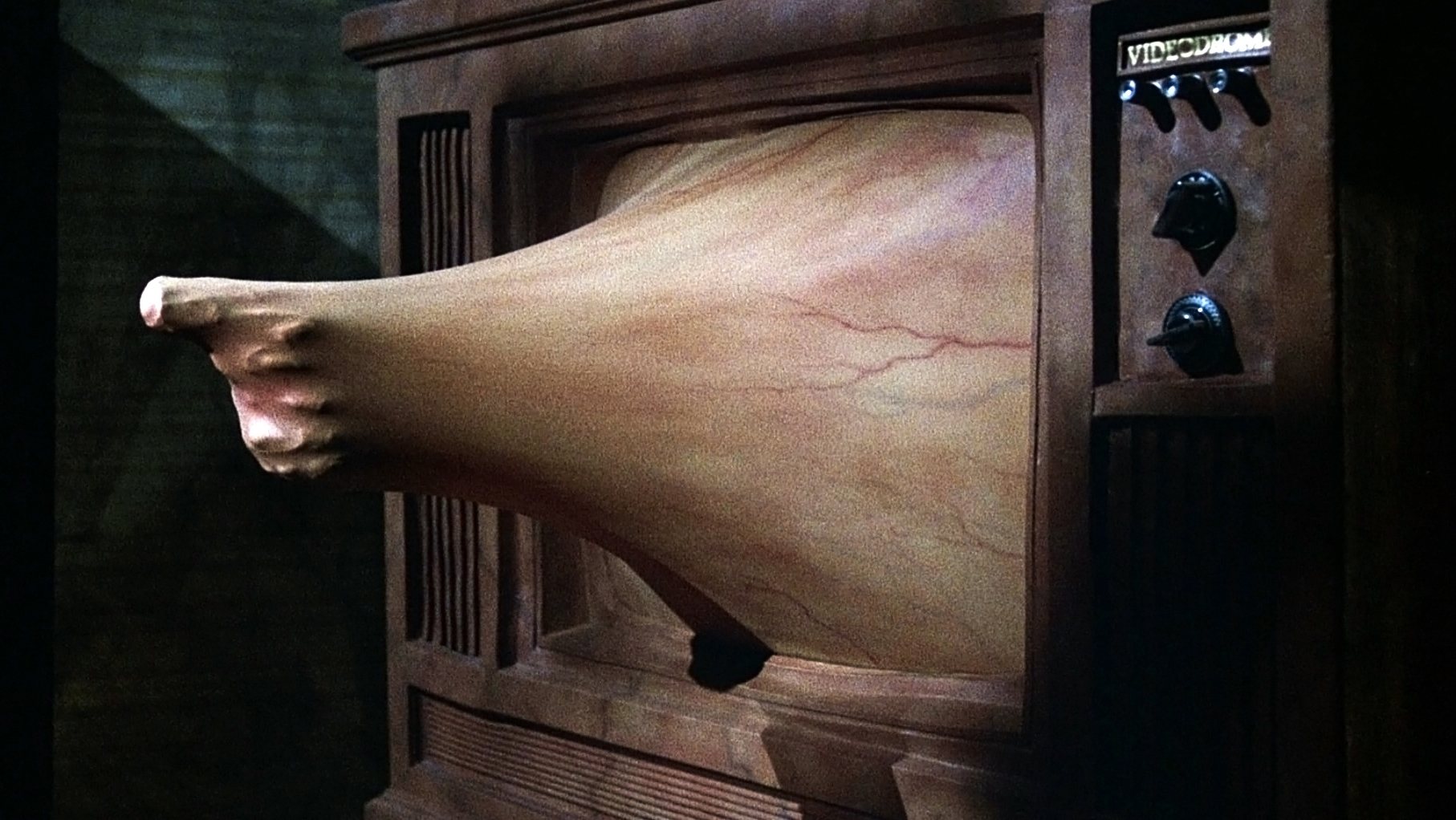
Prognostication is often a losing game, as trends and culture change so rapidly and drastically that accurately predicting the future can be nearly impossible. Most works of cinematic science-fiction look curiously dated in retrospect, their ideas of the future merely an extrapolation of the era in which they were made. While these films still have value as time capsules, it’s rare to see a sci-fi, horror, or satire movie made that actually contains prescience. Two such films were released within just a few years of each other: 1981’s Shock Treatment and 1983’s Videodrome, both of which concerned the growing influence of television on North American culture and lifestyles. Both movies flopped upon their initial release, largely ignored by audiences and dismissed by critics, in part because the films depict worlds, environments, and concepts that felt too bizarre in the early ‘80s. Now, in 2021, these movies feel like hauntingly accurate predictions of the digital social media age, a time when technology has indeed trapped and transformed humanity forever.
Shock Treatment and Videodrome belong to an interesting time in Western culture, one in which the possibilities and potential of emergent technologies seemed as boundless as they were ill-defined. Most of this wonder and confusion centered around the computer, a device that was just beginning to move out of ominously large rooms housing huge servers and into the household in significantly more compact form. While those relative few who had experience with computers were encouraged by the shift, the general public seemed more wary, the electronic villains of films like 2001: A Space Odyssey (1968) and Demon Seed (1977) still fresh in the consciousness. Computers seemed like they could become a terrifying and awesome gateway to human evolution (as in 1982’s Tron) or at least easily put too much power in the wrong hands (as in 1983’s WarGames).
Television, by comparison, was far from a new phenomenon, with the first commercial TV sets entering homes in the late 1930s. Curiously, the TV became lumped in with this early ‘80s wave of technological anxiety, with films like 1982’s Poltergeist joining Shock Treatment and Videodrome in examining how television was absorbing more of people’s time as well as beginning to dictate the culture. The reasons for this include TV’s expansion into cable (which exponentially increased the amount of program choices as well as expanded content boundaries) and the rise of “video pirates,” people who could intercept and manipulate signals to their own ends. More than ever before, the world of television felt unregulated and unfiltered, the old-fashioned days of a small handful of broadcast channels changing into a Wild West of possibility. The filmmakers of Shock Treatment (director/co-writer Jim Sharman, co-writer/star Richard O’Brien and co-writer/production designer Brian Thomson) and Videodrome (co-writer/director David Cronenberg) comment on these then-current trends with an eye toward the potential future of how such technologies might warp the culture.
Thanks to their respective production issues, Shock Treatment and Videodrome end up having a sense of unreality that is part of what makes them totally unique. Shock Treatment began life as a full-blown sequel to Sharman and O’Brien’s The Rocky Horror Picture Show (1975), but O’Brien ended up turning the concept away from pure Rocky material into a media satire featuring the return of Rocky’s all-American hero couple in a script entitled The Brad and Janet Show. Due to a strike delaying production, the film lost its principal Texas locations and was relegated to shoot entirely inside a London soundstage, forcing yet another rewrite to accommodate the shift. Thus, Shock Treatment’s most subversive satirical element—all the characters, including the entire town of Denton, Texas, are kept inside a TV studio—came about via circumstance.
Similarly, Cronenberg was still working on the Videodrome script (originally entitled Network of Blood) when the financing for the film came through in October of 1981, with a stipulation that principal photography must be finished by December 31st of that same year. Videodrome was Cronenberg’s most ambitious project yet, and the director scrambled to get the many groundbreaking makeup effects by Rick Baker ready to shoot, let alone finish writing the screenplay. As a result, the final cuts of both Shock Treatment and Videodrome contain characters, subplots, and allusions that lead nowhere, as well as vestiges of deleted or abandoned elements that are only enhanced by each film’s use of hallucinatory dream logic, all of which makes the films feel that much more dense and strange.
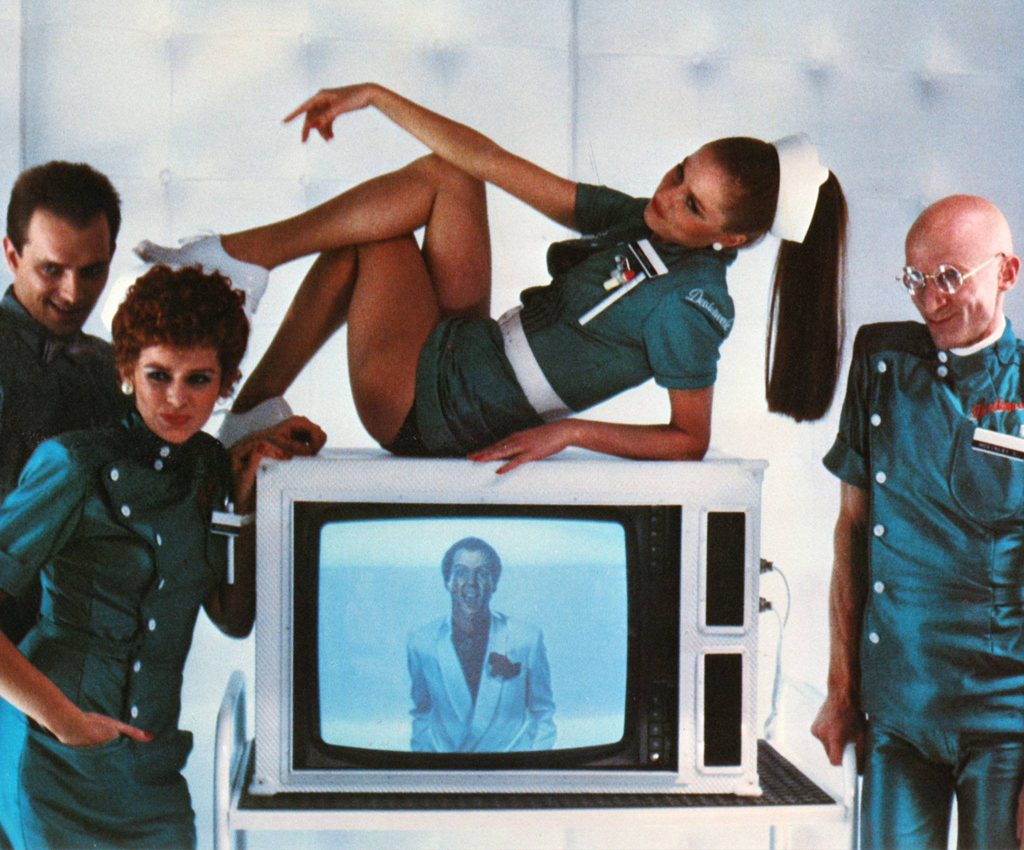
Like the tumor-creating Videodrome signal buried inside pirate transmissions, the prescient satire within both movies hits that much harder thanks to the films’ kooky strangeness. Shock Treatment is a musical, a fanciful format to begin with made even odder by the film presenting its songs alternatively as televised live performances, traditionally integrated numbers and dream/fantasy sequences. With the entirety of life in Denton revolving around “DTV”—the inhabitants are either stars of a TV show or audience members, and usually both—Shock Treatment incisively predicts the rise of reality television and, beyond that, the 24-hour world of persona creation and curation that is social media. In the film’s best number, “Bitchin’ in the Kitchen,” Brad (Cliff De Young) and Janet (Jessica Harper) are prompted to sing their respective lyrics about their relationship disillusionment by a series of commercials they’re watching. As the movie’s title implies, the film also concerns issues of neurosis and mental health (Brad is committed to a combination mental hospital and soap opera under false pretenses; O’Brien and Patricia Quinn play doctors who turn out to be mere “character actors”), the implication being that this inescapable world of mood-altering and life-dictating television is creating a town (if not a world) full of nutcases.
One of the big numbers in Shock Treatment is a song entitled “Look What I Did to My Id,” a title that doubles as a thematic mission statement for all of David Cronenberg’s characters, with Videodrome being no exception. In Videodrome, TV station operator Max Renn (James Woods) becomes obsessed with the pirate broadcast of “Videodrome,” a show that depicts acts of real torture and murder. With transgressive sexuality and violence acting as a gateway to opening the “neural floodgates” needed to allow Videodrome’s signal to get through, the sleazy and amoral smut peddler Max soon finds his entire life becoming Videodrome, with no separation between his hallucinations and reality.
As one of the earliest masters of body horror, Cronenberg isn’t content with depicting Max’s transformation abstractly, showing in gloriously gooey detail how the character literally becomes a receptacle for and a tool of other people’s ideas. As Max bounces from the right-wing agenda of Barry Convex (Les Carlson) to the militant revolutionary cause of Bianca O’Blivion (Sonja Smits), Cronenberg’s chronicling of Max’s radicalization doubles as an eerie parallel to the modern epidemic of online indoctrination, particularly the recent QAnon psychosis and its origins on internet message boards. Max is literally seduced into the world of Videodrome thanks to the comely and enigmatic radio show host Nicki Brand (Debbie Harry), a woman who either becomes a victim of Videodrome, was a pawn of Barry or Bianca all along, or who may never have even existed. Her character, then, is an early version of a virtual avatar (as Harry chooses to describe her in a commentary track for the film), a device now known as a “bot” meant to entice people to compromise themselves.
Both films illustrate the all-encompassing effect media has on daily life. Max begins his morning with a special wake-up-call transmission from his secretary Bridey (Julie Khaner), and DTV owner Farley Flavors (De Young in a dual role) communicates almost exclusively through special TV sets. Videodrome’s Marshall McLuhan-esque Brian O’Blivion (Jack Creley)–who does appear exclusively on television–states at one point that everyone in the future will “have special names” (a fairly apt description of social media handles) and one of Janet’s numbers in Shock Treatment sees her chanting “me, me, me” as a chorus, sending up not just the evergreen egocentric desire for fame and attention but predicting how technology will allow everyone to succumb to that desire.
While television didn’t end up being nearly as revolutionary in all the ways each film predicted it would, the fact that the internet and social media did end up fulfilling the movies’ satiric observations can be seen as a Videodrome-like mutation of form. In essence, computers and smartphones picked up where television left off. Even if it was due to the films’ production issues, each film’s ending irresolution makes their effect that much stronger. We never see what, if anything, lies outside the DTV studios, and we’re not privy to what happens to Max after his fateful final act—both films simply end their transmissions. It’s a subtle indication toward the sense of how completely technology could take over our lives, a fate that may already be our reality. Each film’s finale seems to say that if it’s not on television (and in the modern parlance, Facebook, Twitter, or Instagram, etc.), it doesn’t only not matter—it might as well not even exist. As each film uncannily observed in the early ‘80s, we’ve all become trapped inside DTV, living in our video reality just to prove we exist, that we matter. As Videodrome’s mantra ironically, ambiguously states: “long live the new flesh.”