Marya Gates
“Hey Yang! Don’t forget to join us!” a computer voice implores during the opening sequence of Kogonada’s new soft sci-fi After Yang. The titular A.I. – or technosapien – joins his human family in a synchronized online dance competition that serves as an introduction to the film’s many characters, but also highlights the underlying theme of the connectedness of family.
Based on Alexander Weinstein’s short story “Saying Goodbye to Yang,” and set in a somewhat distant future, After Yang continues writer-director Kogonada’s fascination with the spaces between. In his first film Columbus, he used the tenets of modernism, specifically the movement’s use of negative space, to draw comparisons to the depths of human emotion and the interconnectedness of individuals, whether they’re strangers or relatives.
In his latest film architecture remains integral, with much of the action taking place within an open concept modernist home. These homes, often made of natural materials like wood and concrete, integrate nature into their layout. In the world of After Yang, it’s implied that civilization is beginning to heal after a disaster, finally coming back to nature. There is a calm, almost sterile atmosphere, with the humans embedded in nature almost as a truce, rather than luxuriating within it.
With similar compositions to Japanese master Yasujirō Ozu, Kogonada and cinematographer Benjamin Loeb favor wide and medium shots, creating a conversation between the bodies and the world around them. Ozu was a master at saying more with silence and space than dialogue and action. Kogonada understands how to harness the power of those silences, that negative space to unearth a well of emotions.
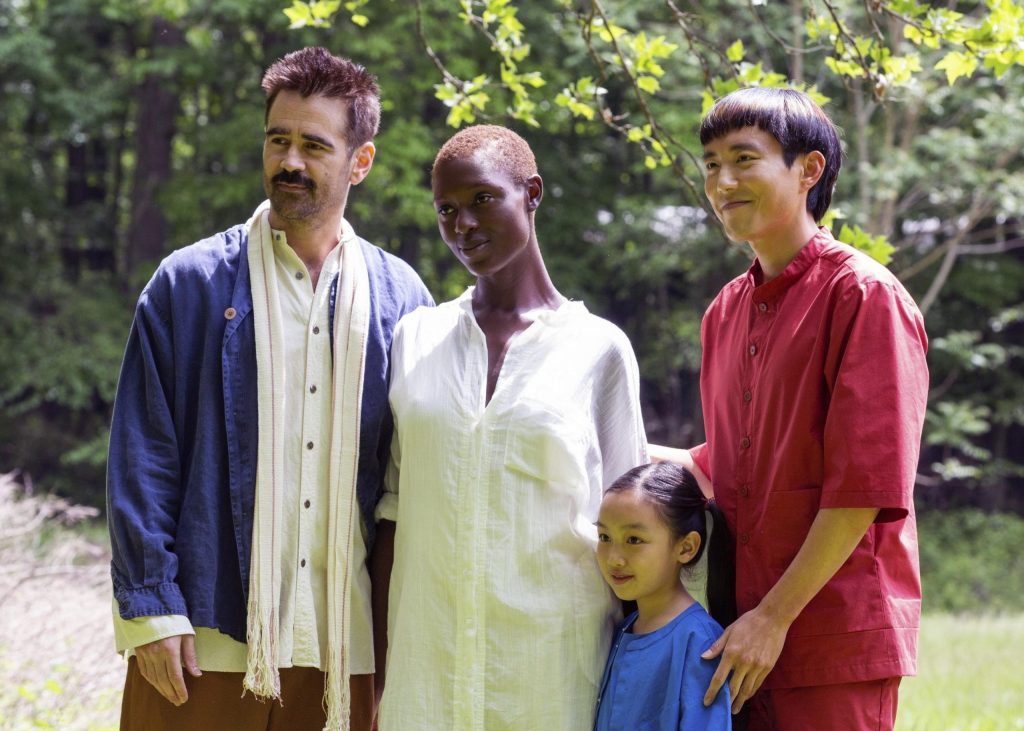
During the opening dance sequence Yang (a wonderfully empathetic Justin H. Min) malfunctions. Purchased – used, at a discount price – by Jake (Colin Farrell) and Kyra (Jodie Turner-Smith) to both care for their adopted daughter Mika (Malea Emma Tjandrawidjaja) and bring her closer to her Chinese heritage, this malfunction leads to a literal and emotional odyssey as Jake attempts to get him repaired.
At first Jake appears to see Yang as only slightly more than a broken appliance, bringing him to the equivalent of a Mac Genius Bar. Brett Dier is hilarious as the demonstrably accommodating employee who is more than ready to help Jake trade Yang in for a new model. Realizing Yang is more than just a piece of scrap metal, Jake takes him to a somewhat sketchy repair shop on the recommendation of his squirly neighbor George (Clifton Collins Jr.), and eventually a technology museum (run by a luminous Sarita Choudhury).
Here Jake discovers that Yang contains multitudes. An older, discontinued model, Yang had been recording 5 second clips throughout his entire time with Jake’s family – small moments that most of us used to forget (until the birth of the smartphone). How many little memories have been digitized forever? Some remain on our phones, others make it to social media. Are we over documenting our lives, or has technology allowed us to keep more of the past alive than ever? After all, it’s these small memories that make up a lifetime.
As Jake learns more about Yang from these snippets, we begin to see the negative space in his life, the connections with his family that may be more fractured than he realizes. Always excellent, Farrell particularly excels in introspective roles, his soulful eyes full of searching for a deeper meaning in the quietest moments. Many of his conversations with his wife Kyra take place over screens – they even share a meal over a screen – emphasizing the distinct disconnect between the two. While Farrell is fully capable of acting opposite a screen, these scenes also unfortunately reveal Turner-Smith’s weakness. What should be scenes full of unsaid tension fall flat, with Turner-Smith unable to fully showcase the emotions behind her character.
Tjandrawidjaja is a wonder as Mika, full of buoyant energy. With the loss of essentially her brother after Yang’s malfunction, Mika and Jake’s relationship blossoms. Mika questions not only Yang’s status, but also Jake’s journey, pushing him to think more about himself and life through her eyes. They share their grief over the loss of Yang, but in doing so find something indefinably human between themselves that had been lacking.
In learning how Yang viewed the world, Jake further explores aspects of humanity we take for granted. Jake views a memory in which he shared his love of tea with Yang, who laments that all he knows about tea is facts. He wishes he could feel something about it the way that Jake does. When discussing Chinese culture with Mika, Yang found similar frustrations. How does his programming make him more of an expert on Chinese culture than Mika?
Yang, like any “real” human, was full of questions about his identity. These questions led him to seek answers, seek connections. In following Yang’s secret quest, Jake himself taps into deep yearnings he’d long since repressed. There’s more to life than simple contentment. There are harsher emotions. Deeper feelings. Yang sought them out despite his supposed inability to feel anything. Through the introspection brought on by the grief felt after losing Yang, maybe Jake will start to feel that deeply again too. 
B+
“After Yang” is out Friday in limited release.